Book Appointment Now
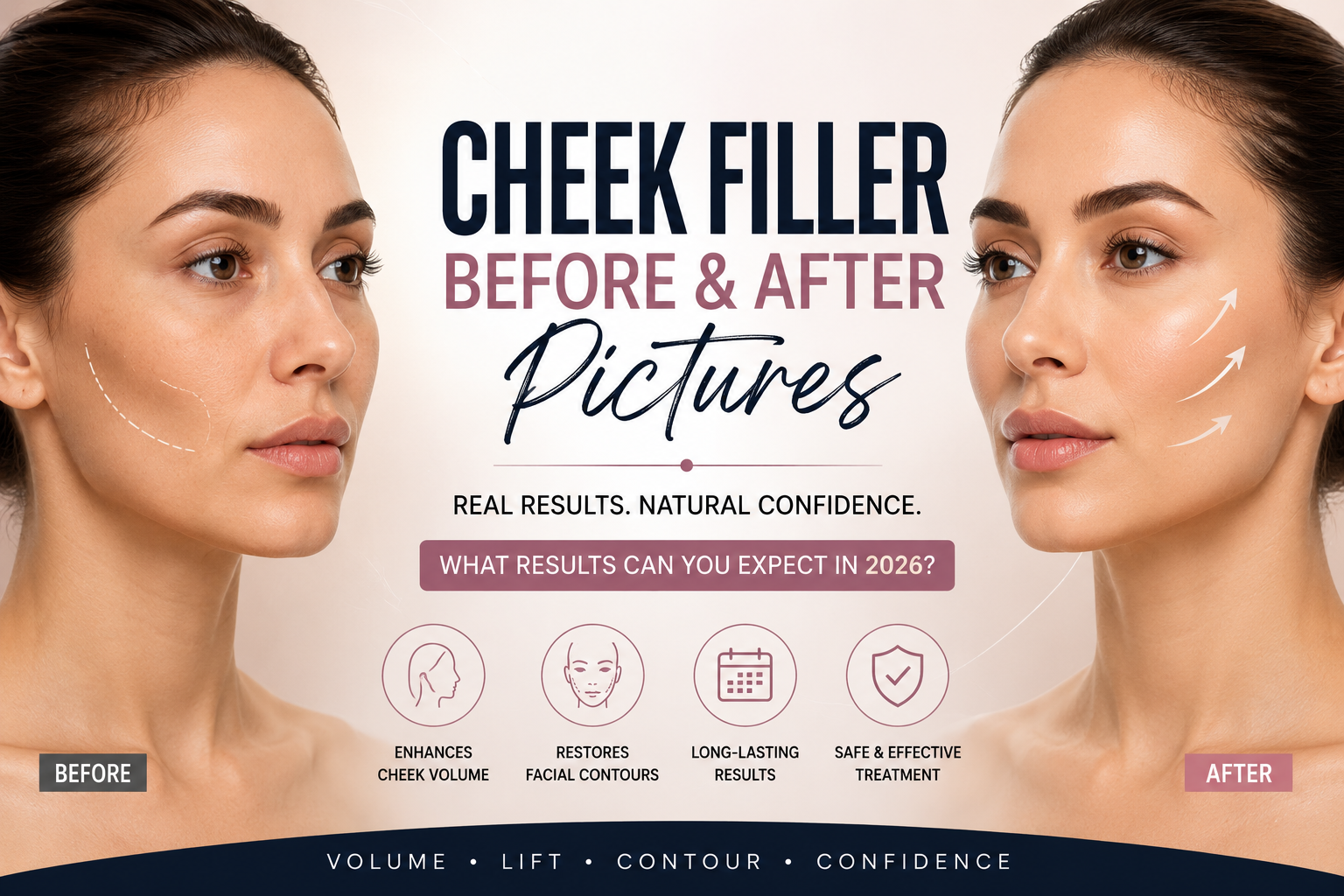
Cheek Filler Before and After Pictures
Cheek Filler Before and After Pictures: What Real Results Can Look Like in 2026
Cheek filler can make a dramatic difference look deceptively simple. One photo shows a flatter midface. The next shows higher cheekbones, more volume, and a sharper facial contour.
But there is a catch.
A good cheek filler result is not simply about adding as much volume as possible. The best results usually depend on where the filler is placed, how much is used, your natural facial structure, and how your face looks after swelling settles.
That is why two people can receive similar amounts of cheek filler and end up with very different results.
If you are searching for cheek filler before and after pictures, you are probably trying to answer a few practical questions. Will my cheekbones look higher? Will hollow cheeks look fuller? Will my face look wider? How long will the swelling last? And how close will my result be to the photos I see online?
This guide answers those questions using current medical information and realistic expectations for 2026.
What Do Cheek Filler Before and After Pictures Actually Show?
Cheek filler before and after pictures usually show changes in facial volume and contour after dermal filler treatment.
The most noticeable changes can include increased cheek projection, a softer midface, improved cheekbone definition, and reduced appearance of hollow areas.
Dermal fillers are gel-like materials injected beneath the skin to create a fuller or smoother appearance. The U.S. Food and Drug Administration recognizes dermal fillers for specific facial uses, including cheek augmentation for approved products and indications. FDA information on dermal fillers
When looking at cheek filler before and after pictures, pay attention to the entire face rather than only the cheeks.
A well-planned result can affect how the cheekbones, under-eye area, temples, nasolabial folds, and lower face appear together.
This is why experienced injectors usually assess facial balance instead of treating one isolated feature.
Cheek Filler Before and After Pictures: What Changes Should You Expect?
The exact result depends on your starting point. However, several changes commonly appear in cheek filler before and after pictures.
Higher-looking cheekbones
Strategic filler placement can make the cheekbones appear more prominent.
This does not necessarily mean making the cheeks look large. A small amount placed in the right area can change the way light hits the face.
More midface volume
Some people naturally have a flatter midface. Others lose cheek volume with age.
Cheek filler can restore or add volume in selected areas. The goal is usually controlled fullness rather than a swollen appearance.
Less noticeable cheek hollowing
Cheek hollowing can become more noticeable because of genetics, facial structure, aging, or changes in body weight.
Filler may soften the transition between fuller and flatter areas.
Improved facial contour
Cheek filler can change the relationship between the upper and lower parts of the face.
Some people notice a more sculpted appearance. Others simply look less tired.
The difference is often subtle when the treatment is conservative.
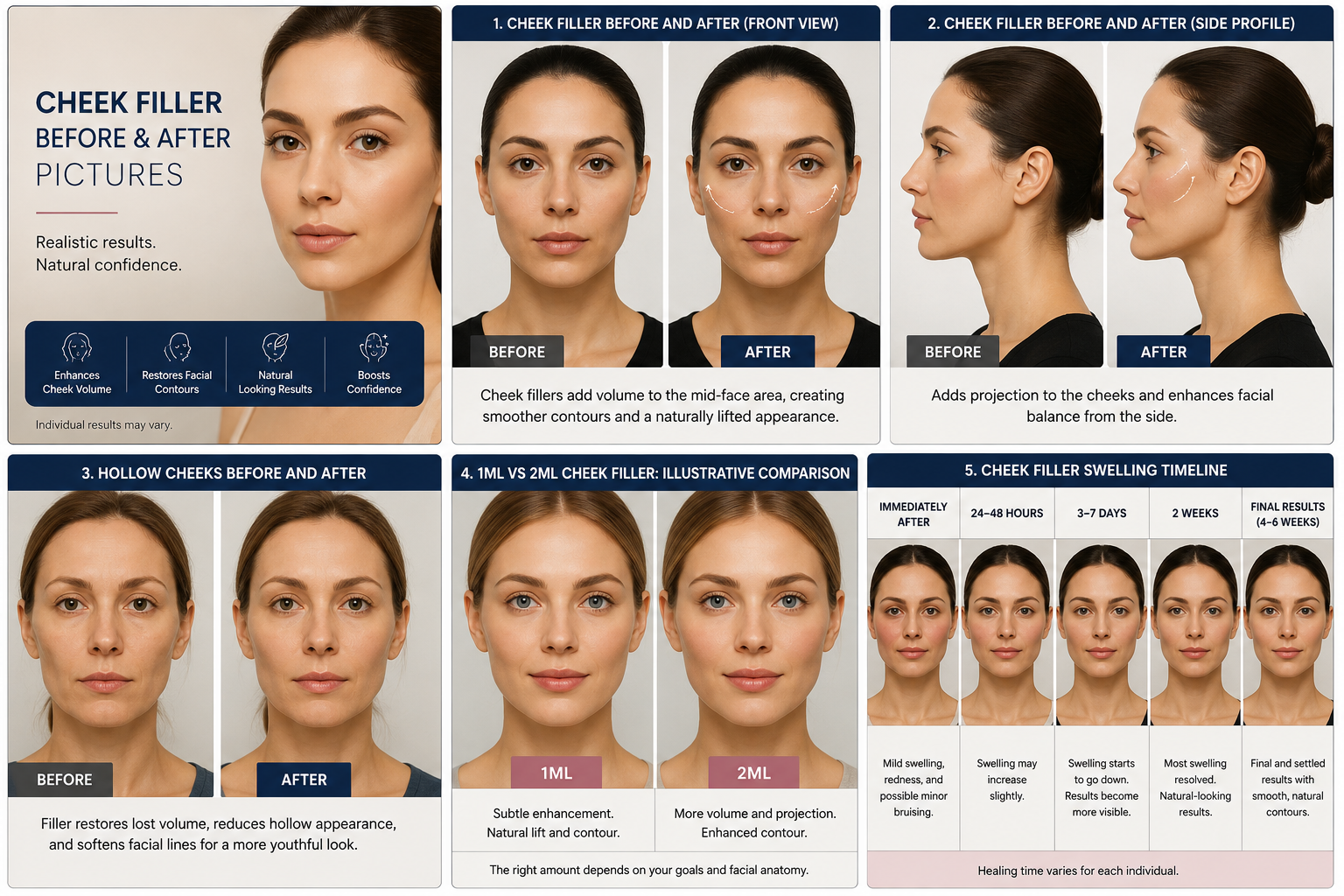
How to Read Cheek Filler Before and After Pictures Correctly
Not every cheek filler before and after picture is a fair comparison.
Lighting, camera angle, facial expression, makeup, hairstyle, filters, and even the distance from the camera can change how the face appears.
Use these checks when comparing photos.
- Look for the same camera angle.
- Check whether the lighting is similar.
- Compare neutral facial expressions.
- Look for similar image distance and framing.
- Check whether makeup is different.
- Find out how long after treatment the second photograph was taken.
- Look for the amount and type of filler used when that information is available.
A photo taken immediately after injections may show more swelling than the final result.
A photo taken several weeks later can provide a more useful picture of the settled appearance.
FDA guidance notes that swelling and bruising are common after dermal filler treatment and often improve over days to weeks. FDA consumer guidance on dermal fillers
Cheek Filler Before and After: Immediate Results vs Final Results
One of the biggest mistakes people make is judging cheek filler too early.
You may notice added volume immediately after the procedure. However, the first few days can include swelling, redness, tenderness, or bruising.
That means your face may temporarily look fuller than it will after healing.
The early photograph is useful for documenting the procedure. It is not always the best representation of the final outcome.
The first day
The cheeks may look fuller immediately after injection. Mild swelling and redness can occur.
Some people also notice tenderness around the injection sites.
The first few days
Swelling and bruising may still be visible.
Your cheeks can look uneven during this stage because each side may heal at a slightly different rate.
After the early swelling
The appearance generally becomes easier to judge once the initial swelling settles.
Your injector may recommend a follow-up appointment to assess the result and decide whether any adjustment is appropriate.
Do not assume that unevenness during the early recovery period automatically means the filler was placed incorrectly.
Also check: 2ml Lip Filler on Thin Lips Before and After: Results, Swelling & Healing
Cheek Filler Before and After Pictures for Hollow Cheeks
Hollow cheeks are one of the most common reasons people search for cheek filler before and after pictures.
The goal is often to restore volume without making the face look heavy.
Hollowing can appear in different locations. Some people have a depression beneath the cheekbone. Others have reduced volume across the midface.
These differences matter because the same injection plan does not work equally well for everyone.
A qualified injector should assess your facial proportions before choosing the injection points and amount of filler.
The FDA states that the outcome of dermal filler treatment depends on factors including the underlying tissue structure, the type and volume of filler, and the treatment area. Learn more from the FDA
1ml vs 2ml Cheek Filler Before and After Pictures
People often search for phrases such as 1ml cheek filler before and after and 2ml cheek filler before and after.
These searches make sense because the amount of filler can affect the degree of visible change.
However, the number of milliliters alone does not predict the final appearance.
One milliliter divided between both cheeks is different from one milliliter placed on one side. Two milliliters can also be distributed in different ways.
Product density, injection depth, placement, facial anatomy, and treatment goals all matter.
For that reason, copying the exact amount shown in somebody else’s before and after picture is not a safe way to plan treatment.
| Factor | Why it matters |
|---|---|
| Filler volume | More product can create more volume, but the ideal amount depends on the individual. |
| Injection location | Different areas create different changes in contour. |
| Facial anatomy | Bone structure and existing soft tissue affect the final appearance. |
| Filler material | Different filler materials have different properties and durations. |
| Healing time | Early swelling can make results appear larger than the settled outcome. |
What Type of Filler Is Used for Cheeks?
Several types of dermal filler materials exist.
Hyaluronic acid is widely used in facial filler treatments. Other materials include calcium hydroxylapatite and poly-L-lactic acid.
The FDA explains that many dermal fillers are temporary because the body gradually absorbs the material. The duration depends on the material and treatment area. FDA information on approved dermal fillers
For example, FDA information describes hyaluronic acid fillers as temporary products whose effects may last around six to twelve months, while other materials can have different durations.
Specific product approvals and treatment indications vary. Your injector should tell you exactly which product is being used and why it is appropriate for the planned treatment.
Do not choose a filler simply because an online photograph looks good.
How Long Does Cheek Filler Last?
There is no single number that applies to every cheek filler treatment.
Duration depends on the product, material, amount injected, treatment area, and individual factors.
Some FDA-approved cheek fillers have demonstrated results lasting close to a year in clinical studies.
For example, FDA documentation for Restylane Contour states that it is indicated for cheek augmentation in adults over 21 and that results in a clinical study may last up to 48 weeks. FDA information on Restylane Contour
This does not mean every person will have the same duration.
When looking at cheek filler before and after pictures, check the date of the after photograph. A picture taken shortly after treatment cannot tell you how the result will look months later.
Can Cheek Filler Make You Look Younger?
Cheek filler can create a more youthful appearance for some people by restoring lost facial volume.
As the face ages, volume can change across several areas. Reduced cheek fullness may affect the transition between the cheek, under-eye region, and lower face.
Adding carefully planned volume can soften these transitions.
However, cheek filler does not stop the aging process.
It also does not replace every facial rejuvenation treatment. Skin texture, pigmentation, wrinkles, facial fat, and bone structure involve different issues.
A strong before and after result should make the face look balanced rather than obviously filled.
Can Cheek Filler Make Your Face Look Wider?
Yes, cheek filler can change the apparent width of the face, depending on where the product is placed.
This is why placement matters as much as volume.
Filler placed toward the outer cheek can influence the width and contour of the face. Filler placed in a more central or higher cheek position can create a different effect.
If you are worried about looking too wide, tell your injector before treatment.
Bring several cheek filler before and after pictures that show the type of result you want. Then discuss whether your facial anatomy can reasonably achieve something similar.
A photograph should be a reference point, not a promise.
Cheek Filler for Different Face Shapes
Face shape can influence how cheek filler appears.
Round faces
People with round faces may prefer definition rather than added fullness across the entire cheek.
Strategic placement can create more visible cheekbone structure.
Oval faces
Oval faces often have balanced proportions, so small changes can have a noticeable effect.
Long faces
Adding excessive vertical cheek volume may not produce the desired balance. Treatment planning should consider the entire facial profile.
Square faces
Cheek filler can interact with strong jaw and cheekbone structure. The goal may be subtle refinement rather than dramatic projection.
These are general patterns, not treatment rules. Your own anatomy matters more than a face-shape label.
What Does Bad Cheek Filler Look Like?
Not every cheek filler before and after picture represents a successful result.
Problems can include excessive volume, visible lumps, asymmetry, poor placement, or a result that does not match the person’s facial proportions.
Overfilled cheeks may appear unusually round or heavy. In other cases, the cheekbone can look too sharp or unnatural.
Good treatment should consider facial harmony.
It should also account for the possibility that swelling is temporarily making the cheeks look larger.
If a result remains painful, unusually discolored, severely swollen, or otherwise concerning, contact the treating healthcare professional promptly.
Cheek Filler Risks You Should Know Before Looking at Results
Before comparing photographs, understand that cheek filler is a medical procedure.
Common side effects can include swelling, bruising, redness, pain, tenderness, itching, and temporary firmness.
Less common complications can include infection, nodules, granulomas, allergic reactions, tissue death, and other problems.
The most serious complications can occur when filler is accidentally injected into a blood vessel. The FDA warns that this can cause tissue death, stroke, or blindness, although such complications are uncommon. FDA dermal filler safety guidance
Seek urgent medical attention if you develop sudden vision changes, severe unusual pain, skin color changes, or symptoms that could indicate a serious complication after filler treatment.
Do not buy injectable filler online and attempt to inject it yourself. The FDA specifically warns against self-injection and products sold directly to consumers.
How to Choose a Provider After Seeing Cheek Filler Before and After Pictures
The injector matters more than the photograph.
A beautiful before and after picture does not guarantee that the same provider will produce the same result for you.
Look for a licensed healthcare professional with appropriate training and experience in facial anatomy and dermal filler injections.
Ask to see examples of the provider’s own work when possible.
Also ask which product is being used, where it will be injected, how much is planned, what side effects are expected, and what the provider would do if a complication occurs.
The FDA recommends working with a licensed healthcare provider who is experienced with dermal fillers, facial anatomy, benefits, risks, and complication management.
Questions to Ask Before Getting Cheek Filler
- What is causing my cheek hollowing or lack of definition?
- Which filler are you recommending?
- Is this product approved for the planned treatment area in my country?
- How much filler do you recommend?
- Where exactly will the filler be placed?
- What will my face look like immediately afterward?
- How long should swelling and bruising last?
- When should I judge the final result?
- What complications should I watch for?
- What is your plan if a serious complication occurs?
- Do you have before and after photographs of patients with similar facial anatomy?
How Much Does Cheek Filler Cost in 2026?
Cheek filler prices vary widely by country, city, provider, product, treatment plan, and amount used.
Some clinics charge by syringe. Others price the complete treatment.
Do not choose a provider based only on the lowest price.
A bargain injection can become expensive if you need correction or treatment for complications.
When comparing prices, ask what is included in the quoted fee. Find out whether the consultation, product, follow-up visit, and any planned adjustment are included.
Remember that a higher price does not automatically mean a better result either.
Why Your Cheek Filler Before and After Result May Look Different From Online Photos
This is one of the most important points to understand.
Your face is not the same as the face in an online photograph.
You may have different cheekbone projection, skin thickness, facial fat, muscle structure, age, or natural asymmetry.
The photograph may also have been taken under different lighting.
Even a small change in camera position can make cheekbones look more or less prominent.
Some photographs are also edited or enhanced.
Use before and after pictures to understand possible treatment patterns. Do not use them as an exact prediction of your result.
What Makes a Good Cheek Filler Before and After Picture?
The best comparison photographs are consistent.
The patient’s head position should be similar. Lighting should remain stable. The facial expression should be neutral. Makeup should be limited or consistent.
Ideally, the after photograph should clearly state when it was taken after treatment.
For example, a photo taken several weeks after injection provides different information from a photograph taken immediately after treatment.
A trustworthy clinic should be transparent about these details.
Cheek Filler Before and After Pictures: What to Look for From the Front
Front-facing photographs are useful for assessing overall facial balance.
Look at the relationship between the cheeks, eyes, nose, lips, and jaw.
Ask whether the cheeks look fuller without overwhelming the rest of the face.
Check whether both sides appear reasonably balanced.
Perfect symmetry is not realistic because most human faces are naturally asymmetric.
Cheek Filler Before and After Pictures: What to Look for From the Side
Side-profile photographs can show cheek projection more clearly.
Look at the transition from the under-eye area toward the cheek and then toward the lower face.
A good profile should look natural rather than excessively projected.
Side photographs are also useful when discussing cheekbone definition with your injector.
Does Cheek Filler Hurt?
Some discomfort is possible during cheek filler injections.
The experience depends on the product, injection technique, individual sensitivity, and whether the product contains a numbing ingredient.
Temporary tenderness after treatment is also possible.
Ask your provider what pain-control options are appropriate before the procedure.
How to Prepare for Cheek Filler
Start with a proper consultation rather than booking treatment based only on a photograph.
Tell your provider about medications, allergies, previous filler treatments, medical conditions, and previous reactions to injections.
Follow the provider’s instructions about medicines, supplements, skincare products, and other treatments.
Do not hide relevant medical information because you want to qualify for treatment.
Your safety matters more than getting the procedure on a particular day.
What Should You Avoid After Cheek Filler?
Your provider should give you specific aftercare instructions based on the product and procedure.
Do not massage or press the treated area unless your healthcare professional tells you to do so.
Avoid making your own decisions based on social media advice.
If swelling or bruising concerns you, contact the clinic rather than trying random treatments.
Cheek Filler vs Fat Transfer
Cheek filler is not the only way to add facial volume.
Fat transfer uses fat taken from another part of the body and transferred to the face. Dermal filler uses an injectable material designed for soft-tissue volume or contouring.
These procedures differ in technique, recovery, risks, cost, and expected longevity.
If you are searching cheek filler before and after pictures because you want long-term volume restoration, ask a qualified professional whether filler or another approach makes more sense.
Can Cheek Filler Be Reversed?
The answer depends on the filler material.
Some fillers can be reduced or treated if problems occur, while other materials can be difficult or impossible to remove completely.
The FDA warns that removal procedures may require additional treatment or surgery and can carry their own risks.
This is another reason to identify the exact filler product before treatment.
Cheek Filler Before and After Pictures: The Most Realistic Expectation
The most realistic expectation is improvement, not a completely different face.
Cheek filler can enhance existing facial structure. It cannot turn every face into the same cheekbone shape shown in a social media photograph.
For some people, the result may be a noticeable increase in cheek projection.
For others, the change may be subtle but still improve facial balance.
The best outcome depends on matching the treatment to the person’s anatomy.
Frequently Asked Questions About Cheek Filler Before and After Pictures
1. What do cheek filler before and after pictures show?
They can show changes in cheek volume, projection, cheekbone definition, and midface contour. Results vary between individuals.
2. How soon can I see cheek filler results?
Some volume is visible immediately, but early swelling can affect the appearance. The result becomes easier to assess after the initial swelling settles.
3. How long does cheek filler last?
It depends on the filler material, product, treatment area, amount used, and individual factors. Many temporary fillers are gradually absorbed by the body.
4. Is 1ml enough for cheek filler?
There is no universal amount that works for everyone. The appropriate volume depends on your anatomy and treatment goals.
5. Is 2ml cheek filler a lot?
It depends on how the product is distributed and the individual’s facial structure. Two milliliters may be divided between both cheeks or used differently.
6. Can cheek filler fix hollow cheeks?
Cheek filler can add volume to selected areas and may reduce the appearance of hollowing. A consultation is needed to determine whether filler is suitable.
7. Will cheek filler make my face look wider?
It can, depending on placement and volume. Treatment planning should consider facial proportions and the desired contour.
8. Does cheek filler make you look younger?
It can create a more youthful appearance when reduced cheek volume contributes to an aged or hollow appearance.
9. How long does swelling last after cheek filler?
Swelling commonly occurs shortly after treatment and can improve over several days. Some people may experience effects for longer.
10. What are the risks of cheek filler?
Common risks include swelling, bruising, redness, tenderness, and pain. Rare but serious complications can occur if filler enters a blood vessel.
11. How do I find good cheek filler before and after pictures?
Look for consistent photographs showing similar lighting, camera angles, facial expressions, and clearly stated treatment timing.
12. Should I choose my filler based on before and after photos?
No. Photos can help you understand possible results, but product selection and treatment volume should be based on your anatomy and consultation with a qualified professional.
Final Takeaway: Look Beyond the Before and After Photo
Cheek filler before and after pictures are useful, but they should be treated as examples rather than guarantees.
The strongest result is usually the one that fits the person’s face instead of copying somebody else’s cheeks.
When comparing photos in 2026, check the treatment amount, filler type, injection area, photography conditions, and time between treatment and the after photo.
Most importantly, choose a qualified healthcare professional who can explain the benefits, risks, product, treatment plan, and expected recovery.
If you are considering cheek filler, save several examples of results you like. Take them to your consultation. Ask what makes those results realistic for your own facial structure.
That conversation is far more useful than choosing a syringe amount from an online photograph.
Trusted External Resources
For current safety information, product approvals, and medical guidance, use reliable sources rather than relying only on social media photographs.