Book Appointment Now
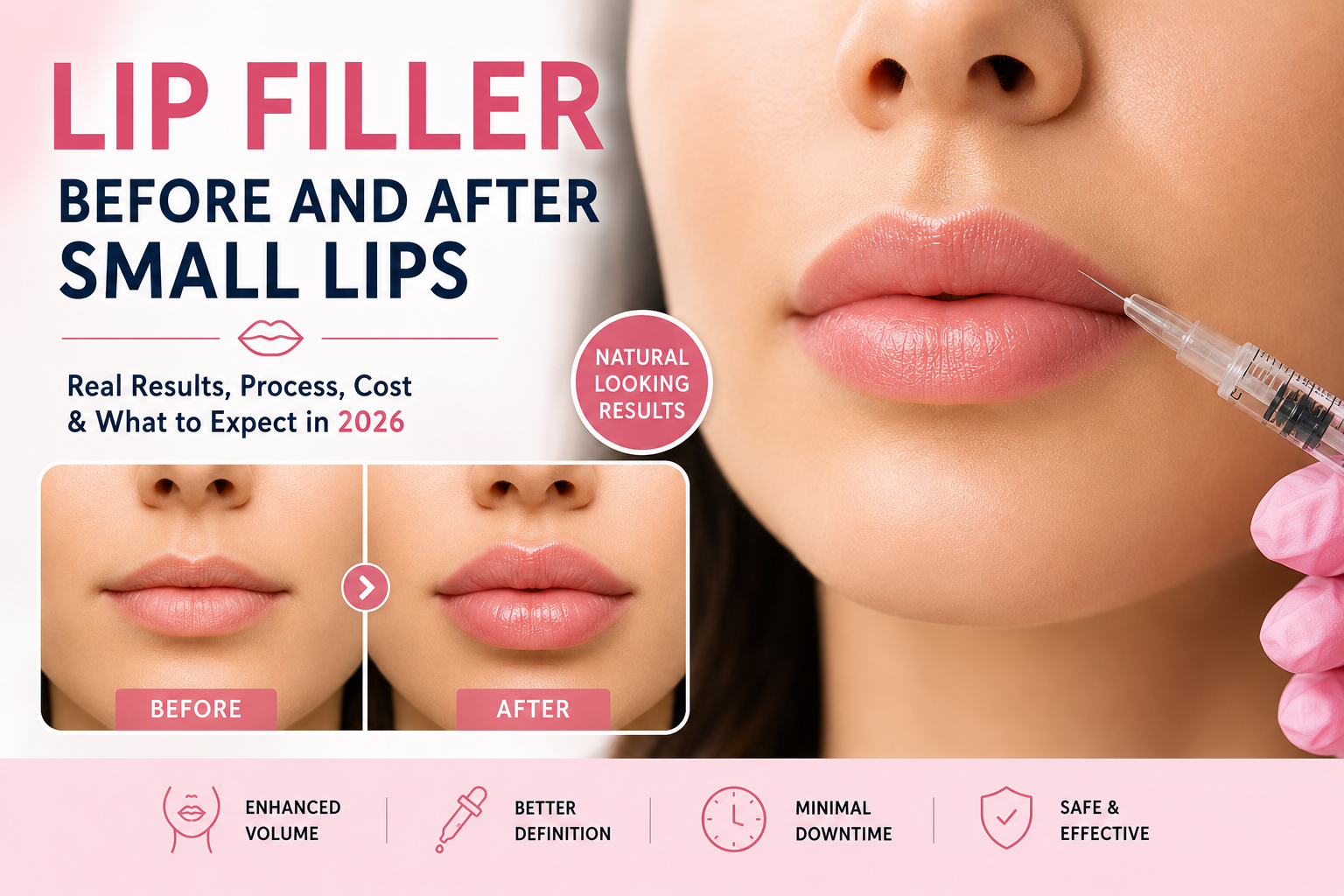
Lip Filler Before and After Small Lips: Results, Cost & 2026 Guide
Lip Filler Before and After Small Lips: 2026 Results, Cost, Swelling and What to Expect
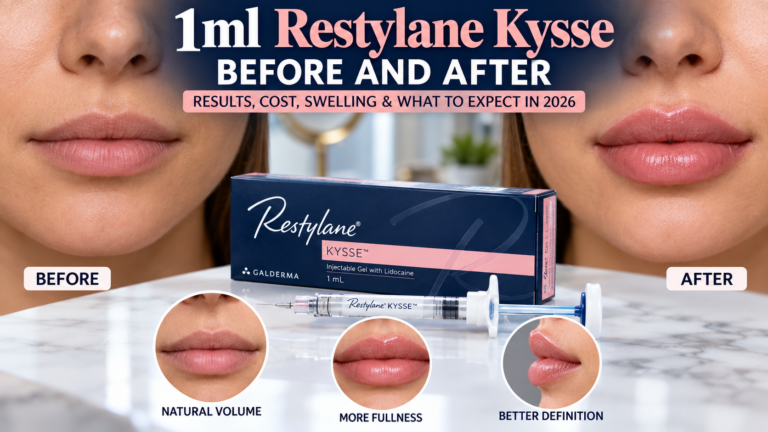
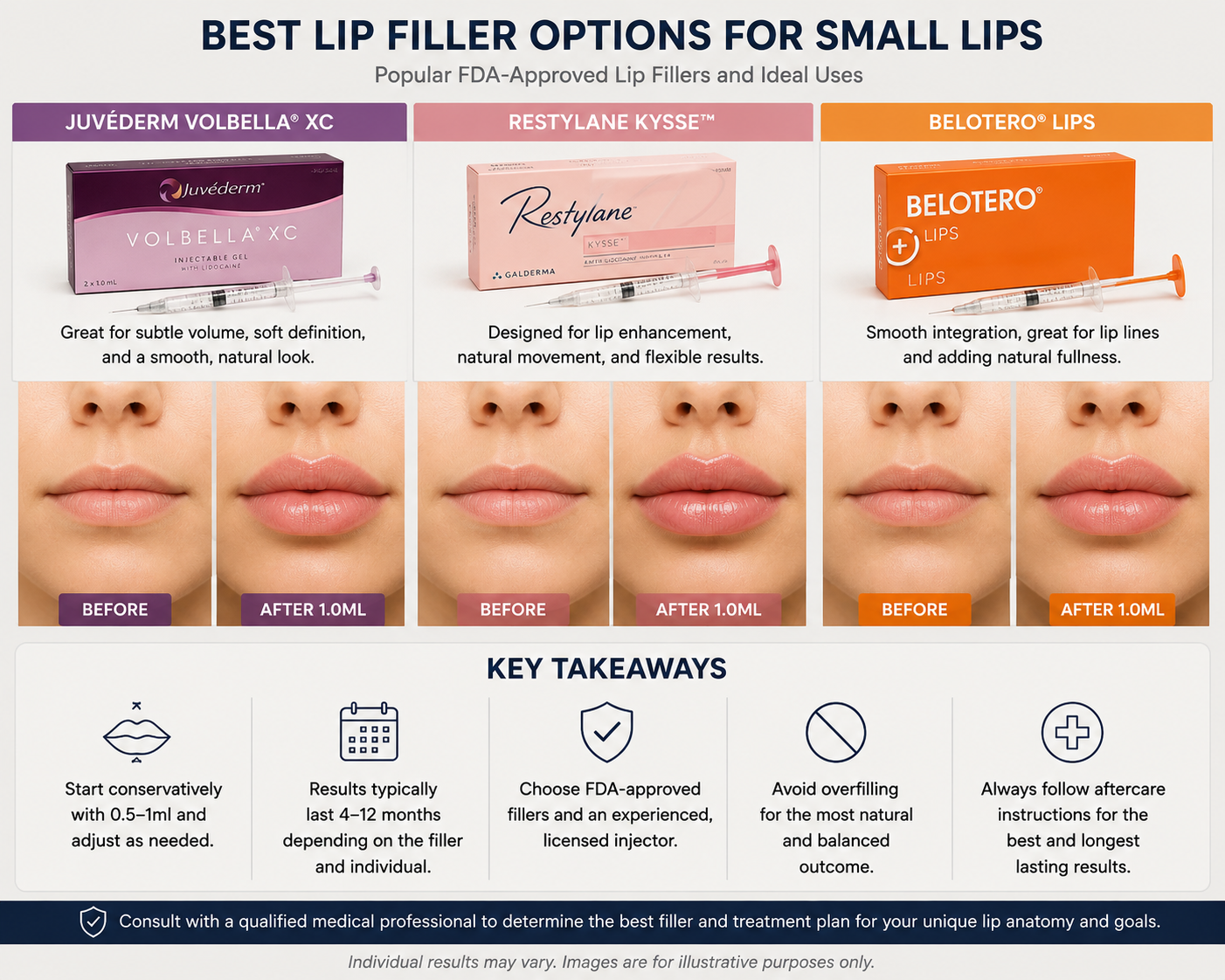
Lip filler before and after small lips photos can look dramatic, but the best results are not always the biggest ones. When naturally small lips are treated well, a few carefully placed injections can improve fullness, shape, balance and definition without making the face look completely different.
That is exactly why people search for before-and-after pictures before booking treatment. They want to know what is realistic. They want to see how small lips can change. They also want answers to practical questions about 0.5ml versus 1ml, swelling, pain, recovery, cost and the risk of filler migration.
This 2026 guide covers those questions in detail. It explains what to look for in genuine before-and-after photos, how filler can change small lips, what happens during recovery, and how to approach treatment safely.
Quick Answer: What Can Lip Filler Do for Small Lips?
Lip filler can increase the fullness of small lips while also improving their shape and definition. Dermal fillers are used to add volume to areas of the face, including the lips. The American Society of Plastic Surgeons specifically lists plumping thin lips as one of the uses of injectable dermal fillers.
The change does not have to mean very large lips. In fact, the American Academy of Dermatology advises that people with very thin lips should avoid dramatic increases in volume if they want a flattering, natural appearance.
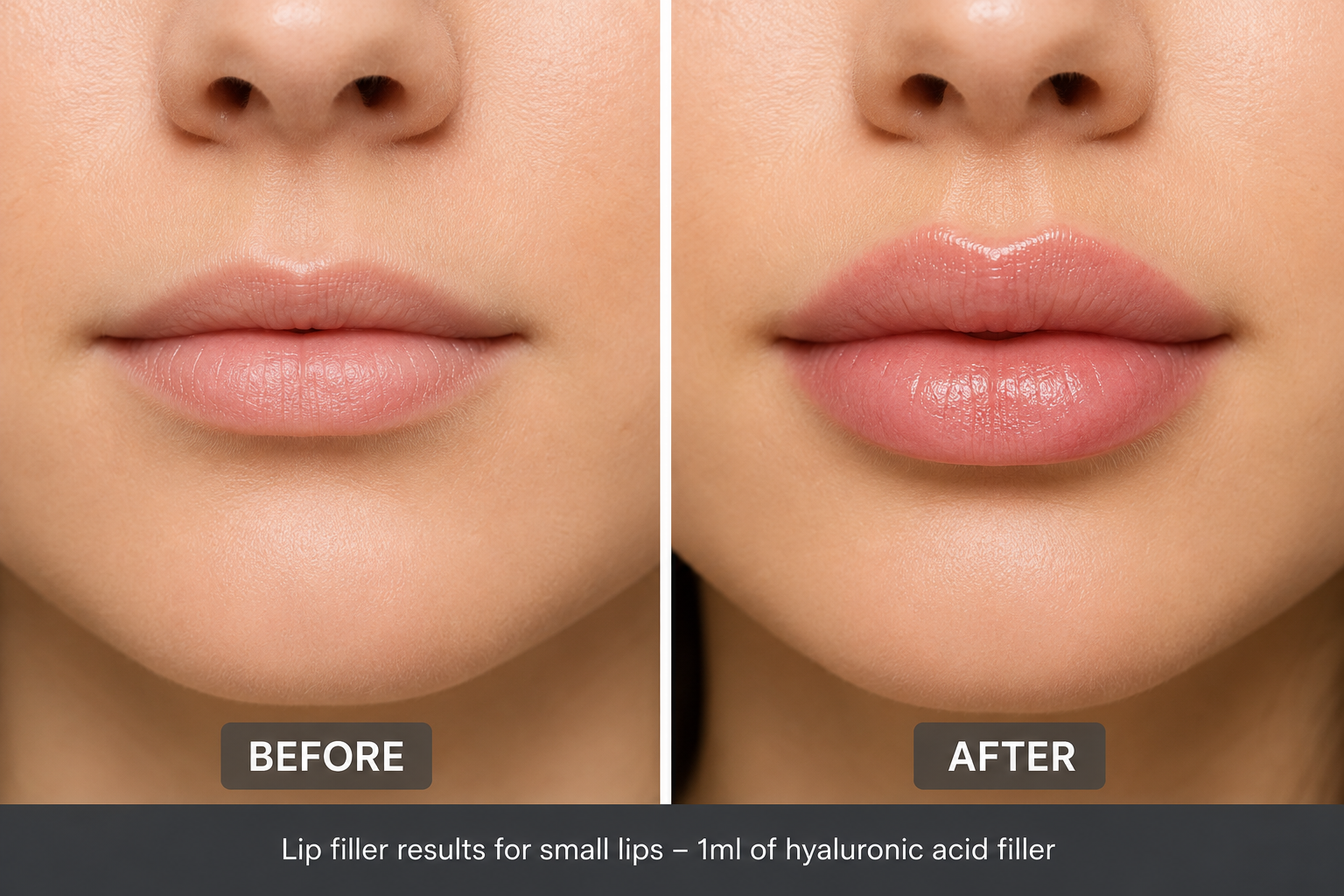
For someone searching for lip filler before and after small lips, the most useful comparison is therefore not simply “small versus big.” Look at the entire lip shape.
- Has the upper lip gained gentle volume?
- Does the lower lip still look balanced?
- Is the Cupid’s bow still defined?
- Does the vermilion border look cleaner?
- Has the lip projection increased without looking excessive?
- Does the result fit the person’s face?
- Does the mouth still move naturally?
These details tell you more about treatment quality than simply measuring how much larger the lips became.
What Does Lip Filler Before and After Small Lips Actually Mean?
The phrase lip filler before and after small lips usually refers to photographs showing the lips before treatment and after dermal filler has been injected.
The “before” photograph shows the patient’s natural starting point. The “after” photograph shows the change after treatment and recovery.
There is one problem with comparing these photographs online. Not every after photo is taken at the same stage of healing.
A picture taken immediately after injections can show much more swelling than the eventual result. That can make the lips appear larger, uneven or more pronounced than they will look once the swelling settles.
When looking at small lips lip filler before and after photos, check when the after photograph was taken. Ideally, you want to know whether the image was captured immediately after treatment or after the early swelling had improved.
The American Academy of Dermatology notes that hyaluronic acid fillers can provide immediate or near-immediate results, while temporary swelling and other side effects can occur after injections.
Why Small Lips Can Be Challenging to Treat
Small lips leave less room for error.
When someone already has limited natural lip volume, adding too much filler can quickly change the proportions of the mouth. The result may look heavy rather than soft and balanced.
The goal is not simply to fill empty space. The injector has to understand the patient’s natural lip anatomy and decide where additional volume will improve the overall shape.
Small lips may also have different concerns from one patient to another. One person may want more central volume. Another may want better definition around the lip border. Someone else may want the upper lip to become slightly more visible when the mouth is relaxed.
These are different treatment goals, even though all three people might describe themselves as having “small lips.”
That distinction matters when comparing before-and-after photographs. A result designed to improve lip definition may look very different from one designed to increase overall volume.
What Changes Can You Expect in Small Lips?
The most common changes involve volume, projection, definition and proportion.
1. More visible lip volume
The most obvious change is usually fullness. Hyaluronic acid filler attracts water and creates a filling effect within the treated tissue.
For small lips, even a modest increase can be noticeable because the starting point is relatively narrow.
2. Better lip definition
Some treatments focus on the vermilion border rather than simply adding bulk.
A clearer border can make the lips look more defined without requiring a dramatic increase in size.
3. More visible upper lip
Some people have an upper lip that appears very thin when they smile or when their mouth is relaxed. Carefully placed filler may make more of the lip visible.
4. Improved balance
The upper and lower lips do not always need identical amounts of filler.
A skilled injector considers the relationship between the two lips, the nose, chin and surrounding facial features.
5. Increased hydration and softness
Hyaluronic acid is naturally present in the body and is widely used in temporary dermal fillers. Some products can improve the appearance of lip fullness while also creating a softer, hydrated look.
0.5ml vs 1ml Lip Filler for Small Lips
One of the most searched questions is whether 0.5ml or 1ml is better for small lips.
There is no universal amount that is right for every person.
A 0.5ml treatment may create a subtle change in some patients. A full 1ml treatment may create a more noticeable change. But the final appearance depends on the filler product, lip anatomy, injection technique and the patient’s starting volume.
This is why choosing a volume simply because it is popular can be a mistake.
0.5ml lip filler for small lips
A smaller amount may appeal to someone who wants a very subtle result.
It can be useful when the main goal is a slight increase in fullness or definition rather than a major change in lip size.
For a person getting filler for the first time, a conservative plan may also make it easier to assess how the lips respond.
1ml lip filler for small lips
One milliliter can create a more noticeable change, but that does not mean every person needs a full 1ml.
The amount should be based on the anatomy and the treatment plan rather than the syringe size alone.
The safest approach is to discuss the desired end result with a qualified injector and let the clinician determine an appropriate treatment plan.
Can Small Lips Look Natural After Lip Filler?
Yes, small lips can look natural after filler. The key is controlling volume and respecting the original shape.
The American Academy of Dermatology states that natural-looking results depend on the expertise of the person placing the filler and recommends a conservative approach.
Natural results usually do not mean “no one can tell anything was done.” Instead, they mean the lips look like a better version of the patient’s natural features.
A natural result may still be clearly visible in a before-and-after photograph.
The difference is that the change looks proportional.
For small lips, this often means avoiding a sudden jump from very little volume to extreme fullness. The transition should suit the patient’s face.
What Makes a Good Small Lips Before and After Photo?
Not every before-and-after image is useful for judging a treatment.
When researching lip filler before and after small lips, look for photos that make comparison easy.
- The lighting should be similar.
- The patient’s head should be positioned similarly.
- The distance from the camera should be similar.
- The lips should be shown from the same angle.
- The before photo should show the natural starting point.
- The after photo should identify the approximate recovery stage.
- The amount and type of filler should be disclosed when possible.
Photos taken immediately after treatment are less useful for judging the final cosmetic result because swelling can temporarily change the shape.
The American Academy of Dermatology recommends asking your provider to show before-and-after photos of previous patients during the consultation.
Also check: Lip Enhancement in 2026: Types, Cost, Results, Benefits and Risks
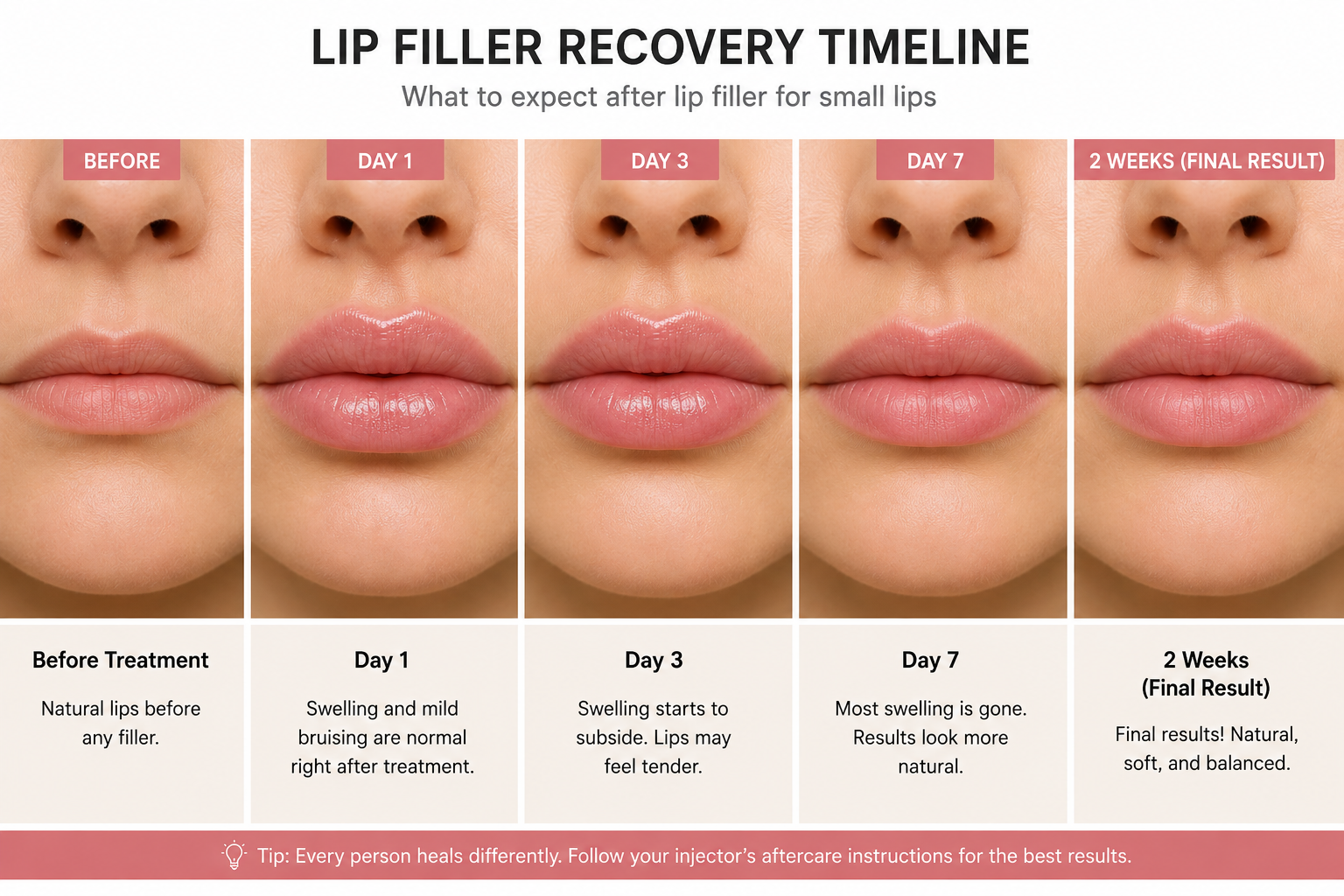
Small Lips Lip Filler Results: What the Timeline Looks Like
The result changes during the first several days.
Immediately after treatment
The lips can look fuller straight away. Hyaluronic acid fillers generally produce immediate or near-immediate results.
However, the lips may also be swollen or slightly uneven.
First 24 hours
Swelling and tenderness may be noticeable. Bruising can also occur.
This is one reason not to judge your final lip filler before and after small lips result from the first photograph taken after treatment.
Days 2 to 3
Swelling may still be present. Some people experience more swelling than others.
The lips can look larger than expected during this stage.
Several days later
As early swelling improves, the shape becomes easier to judge.
After the early healing period
The treated lips should provide a much better idea of the cosmetic outcome once the initial swelling has settled.
The exact timeline varies between patients. The FDA notes that common filler side effects such as swelling and bruising often occur soon after injection and can resolve over days to weeks.
Lip Filler Swelling With Small Lips
Swelling is one of the biggest reasons early lip filler photos can be misleading.
Someone with naturally small lips may be surprised by how different their mouth looks during the first few days.
That does not automatically mean too much filler was used.
It may simply reflect the body’s response to injections.
However, severe or unusual symptoms should not be dismissed as normal swelling.
The FDA advises patients to seek immediate medical attention if they experience unusual pain, changes in vision, or white, gray or blue skin near the injection site. The agency also lists stroke symptoms that require urgent medical attention.
That distinction is important. Mild swelling after treatment is common. Severe pain, skin color changes or vision problems require urgent assessment.
How to Reduce the Chance of a Poor Result
The best way to improve the odds of a good result is to focus on the injector, product and treatment plan before the appointment.
Choose an experienced medical provider
Dermal filler should be treated as a medical procedure, not as a casual beauty service.
The FDA recommends choosing a licensed healthcare provider who has experience with dermal filler injections and understands the relevant anatomy and risks.
Ask about their experience with small lips
Do not only ask how many filler treatments they perform.
Ask whether they regularly treat naturally small or thin lips.
Small lips require careful planning because adding too much volume can quickly change the proportions of the mouth.
Look at real patient photographs
Ask to see before-and-after photographs of patients with a similar starting lip shape.
The American Academy of Dermatology specifically recommends asking about before-and-after photographs during consultation.
Explain the result you want
Do not simply say, “I want bigger lips.”
Explain whether you want more definition, more volume, more upper-lip visibility or a subtle change.
Bringing an old photograph of yourself that shows the lip shape you prefer can also help explain your goal.
What Is the Best Lip Filler for Small Lips?
There is no single filler that is automatically the best for every person with small lips.
Many lip treatments use hyaluronic acid fillers because hyaluronic acid is temporary and has a long history of use in cosmetic medicine.
The FDA lists hyaluronic acid among the materials used in temporary dermal fillers.
The product should be selected according to the treatment area, desired effect and the clinician’s experience with that product.
Instead of asking only, “What is the best filler for small lips?” ask these questions:
- Which product is appropriate for my lips?
- Is it approved for the intended use in my country?
- How long should the result last?
- How much product do you recommend?
- Why is that amount appropriate for my anatomy?
- What complications should I watch for?
- What happens if I do not like the result?
The AAD recommends asking whether the filler is approved for the intended use, whether results are temporary, what side effects can occur and how much experience the provider has with the filler.
How Long Does Lip Filler Last on Small Lips?
There is no exact expiration date that applies to every patient.
The American Academy of Dermatology states that hyaluronic acid gel fillers typically last around 4 to 12 months.
Individual results can differ based on the product, treatment area, metabolism, injection technique and other factors.
The FDA also explains that many dermal fillers are temporary because the body eventually absorbs the filler material. Repeat treatment may therefore be needed to maintain the desired effect.
For someone with small lips, maintenance should not mean automatically repeating the same amount each time.
The lips should be assessed again before additional filler is placed.
Can Lip Filler Migrate in Small Lips?
Filler migration is a concern that deserves a serious discussion, but it should not be treated as an unavoidable outcome.
Migration refers to filler moving beyond the area where it was intended to remain.
The appearance may include fullness above the natural lip border or an unusually swollen area around the mouth.
There can be several reasons for an undesirable appearance after lip filler. Swelling, anatomy, product placement and previous treatments can all affect the result.
Using more filler does not automatically create a better result.
This is especially relevant for small lips. If a patient repeatedly adds more product without allowing previous treatment to settle or without reassessing the anatomy, the lips can eventually look overfilled.
A qualified injector should discuss your previous filler history before recommending additional treatment.
Can Lip Filler Correct Very Thin or Small Lips?
Dermal fillers can be used to increase fullness in thin lips.
The American Society of Plastic Surgeons lists plumping thin lips as a common use for injectable dermal fillers.
However, filler cannot completely change every aspect of lip anatomy.
If the main concern is lip length, muscle movement, gum exposure or another structural issue, a consultation may identify a different procedure as a better option.
Fillers are designed to add volume and modify soft-tissue contours. They are not a universal solution for every concern around the mouth.
Does Lip Filler Hurt?
Some discomfort is possible because lip filler involves injections.
Many filler products contain or are used with local anesthetic to improve comfort, and providers may also use topical numbing methods.
The experience varies from person to person.
The lips are sensitive, so it is reasonable to ask the provider what pain-control methods they use before treatment.
Do not take medication or supplements before treatment simply because someone online recommended them. Tell your provider about every medicine, vitamin and supplement you use.
The AAD specifically advises patients to disclose medications, vitamins, minerals and herbal supplements before receiving filler.
What Happens During a Lip Filler Appointment?
A proper appointment should begin with a consultation, not immediately with an injection.
Step 1: Assessment
The provider examines your lips, surrounding tissue and facial proportions.
Step 2: Discussion of your goal
You explain what you want to change.
Step 3: Review of medical history
The provider should ask about allergies, medications, previous fillers, previous cosmetic procedures and relevant health issues.
Step 4: Product discussion
You should know what product is being injected and why it has been selected.
Step 5: Treatment planning
The provider decides where and how much filler should be placed.
Step 6: Injection
The filler is placed into specific areas of the lips using an injection technique selected by the provider.
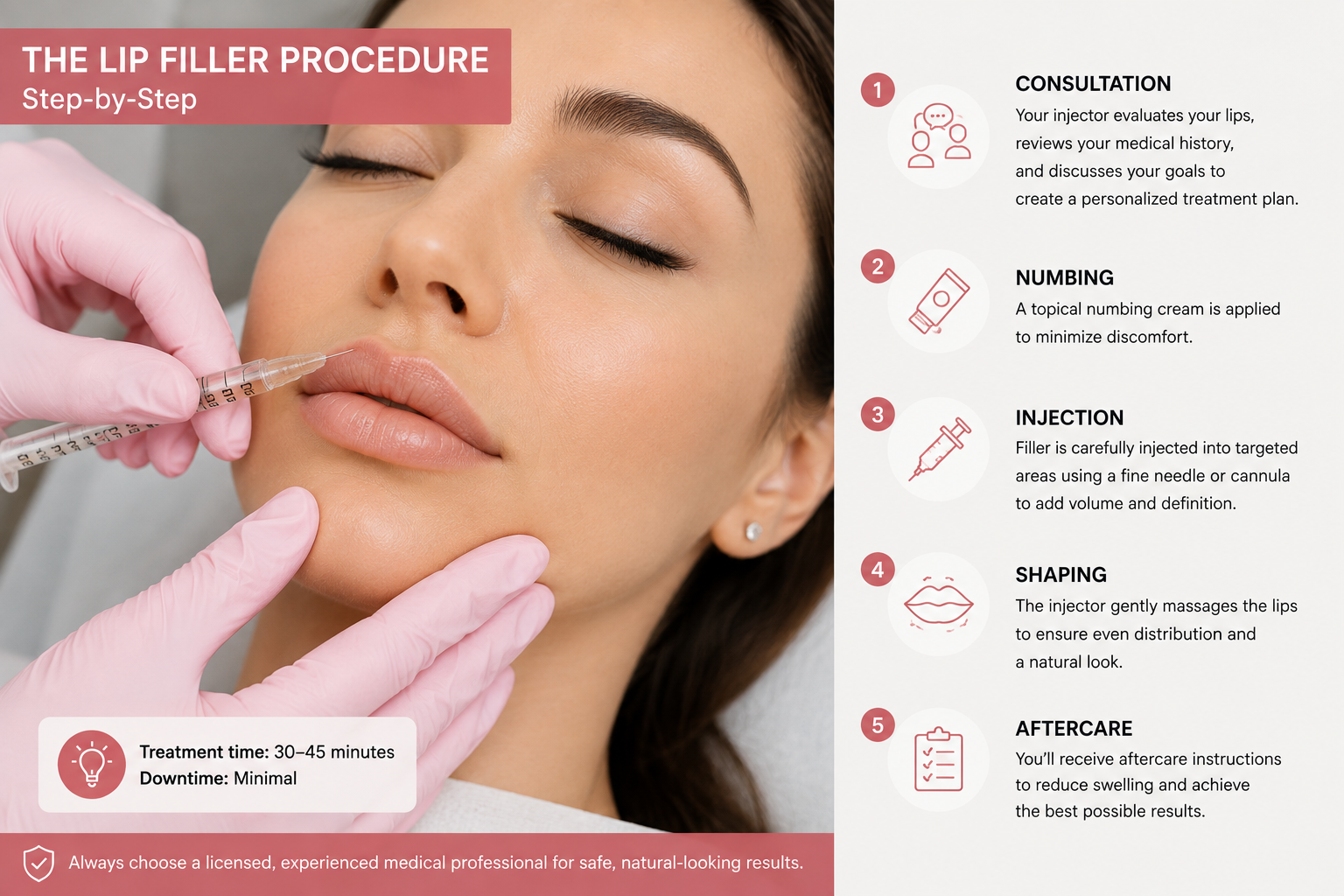
Step 7: Aftercare instructions
You should leave knowing what symptoms are expected and which symptoms require medical attention.
The FDA recommends discussing the injection sites, risks and benefits with a qualified healthcare provider before treatment.
Lip Filler Before and After Small Lips: What to Look for in the Upper Lip
The upper lip often receives special attention because small upper lips can appear less visible than the lower lip.
A good before-and-after comparison should show whether the upper lip has gained volume without losing its natural landmarks.
Look at the Cupid’s bow, central lip and outer portions of the upper lip.
If every part of the lip appears equally swollen, the image may simply show early post-treatment swelling rather than the final result.
A more refined result often has variation in volume across different areas.
Lip Filler Before and After Small Lips: What to Look for in the Lower Lip
The lower lip can also change significantly after filler.
Because the lower lip is often naturally fuller, adding too much volume can affect facial balance.
The goal is not necessarily to make the upper and lower lips identical.
Instead, the injector should consider the natural relationship between them.
When comparing photos, check whether the lower lip still looks proportionate to the upper lip and whether the mouth retains a natural shape when relaxed.
What Does a Natural Lip Filler Result Look Like?
A natural result is usually one that respects the patient’s original anatomy.
The lips can be fuller without looking inflated.
The border can be clearer without looking sharply drawn.
The Cupid’s bow can remain recognizable.
The upper and lower lips can remain balanced.
The mouth should also continue to move normally.
The AAD notes that conservative treatment can help create more natural-looking results, particularly when patients with very thin lips are treated.
This is one of the most useful lessons from before-and-after photographs: more volume is not automatically better.
Lip Filler Cost for Small Lips in 2026
The price of lip filler varies by country, clinic, provider, product and amount used.
In the United States, the American Society of Plastic Surgeons reports an average cost of $743 for lip augmentation with dermal fillers in its published statistics.
That figure should not be treated as a worldwide price.
Prices in Zambia, the United Kingdom, South Africa, Australia, Canada and other countries can be very different.
The cheapest option is also not necessarily the safest option.
When comparing prices, ask what the quoted fee includes.
- The filler product
- The amount used
- The injector’s professional fee
- The consultation
- Follow-up care
- Management of complications if they occur
A suspiciously cheap injection from an unlicensed provider is not a bargain if something goes wrong.
The FDA warns against purchasing filler directly online and emphasizes that dermal filler injections should be performed by appropriately trained, licensed healthcare providers.
Who Is a Good Candidate for Lip Filler?
Candidate selection depends on health, expectations, anatomy and the specific treatment goal.
The American Society of Plastic Surgeons says suitable candidates should generally be physically healthy, have realistic goals and be committed to maintaining healthy skin.
A consultation is necessary because not every person who wants larger lips is automatically a good candidate for filler.
The provider should also know about previous filler, allergies, cold sore history, medications and other relevant medical information.
The AAD recommends giving your dermatologist this information before treatment.
Who Should Not Rush Into Lip Filler?
You should postpone treatment if you have not had a proper consultation or if the provider cannot clearly explain the product, risks and treatment plan.
You should also be cautious if someone promises a perfect result or guarantees that complications cannot happen.
Dermal filler is a medical procedure. Even when performed correctly, complications are possible.
The FDA and professional medical organizations recommend using qualified healthcare professionals with appropriate training.
Lip Filler Risks You Should Know Before Treatment
Most people searching for before-and-after photographs focus on appearance. Safety deserves equal attention.
Possible side effects can include swelling, bruising, tenderness, redness and other injection-site reactions.
More serious complications can occur when filler enters or affects a blood vessel.
The FDA warns about rare but serious complications involving blocked blood vessels, which can lead to tissue damage, vision problems or other severe outcomes.
That is why the injector’s training matters so much.
Do not use needle-free devices marketed as an easy alternative to injections. The FDA and AAD warn that needle-free filler devices can cause serious injury.
Red Flags After Lip Filler
Some swelling can be expected after treatment. Certain symptoms should not be ignored.
Seek urgent medical attention if you develop unusual or severe pain, significant skin color changes such as white, gray or blue skin near the injection site, or vision changes.
The FDA also advises urgent assessment for symptoms that could indicate a stroke, including sudden weakness, difficulty speaking, facial drooping, severe headache or confusion.
Do not wait for these symptoms to “settle down” on their own.
How to Prepare for Lip Filler on Small Lips
Good preparation starts before you sit in the treatment chair.
- Research the provider’s qualifications.
- Look for real before-and-after photographs.
- Write down your desired result.
- Tell the provider about previous filler.
- Tell them about medications and supplements.
- Discuss any history of cold sores.
- Ask which product will be used.
- Ask how much filler is recommended.
- Ask what swelling and recovery should look like.
- Ask what to do if you develop a complication.
The AAD provides a similar consultation checklist and recommends asking about side effects, approval, experience, cost and before-and-after photographs.
Questions to Ask Before Getting Lip Filler for Small Lips
If you are planning your first appointment, take these questions with you.
- How often do you treat small or thin lips?
- Can I see before-and-after photos of patients with similar lips?
- Which filler do you recommend and why?
- How much filler do you recommend for my lips?
- Would you start conservatively?
- What will happen if I want more volume later?
- How long should the result last?
- How much swelling should I expect?
- What symptoms require urgent medical attention?
- How are complications managed?
- What happens if I dislike the result?
The American Society of Plastic Surgeons also recommends asking about the provider’s training, qualifications, risks, recovery, expected results and options if you are dissatisfied.
Why “Before and After” Does Not Tell the Whole Story
A photograph captures only one moment.
It does not show the injector’s planning, the patient’s anatomy, the amount of filler used, the injection technique or how the lips looked during healing.
Two people can receive the same amount of filler and have very different results.
That is why copying a celebrity’s lips or asking for the same number of milliliters shown in another person’s photograph is not a reliable treatment plan.
The FDA explains that successful filler results depend on factors including the underlying tissue structure, the filler volume and the type of filler used.
Small Lips and the “Overfilled” Look
The fear of looking overfilled is common, especially among people with naturally small lips.
The simplest way to reduce this risk is to avoid treating syringe volume as the goal.
The goal should be a specific change in appearance.
For example, someone may want slightly more upper-lip visibility without dramatically increasing the overall size.
Another person may want more central volume.
Someone else may want a clearer border.
Those goals can require different approaches.
A conservative treatment plan also leaves room for future adjustments.
Can You Get Lip Filler if You Have Extremely Small Lips?
Having very small lips does not automatically mean you cannot have lip filler.
It does mean that expectations need to be realistic.
Dermal filler can add volume, but it cannot transform every anatomical feature.
A qualified provider should assess whether filler can achieve the change you want and whether another procedure would be more appropriate.
The American Society of Plastic Surgeons notes that fillers can help plump thin lips but also explains that non-surgical treatments cannot achieve every result that surgery can provide.
How to Find a Qualified Lip Filler Provider
Start with credentials, experience and safety rather than social media followers.
Look for a licensed healthcare professional who has specific training in dermal filler injections and facial anatomy.
Ask how frequently they perform lip filler treatments.
Then ask to see genuine before-and-after photographs.
When possible, compare photographs of patients with similar lip shapes and treatment goals.
The FDA recommends selecting a licensed healthcare provider experienced in dermal filler injections.
The American Society of Plastic Surgeons also recommends choosing a qualified plastic surgeon and provides a checklist for evaluating providers.
External Medical Resources for Lip Filler Research
If you are researching lip filler before and after small lips, use medical sources rather than relying only on social media posts.
FDA: Dermal Fillers and Soft Tissue Fillers
for information about approved uses, risks, warnings and patient safety.
[FDA: Dermal Fillers and Soft Tissue Fillers](https://reference-url-citation.invalid/35)
American Academy of Dermatology: Fillers FAQs
for information about results, duration and natural-looking filler treatment.
[AAD: Fillers FAQs](https://reference-url-citation.invalid/36)
American Society of Plastic Surgeons: Dermal Fillers
for information about candidates, treatment, results, costs and risks.
[ASPS: Dermal Fillers](https://reference-url-citation.invalid/37)
American Academy of Dermatology: Filler Preparation
for questions to ask before treatment and information to share with your provider.
[AAD: Filler Preparation](https://reference-url-citation.invalid/38)
Lip Filler Before and After Small Lips: What Results Are Realistic in 2026?
The most realistic expectation is a noticeable but controlled improvement.
Some patients may see a clear difference in volume.
Others may notice a smaller change in size but a larger improvement in definition.
There is no single “perfect” result for small lips.
A successful result should match the patient’s facial proportions and personal goal.
The American Academy of Dermatology emphasizes that natural-looking filler results depend on the skill of the person placing the filler and recommends avoiding excessive treatment.
That makes a conservative approach especially useful for someone who has never had lip filler before.
What If You Want More Volume Later?
Starting conservatively does not mean you have to stop there.
Some patients prefer to see how their lips respond before deciding whether they want additional volume.
This can be particularly useful when the starting lips are very small.
Instead of trying to create the final look in one appointment, the treatment plan can be based on how the lips actually respond.
Any additional treatment should be discussed with the same qualified provider or another qualified medical professional who can assess the existing filler.
Final Takeaway for Anyone Searching “Lip Filler Before and After Small Lips”
Small lips can respond well to lip filler, but the best result is not necessarily the largest result.
Before-and-after photographs are useful when they show similar lighting, angles and healing stages. Look beyond the increase in size. Pay attention to shape, balance, definition and facial proportions.
There is no universal rule that says every person with small lips needs 0.5ml, 1ml or another fixed amount. Your anatomy and treatment goal should determine the plan.
Hyaluronic acid fillers can produce immediate fullness, while swelling and bruising may affect the appearance during the early recovery period. The AAD reports that hyaluronic acid fillers commonly last about 4 to 12 months, although individual results vary.
Most importantly, choose a qualified healthcare professional who has experience with lip filler and knows how to manage complications. The FDA considers dermal filler injection a medical procedure and recommends licensed, appropriately trained providers.
If your goal is natural-looking small lips before and after results, focus less on getting the biggest lips possible and more on getting the right shape for your face.
Frequently Asked Questions About Lip Filler Before and After Small Lips
1. Does lip filler work well on small lips?
Yes. Dermal fillers can add fullness and definition to naturally small or thin lips. The American Society of Plastic Surgeons lists plumping thin lips as a common use of dermal fillers.
2. Is 0.5ml enough for small lips?
It can be enough for someone seeking a subtle change, but there is no universal amount. The appropriate volume depends on anatomy, filler product, treatment goals and the injector’s assessment.
3. Is 1ml too much for small lips?
Not necessarily. One milliliter can be appropriate for some patients, while another person may need less. The amount should be based on the individual treatment plan rather than a standard rule.
4. Will small lips look bigger immediately after filler?
Usually, some increase in fullness is visible quickly with hyaluronic acid filler. However, swelling can temporarily make the lips look larger than the eventual result.
5. How long does swelling last after lip filler?
Swelling varies between patients. The FDA says swelling and bruising commonly occur soon after dermal filler injections and many side effects resolve over days to weeks.
6. When can I see my final lip filler result?
The initial result is visible quickly, but early swelling can make the lips appear different from the settled result. The final appearance becomes easier to judge once the early swelling has improved.
7. Can lip filler make small lips look natural?
Yes. Natural-looking results depend on appropriate volume, careful placement, good technique and respecting the patient’s facial proportions. The AAD recommends conservative treatment for natural results.
8. What is the best lip filler for small lips?
There is no single best filler for everyone. A qualified provider should select the product based on your anatomy, goals, the treatment area and the product’s approved use.
9. Can lip filler migrate above the lip?
Undesirable filler movement can occur, although it is not inevitable. Appropriate product selection, careful injection technique and avoiding excessive treatment can help reduce the chance of an unwanted appearance.
10. How long does lip filler last?
The duration varies by product and patient. The American Academy of Dermatology states that hyaluronic acid gel fillers typically last about 4 to 12 months.
11. Is lip filler safe for very small lips?
Lip filler can be used for small lips, but it is a medical procedure with risks. Choosing a licensed and experienced healthcare provider is an important safety step.
12. What should I look for in lip filler before and after small lips photos?
Look for similar lighting, camera angle, facial expression and recovery timing. Also look for information about the filler used and the amount injected.
13. Can I get lip filler if my lips are extremely thin?
Some people with very thin lips can benefit from filler. However, expectations should remain realistic because filler cannot change every structural feature of the lips.
14. Does lip filler hurt?
Some discomfort is possible because filler is injected into the lips. Providers may use topical or local numbing methods, and some filler products contain lidocaine to reduce discomfort.
15. How much does lip filler cost?
The cost varies by country, clinic, provider, filler product and amount used. In published U.S. statistics, ASPS reports an average cost of $743 for lip augmentation with dermal fillers, but local prices can differ substantially.
16. Can I avoid the overfilled look?
A conservative treatment plan can help. Discuss the exact amount and type of change you want rather than simply asking for larger lips. The AAD recommends conservative treatment for natural-looking results.
17. Can lip filler improve lip definition without making lips very large?
Depending on the anatomy and treatment plan, filler can be used to improve definition as well as volume. Your provider should determine the safest placement and amount for your desired result.
18. What should I do if I have severe pain after lip filler?
Contact your medical provider urgently. The FDA advises immediate medical attention for unusual pain, changes in vision or white, gray or blue skin near the injection site.
19. Should I use needle-free filler for small lips?
No. The FDA has warned about serious injuries linked to needle-free filler devices. These devices should not be treated as a safer substitute for properly performed medical injections.
20. What is the most important thing to check before getting small lips lip filler?
Check the provider’s qualifications, experience, treatment plan and ability to manage complications. Ask to see genuine before-and-after photographs of patients with similar anatomy and goals.