Book Appointment Now

Lip Filler Before and After 60 Years Old: Results & Risks 2026
Lip Filler Before and After 60 Years Old: What Really Changes, What Looks Natural, and What to Expect in 2026
Searching for lip filler before and after 60 years old usually comes with one simple question: “Will I still look like myself?”
That question matters more than the size of your lips.
After 60, the goal of lip filler is rarely to create dramatically larger lips. A well-planned treatment can restore some lost fullness, soften vertical lip lines, improve the shape of the lip border and bring balance back to the lower face.
The best results are often subtle.
You may notice that lipstick sits better. Your mouth may look less drawn in. Fine lines around the lips may appear softer. Your lips can look hydrated and slightly fuller without giving you an obviously “filled” appearance.
But there is another side to the conversation.
Mature lips are different from younger lips. The skin is thinner, tissues have changed, facial volume has shifted and the surrounding mouth area may have developed deeper lines. That means technique matters enormously.
This guide explains what lip filler before and after 60 years old can realistically look like, what changes with age, which filler types are commonly considered, how long results may last, what recovery involves, what risks you need to know and how to avoid an overfilled appearance.
The information below is educational and does not replace an examination by a qualified medical professional. Dermal filler is a medical procedure, not a beauty treatment that should be performed casually.
Quick Answer: Can You Get Lip Filler After 60?
Yes. Being over 60 does not automatically prevent you from having lip filler.
In the United States, the FDA has approved certain dermal fillers for adults aged 22 and older for specific uses, including lip augmentation. The exact product, injection area and approved indication matter.
Age alone is not the main question.
Your injector should consider your health history, medications, allergies, skin condition, facial anatomy, previous filler treatments and the result you want.
For many people over 60, a conservative approach makes more sense than chasing the fuller lips they may remember having decades earlier.
The goal should be restoration rather than exaggeration.
What Does Lip Filler Before and After 60 Years Old Actually Mean?
The phrase lip filler before and after 60 years old can be misleading because there is no single “after” that every 60-year-old should expect.
Faces age differently.
Some people naturally keep good lip volume into their 60s. Others notice significant thinning much earlier. Genetics, sun exposure, smoking history, dental changes, facial structure and general aging can all affect the appearance of the mouth.
A good before-and-after comparison should therefore focus on changes that suit the individual face.
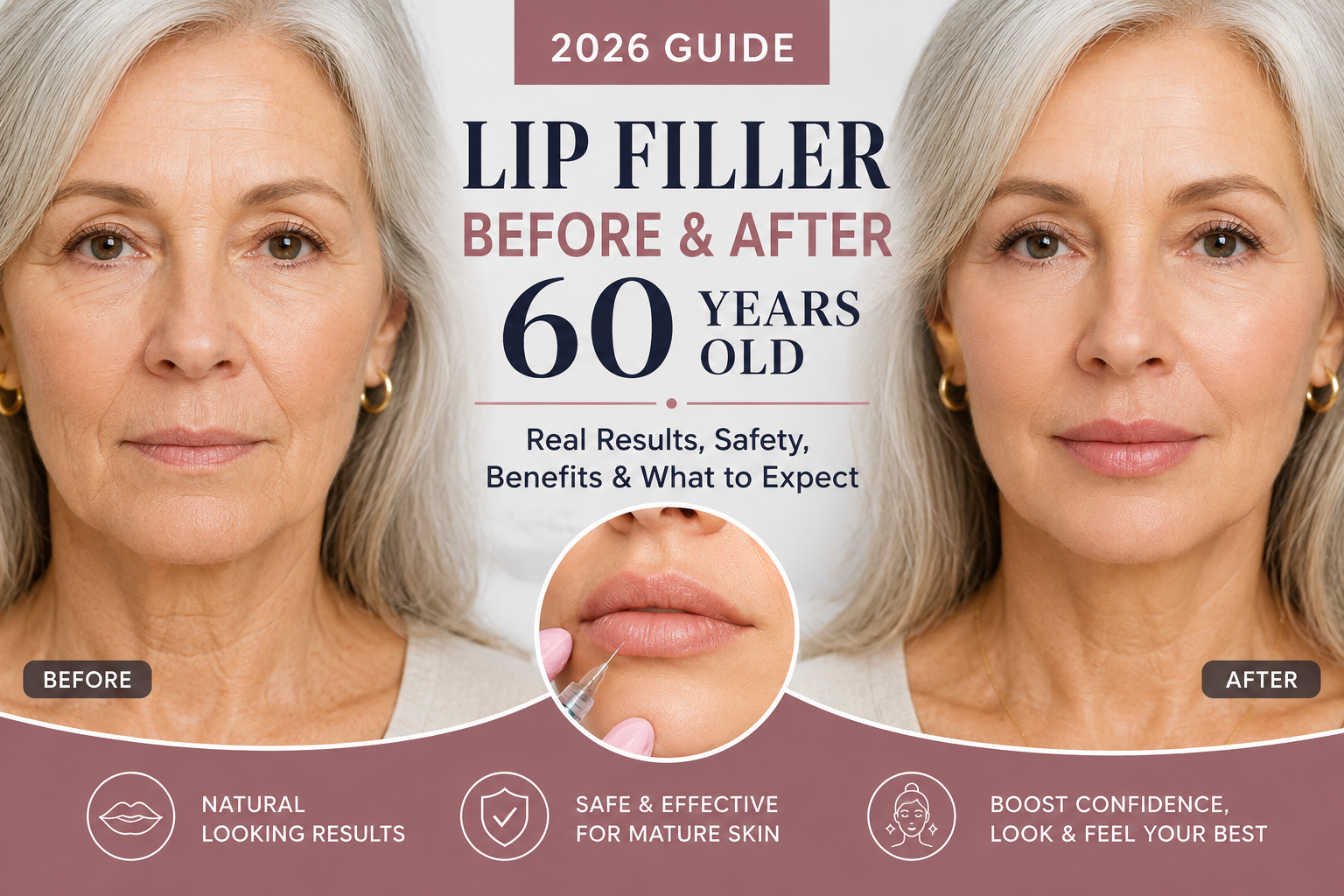
Before treatment, an older patient may have:
- Reduced lip volume.
- A less defined vermilion border.
- More vertical lines above the upper lip.
- A flatter upper lip.
- Downturned corners of the mouth.
- Less visible pink lip tissue.
- Changes in the relationship between the upper and lower lips.
- Dry-looking or less hydrated lips.
- Fine lines that become more noticeable when lipstick is applied.
After a carefully planned treatment, the changes may include:
- A modest increase in lip fullness.
- Better definition around the lip border.
- A smoother appearance around selected lines.
- Improved lip shape.
- A more balanced upper-to-lower lip relationship.
- A fresher appearance without dramatic enlargement.
The difference should still look like your face.
Why Lips Change After 60
Lip aging is not simply a matter of losing volume. Several changes happen around the mouth at the same time.
As we age, the skin becomes thinner and facial tissues change. The lips themselves can lose fullness, while the surrounding structures also change. Fine lines can become more visible, and the distance between the nose and upper lip may appear longer.
These changes can make the lips look smaller even when the actual change in lip volume is not dramatic.
Sun exposure can also contribute to visible aging around the mouth. Repeated facial movement adds to the formation of lines, while changes in the supporting tissues can affect lip shape.
This is why simply injecting a large amount of filler into the lips is not always the best solution.
A mature-face treatment may need to consider the entire mouth area.
What Makes Lip Filler After 60 Different From Lip Filler at 30?
The biggest difference is usually the treatment goal.
A younger patient may want more obvious lip enhancement. A patient in their 60s may want restoration of lost definition and a softer appearance around the mouth.
Mature lips can also require more careful planning because the surrounding skin and tissues have changed.
For example, putting too much filler into a thin upper lip can create a disproportionate result. The lip may project forward instead of simply looking naturally fuller.
The American Academy of Dermatology advises a conservative approach for natural-looking filler results. It also notes that injector expertise strongly affects how natural the result looks.
This is one reason before-and-after photos should be viewed carefully.
You are not looking for the biggest “after.”
You are looking for an after that still looks believable.
What Does a Natural Lip Filler Result After 60 Look Like?
A natural result is usually easier to recognize than to describe.
The lips may look slightly fuller, but they should not dominate the face.
The upper lip may regain some definition. The lower lip may receive enough support to restore balance. The border can look clearer without appearing sharply drawn.
Fine lines may become less noticeable, although filler does not erase every wrinkle.
In some cases, the biggest improvement is not obvious at first glance. Friends may simply think you look rested.
That is often a better target than having everyone notice that you had filler.
Signs of a natural result
- The lips remain proportional to the rest of the face.
- The upper lip does not project excessively.
- The lower lip remains naturally fuller than the upper lip when that suits the patient’s anatomy.
- The lip border looks defined but not artificially sharp.
- The mouth can move normally.
- The result does not create an obvious shelf above the upper lip.
- The treatment addresses the patient’s actual concerns rather than adding volume everywhere.
What Can Lip Filler Improve After 60?
Lip filler can address several concerns, but it cannot correct every sign of facial aging.
1. Lost lip volume
This is one of the most common reasons people consider treatment.
A hyaluronic acid filler can temporarily add volume to the lips. The FDA describes dermal fillers as products that can create a smoother or fuller appearance, including increased lip fullness with approved products.
2. Weak lip definition
The edge of the lip can become less distinct with age. Carefully placed filler may improve definition without adding a large amount of volume.
3. Vertical lip lines
Some fillers are approved for certain perioral lines, depending on the specific product. Treatment planning matters because deep lines may need more than simply filling the lip itself.
4. Lip asymmetry
Small differences between the two sides of the mouth are normal. Filler can sometimes improve mild asymmetry.
5. Loss of a defined Cupid’s bow
The central shape of the upper lip can become less pronounced over time. A skilled injector may use a small amount of filler to improve definition.
6. A tired-looking mouth
Some patients notice that their mouth looks less youthful because of changes around the corners. Filler may help in selected cases, but it is not always the right treatment for downward mouth corners.
What Lip Filler Cannot Fix After 60
Filler is not a facelift in a syringe.
This distinction can prevent unrealistic expectations.
Filler may improve volume loss, but it cannot fully tighten significant loose skin. It cannot completely remove deep wrinkles. It cannot reverse every structural change caused by aging.
If the main concern is substantial skin laxity, jowling or a long upper lip, a different treatment may be more appropriate.
Depending on the concern, a medical professional might discuss options such as laser treatment, resurfacing, neuromodulators, surgical procedures or other approaches.
The right answer depends on the person’s anatomy and goals.
Which Lip Filler Is Best After 60?
There is no single best lip filler for every person over 60.
However, hyaluronic acid fillers are commonly used for temporary facial volume correction, including lip augmentation.
Hyaluronic acid is naturally present in body tissues and attracts water. The FDA lists hyaluronic acid among absorbable temporary filler materials.
Different hyaluronic acid products have different properties. Some are designed to provide more structure. Others are softer and may be better suited to areas where movement is frequent.
The choice should be based on the specific product’s approved indication, characteristics and the injector’s assessment.
Do not choose a filler simply because it is popular on social media.
Why Hyaluronic Acid Filler Is Often Discussed for Mature Lips
Hyaluronic acid has one major practical advantage: many HA fillers are temporary.
The FDA states that the effects of HA fillers generally last around 6 to 12 months, although actual duration varies by product and treatment area.
The American Academy of Dermatology gives a broader range of about 4 to 12 months for hyaluronic acid gel fillers.
That temporary nature can be useful when treating mature lips.
Your face continues to change with age. A result that looks ideal today may need adjustment later.
Temporary filler allows a patient and injector to reassess the result rather than committing to permanent volume.
ALSO CHECK: Lip Filler Before and After Older Woman: 2026 Restorative Guide
What About Specific Products Such as Restylane Kysse or RHA 3?
Some specific hyaluronic acid products have regulatory approval for lip augmentation.
For example, the FDA states that Restylane Kysse is indicated for lip augmentation and correction of upper perioral rhytids in adults over 21.
The FDA also approved an expanded indication for RHA 3, including injection into the lips, vermilion borders and oral commissures for lip augmentation in adults aged 22 and older.
That does not mean either product is automatically the best choice for someone aged 60, 65 or 70.
The product should match the treatment goal, anatomy and medical assessment.
Lip Filler Before and After 60 Years Old: What Results Should You Expect?
Expect improvement, not a complete reversal of aging.
Results can vary widely, but a conservative treatment may produce changes such as slightly fuller lips, improved definition and a smoother-looking mouth area.
The first day can be misleading.
Swelling can temporarily make the lips appear larger than the final result. Bruising can also change the appearance.
Most fillers provide immediate or nearly immediate visible results, according to the American Academy of Dermatology. Swelling can make the final appearance harder to judge during the first few days.
This is why before-and-after photographs should ideally compare a properly healed result with the original photograph.
How Much Lip Filler Is Usually Needed After 60?
There is no safe universal amount that applies to every 60-year-old.
The amount depends on the starting anatomy, lip size, skin quality, treatment goal and filler selected.
Using more product does not automatically produce a better result.
For mature lips, a conservative first treatment can make sense. The injector can assess the result after swelling settles and determine whether additional correction is actually needed.
This approach is often better than trying to create the final look in one aggressive session.
Can Lip Filler Make You Look Younger After 60?
It can make the mouth look fresher, but it does not literally make the face younger.
Restoring modest lip volume can change facial balance.
That can have a surprisingly noticeable effect.
The lips may look less thin. Lipstick may sit differently. The area above the lip can look softer. The mouth may appear less drawn inward.
But the best result respects the person’s age and facial structure.
Trying to recreate the lips of a 25-year-old can make an otherwise attractive result look artificial.
Can You Get Lip Filler at 65?
Yes, a person aged 65 may be a candidate for lip filler.
The same principle applies at 60, 65, 70 and beyond: age alone does not determine suitability.
The medical assessment matters more.
A qualified provider should review health conditions, medications, allergies and previous cosmetic procedures before treatment.
The FDA specifically recommends discussing your medical history and potential risks with a licensed health care provider who has experience with dermal filler injections.
Can You Get Lip Filler at 70?
Some people in their 70s may still be candidates for lip filler.
But older age can make the consultation even more important.
The treatment should be based on your current facial structure rather than an age-based formula.
If you have significant skin laxity or other structural concerns, your provider may explain why another treatment would produce a better result.
A responsible injector should also be comfortable saying no when filler is not appropriate.
What Happens During a Lip Filler Appointment?
A good appointment begins with assessment, not injection.
The provider should examine your lips, mouth area and facial proportions. They should ask about your medical history and discuss your desired result.
You should also have time to ask questions.
The FDA recommends choosing a licensed health care provider experienced in dermal filler injections and discussing the specific product and risks before treatment.
The actual injection may involve a needle or cannula, depending on the provider’s technique and product instructions.
Some fillers contain lidocaine to reduce discomfort.
The provider may use several small injection points rather than placing a large amount of filler in one area.
How Long Does Lip Filler Take?
The injection itself is usually a relatively short procedure, but the appointment can take longer because consultation, preparation and assessment are part of the process.
Do not choose a provider based on who can inject the fastest.
Precision matters more than speed.
Does Lip Filler Hurt After 60?
Some discomfort is expected.
Patients can experience tenderness, swelling, bruising and pain after filler injections. These are among the common risks listed by the FDA.
Individual experiences vary.
Some people describe the procedure as uncomfortable rather than painful. Others are more sensitive.
Your provider can explain what pain-control measures are appropriate for the specific procedure.
How Long Does Swelling Last After Lip Filler?
Swelling can make the lips look larger than the final result.
Most common filler side effects occur soon after injection and often resolve over days to weeks, according to the FDA.
The exact recovery time varies.
Some patients look presentable quickly. Others need more time for swelling or bruising to settle.
Do not judge the final result based on the first few hours.
What Should You Avoid After Lip Filler?
Your injector should give you specific aftercare instructions because recommendations can vary by product and technique.
In general, ask your provider before exercising heavily, applying pressure to the treated area, receiving dental treatment soon after injection or undergoing another cosmetic procedure.
Do not massage or manipulate the filler unless your treating clinician tells you to do so.
If something feels unusual, contact the provider rather than trying to fix it yourself.
How Long Does Lip Filler Last After 60?
Temporary lip filler usually does not last forever.
Duration depends on the filler, injection site, amount used and individual factors.
The FDA lists approximately 6 to 12 months for hyaluronic acid filler effects, while the American Academy of Dermatology gives about 4 to 12 months as a typical range for HA gel.
That does not mean every patient needs a refill on an exact schedule.
Some people may choose maintenance earlier. Others prefer to wait until the effect has substantially faded.
Does Lip Filler Look Better After the Swelling Goes Down?
Usually, the healed appearance is a better representation of the result.
Immediately after injection, swelling can make the lips look unusually full or uneven.
As swelling settles, the shape becomes easier to evaluate.
This is why a responsible before-and-after comparison should use photographs taken under similar lighting, facial expression and camera distance after the lips have healed.
How to Read Lip Filler Before and After Photos
Do not judge a filler result from a single dramatic photograph.
Look for consistency.
- Is the lighting similar?
- Is the camera angle the same?
- Is the patient’s expression similar?
- Was the “after” photograph taken after swelling settled?
- Is the entire lower face visible?
- Does the result fit the person’s facial proportions?
- Does the patient still look like themselves?
These questions matter because before-and-after photographs can be misleading when lighting, makeup, facial expression and camera angles change.
What Does Overfilled Lip Filler Look Like After 60?
Overfilling can be especially noticeable when the natural lip structure is thin.
Possible signs include excessive forward projection, an unusually large upper lip, a stiff appearance or a visible ridge around the lip border.
That does not mean every fuller lip is “bad.” The correct amount depends on the person’s face.
The problem is proportionality.
The American Academy of Dermatology warns that dramatic enlargement of very thin lips can look unnatural. It recommends a conservative approach when the goal is a natural result.
Should You Start With a Small Amount of Filler?
For someone seeking a natural result, conservative treatment is worth discussing.
You can always ask whether the provider prefers a staged approach.
Instead of trying to produce dramatic fullness immediately, the provider can assess how the tissue responds and decide whether another small adjustment is appropriate.
This can be particularly useful when someone has never had lip filler before.
Lip Filler vs Lip Flip After 60
These treatments are not the same.
Lip filler adds volume.
A lip flip uses a neuromodulator to change muscle activity around the upper lip.
The FDA explains that botulinum toxin products are injectable drugs and are not dermal fillers. They work differently from filler.
A lip flip may create the appearance of more upper-lip show without adding the same type of physical volume as filler.
Which option makes sense depends on what you are trying to change.
Lip Filler vs Lip Lift After 60
A lip lift is a surgical procedure. Lip filler is injectable.
They solve different problems.
If the main issue is loss of volume, filler may be considered.
If the concern is a long upper-lip area or reduced upper-lip show caused by structural changes, a surgeon may discuss whether a lip lift is more suitable.
A consultation can help determine whether the problem is volume, skin, muscle, structure or a combination.
Can Lip Filler Help Smokers’ Lines After 60?
Vertical lines above the upper lip are often called smoker’s lines, even in people who have never smoked.
Repeated lip movement, aging and sun exposure can all contribute to these lines.
Some dermal fillers are approved for certain perioral lines, depending on the product. The FDA specifically notes that certain absorbable fillers are approved for moderate-to-severe perioral lines.
However, deeper lines may require a broader treatment plan.
Filling every line directly can sometimes produce an unnatural appearance.
Is Lip Filler Safe After 60?
Lip filler can be appropriate for some people over 60, but it is not risk-free.
The FDA lists common effects such as bruising, redness, swelling, pain, tenderness and itching. Less common problems include infection, nodules, allergic reactions and tissue death.
The most serious complications involve accidental injection into a blood vessel.
These events are uncommon, but they can cause tissue necrosis, vision problems, blindness or stroke.
That is why injector training matters.
What Is Vascular Occlusion?
A vascular occlusion happens when blood flow is blocked.
With dermal filler, this can occur if filler is unintentionally introduced into a blood vessel or, in some circumstances, interferes with blood flow.
The complication can damage skin tissue and, in rare situations, affect vision or the brain.
Published medical reviews describe vascular complications as uncommon but potentially severe.
The FDA also identifies accidental injection into a blood vessel as the most concerning risk of dermal filler treatment.
Can Lip Filler Cause Blindness?
Rarely, filler injections have been associated with serious vision complications.
This is one of the reasons cosmetic filler should be treated as a medical procedure.
Reviews of published cases show that filler-related vision loss is rare but potentially devastating. Hyaluronic acid has been involved in many reported cases, although the highest-risk injection sites in the literature have often involved areas such as the nose, forehead and glabella rather than the lips.
A systematic review of hyaluronic acid-related vision loss found that the most commonly implicated areas were the nose, glabella and forehead, with no reported cases in that review from the lips.
That finding should not be interpreted as “lip filler has zero risk.” It means the published risk profile varies by injection location, anatomy and technique.
Warning Signs After Lip Filler That Need Urgent Medical Attention
Do not wait for a routine follow-up if you develop unusual or severe symptoms.
The FDA advises seeking immediate medical attention for unusual pain, vision changes, or skin that becomes white, gray or blue near the injection site. It also lists stroke symptoms such as sudden difficulty speaking, weakness or numbness, facial drooping, severe headache, dizziness, confusion or visual changes.
These symptoms require urgent medical assessment.
Do not attempt to treat a suspected vascular complication at home.
Why Injector Experience Matters More After 60
The skill of the injector can make a major difference in both appearance and safety.
The American Academy of Dermatology recommends having fillers performed by a licensed physician and stresses the importance of appropriate training and experience.
The FDA also advises patients to choose a licensed health care provider who has experience with dermal filler injections.
Ask about the provider’s training.
Ask how often they perform lip filler.
Ask whether they have treated mature lips.
Ask to see before-and-after photographs of patients with similar starting anatomy and goals.
Do not choose an injector simply because the price is low.
Questions to Ask Before Lip Filler at 60
Take a short list to your consultation.
- What changes do you recommend for my lips?
- How much volume do you think I actually need?
- Which filler are you recommending?
- Is that product approved for the treatment area?
- Why did you choose that product?
- How long should I expect the result to last?
- What are the common side effects?
- What serious complications should I know about?
- How do you manage a vascular complication?
- What should I do if I develop unusual pain or skin color changes?
- Can I see your before-and-after results on patients around my age?
- What happens if I do not like the result?
These questions can tell you more about a provider than a glossy social media page.
What Medical History Should You Tell Your Injector?
Tell your provider about medications, allergies and relevant medical conditions before treatment.
The FDA recommends discussing bleeding disorders, severe allergies, previous allergic reactions and other relevant conditions before receiving filler.
You should also mention previous filler treatments.
Tell the provider if you have experienced problems with fillers before.
Do not hide medications because you think they are unrelated to cosmetic treatment.
Your clinician needs the complete picture.
What About Blood Thinners?
Some medicines and supplements can affect bruising or bleeding.
Do not stop prescribed medication on your own just because you are planning filler.
Ask the clinician who manages your medication whether any changes are appropriate.
Stopping an important prescription without medical advice can create a greater risk than bruising.
Can Dental Work Affect Lip Filler?
Tell your injector about planned dental work.
The FDA notes that inflammation around filler can sometimes occur after infections, vaccinations or dental procedures.
Your provider can advise you on appropriate timing.
If you already have an active infection or inflammation around the mouth, filler may need to be delayed.
How Much Does Lip Filler Cost After 60?
There is no single price for lip filler after 60.
Cost depends on the country, clinic, injector, product, amount used and whether additional treatments are included.
In the United States, clinics often price filler by syringe or treatment area. Prices can differ substantially between cities and providers.
In other countries, prices may be quoted per syringe, per treatment or in local currency.
Do not use a low price as your main reason for choosing a provider.
The cost of correcting a poor result can be much higher than paying a qualified injector for the initial treatment.
Why the Cheapest Lip Filler Can Become Expensive
Cheap treatment can look attractive when you are comparing prices online.
But ask what is included.
Is the injector qualified?
Is the product genuine?
Is the product approved for the intended use?
Does the clinic have a plan for complications?
Are you being treated in a proper medical setting?
The FDA warns consumers not to purchase dermal fillers directly online and advises against self-injection.
What Happens If You Do Not Like Your Lip Filler?
Do not panic during the first few days.
Swelling can temporarily distort the shape.
Wait for the period recommended by your provider before judging the final result.
If you still dislike the result, return to the treating clinician for assessment.
Some hyaluronic acid fillers can be reduced using hyaluronidase under medical supervision, but this is not something you should attempt yourself.
The FDA notes that filler removal can require injections, surgery or other interventions, and removal may be difficult or impossible with some materials.
Should You Choose Permanent Lip Filler After 60?
Think carefully before choosing any permanent filler.
Your face will continue to change.
A permanent material placed today remains part of a face that may look different years later.
The FDA notes that permanent fillers can be difficult or impossible to remove, especially when they are not made from materials such as hyaluronic acid.
For many patients seeking a first treatment, the temporary nature of HA filler may offer more flexibility.
The choice still belongs in a medical consultation.
Can Lip Filler Make Your Face Look Wider?
It can change facial balance if too much volume is added.
The lips sit at the center of the lower face, so even a small change can affect how the entire mouth area looks.
A skilled injector should consider your nose, chin, teeth, jaw and overall facial proportions.
This is another reason why “more filler” is not automatically better.
Natural Lip Filler for Women Over 60
For many women over 60, natural-looking enhancement is the main goal.
That usually means working with the existing lip shape rather than creating a completely new one.
A conservative plan may focus on restoring lost fullness, improving definition and softening selected lines.
Makeup can also help reveal whether the result is working.
If lipstick previously settled into vertical lines, improved lip shape and surface support may make application easier.
Natural Lip Filler for Men Over 60
Men can also consider lip filler.
The same principle applies: restore proportion rather than create an obviously enlarged appearance.
Male and female facial proportions can differ, so treatment should be individualized.
The goal is not to make every face follow the same beauty template.
Does Lip Filler Change Your Smile?
It can temporarily affect how the mouth feels or moves while swelling is present.
The final appearance depends on where filler is placed and how much is used.
If you rely heavily on natural lip movement for speaking, singing or professional work, tell your provider.
That information can influence treatment planning.
Can Lip Filler Help With a Long Upper Lip?
Sometimes the appearance of a long upper lip is caused by structural changes rather than simple loss of lip volume.
Adding filler may not be the best answer in every case.
Too much filler can increase projection without solving the underlying concern.
If this is your main issue, ask whether a surgical lip lift or another treatment should be considered instead.
What Should You Look for in Lip Filler Before and After 60 Photos?
Look for patients with similar age, lip shape and concerns.
A 60-year-old with thin lips and deep perioral lines should not compare herself only with a 25-year-old model with naturally full lips.
Look for:
- Patients in their 60s or older.
- Similar starting lip volume.
- Similar skin quality.
- Similar concerns around the mouth.
- Photos taken after swelling has settled.
- Consistent lighting and camera angles.
- Natural facial expressions.
The best comparison is not the most dramatic one.
It is the one that gives you a realistic idea of what your own result might look like.
Common Mistakes People Make When Searching for Lip Filler Before and After 60 Years Old
Mistake 1: Looking only at dramatic transformations
Dramatic photos attract attention, but they may not represent your desired result.
Mistake 2: Assuming age determines the amount needed
Two 60-year-olds can have completely different lips.
Mistake 3: Choosing an injector based only on price
Training, experience and emergency planning deserve more attention.
Mistake 4: Judging the result immediately
Swelling can temporarily make the lips look much larger.
Mistake 5: Assuming filler fixes every mouth wrinkle
Different signs of aging can require different treatments.
Mistake 6: Buying filler online
The FDA warns against purchasing dermal fillers directly from the public because products may be counterfeit, contaminated or unauthorized.
Mistake 7: Using needle-free filler devices
The FDA has warned against needle-free devices for dermal filler injection because of safety concerns and lack of sufficient control.
What Makes a Good Lip Filler Consultation After 60?
A good consultation should feel like a medical discussion, not a sales pitch.
The provider should ask what bothers you about your lips.
They should examine your facial proportions.
They should explain what filler can and cannot achieve.
They should tell you about common and serious risks.
They should explain the product being used.
They should give you realistic expectations about duration.
They should also explain what happens if a complication occurs.
The American Academy of Dermatology recommends choosing a qualified physician and asking to see before-and-after photos of previous patients.
Is Lip Filler Worth It After 60?
It can be worth considering if your expectations are realistic.
If you want modest restoration, lip filler may offer a visible but subtle change.
If you want to remove every wrinkle, restore a much younger face or dramatically enlarge thin lips, filler may not meet your expectations.
The procedure makes the most sense when you understand exactly what it can change.
How to Prepare for Your Lip Filler Consultation
Take clear photographs of yourself from the front and side before the appointment.
Think about what bothers you most.
Is it thin lips?
Loss of definition?
Vertical lines?
Uneven lips?
Downturned corners?
Reduced upper-lip show?
Being specific makes the consultation more useful.
Bring a list of your medications and allergies.
Tell the provider about previous cosmetic procedures.
Most importantly, explain the kind of result you want.
What Is the Best Age to Start Lip Filler?
There is no universal best age.
Someone may choose filler at 40 because of naturally thin lips. Another person may not consider it until their 60s.
The right time depends on your concerns, health and expectations.
Being 60 does not mean you are “too old” for lip filler.
It also does not mean you need filler because you are 60.
Cosmetic treatment should be a personal choice.
Lip Filler Before and After 60 Years Old: What Should the Final Result Look Like?
The most convincing result is usually the one that does not scream “cosmetic procedure.”
The lips can look fuller.
The border can look clearer.
The mouth can look refreshed.
Fine lines may look softer.
Yet your face should remain recognizable.
That is the standard worth aiming for.
Important Safety Advice Before Getting Lip Filler
Dermal filler should be injected by an appropriately licensed and trained health professional in a suitable medical setting.
The FDA recommends using approved products and warns against self-injection and needle-free filler devices.
Ask what product you are receiving.
Ask where it is approved for use.
Ask about the risks.
Ask what the clinic would do if a vascular complication occurred.
These questions are not excessive.
They are part of making an informed decision.
External Medical Resources for Lip Filler Research
For official information about dermal filler approval, risks and patient safety, review the U.S. Food and Drug Administration’s dermal filler guidance.
You can also review the FDA’s consumer guidance covering filler safety, approved uses and warning signs.
The American Academy of Dermatology provides patient information about filler results, natural-looking outcomes and treatment expectations.
For scientific literature about vascular complications, published reviews in PubMed provide useful medical background.
Frequently Asked Questions About Lip Filler Before and After 60 Years Old
1. Is 60 too old for lip filler?
No. Being 60 does not automatically make someone too old for lip filler. Suitability depends on health, facial anatomy, medications, allergies, skin condition, treatment goals and the specific filler being considered.
2. Does lip filler look natural after 60?
It can. Natural results usually come from conservative treatment that respects the person’s existing lip shape and facial proportions. The American Academy of Dermatology recommends avoiding overfilling when a natural appearance is the goal.
3. What is the best lip filler for a 60-year-old?
There is no single best filler for every 60-year-old. Hyaluronic acid fillers are commonly used for temporary lip augmentation, but the specific product should be selected by a qualified provider based on your anatomy and treatment goals.
4. Can a 65-year-old get lip filler?
Yes. A 65-year-old may be a candidate for lip filler if a qualified medical professional determines that treatment is appropriate.
5. Can a 70-year-old get lip filler?
Some people aged 70 and older may be suitable candidates. Age alone does not determine eligibility. A medical assessment is necessary.
6. How much lip filler should a 60-year-old get?
There is no standard amount based on age. The amount depends on the person’s starting anatomy, desired result, product and treatment plan. Conservative treatment is often appropriate when natural results are the priority.
7. How long does lip filler last after 60?
Temporary hyaluronic acid fillers commonly last several months. The FDA gives approximately 6 to 12 months for HA fillers, while the American Academy of Dermatology lists roughly 4 to 12 months. Actual duration varies by product and patient.
8. Does lip filler remove wrinkles around the mouth?
It can improve some lines and restore volume, but it does not remove every wrinkle. Certain fillers are approved for specific perioral lines, depending on the product.
9. Can lip filler make an older woman look younger?
It can make the mouth look fuller or more refreshed, but it does not reverse overall facial aging. The most natural result restores proportion instead of trying to recreate a much younger face.
10. What are the risks of lip filler after 60?
Common risks include swelling, bruising, redness, pain and tenderness. Less common complications include infection, nodules, allergic reactions and tissue death. Rare vascular complications can cause serious injury, including vision problems or stroke.
11. Can lip filler cause blindness?
Rare cases of vision loss have been reported after facial filler injections. Published reviews show that the highest-risk sites are often the nose, forehead and glabella. The risk is rare, but the potential outcome can be devastating.
12. What should I do if I have severe pain after lip filler?
Contact your treating provider immediately. If severe or unusual pain occurs with skin color changes or vision symptoms, seek urgent medical attention. The FDA specifically advises immediate medical attention for unusual pain, vision changes or white, gray or blue skin near the injection site.
13. Should I get lip filler if I have very thin lips?
You may be able to, but thin lips often require a conservative plan. Adding too much filler can create excessive projection. A qualified injector should assess your natural lip anatomy before recommending an amount.
14. Is hyaluronic acid filler better than permanent filler after 60?
There is no universal answer, but temporary HA filler offers an advantage because its effects generally diminish over time. Permanent fillers can be difficult or impossible to remove, according to the FDA.
15. Can lip filler improve smoker’s lines if I am over 60?
Some dermal fillers are approved for certain perioral lines. However, deeper or widespread lines may require a broader treatment plan. The correct approach depends on the cause and severity of the lines.
16. How soon can I see lip filler results?
Many hyaluronic acid fillers produce immediate or nearly immediate visible results. Swelling can temporarily change the appearance, so the first-day result should not be considered the final result.
17. Will lip filler make my lips look too big?
It can if too much filler is used. This is why a conservative approach is often preferred for mature lips when the goal is natural enhancement.
18. Can I get lip filler and Botox at the same time?
These are different treatments. The FDA notes that the safety of combining dermal fillers with neuromodulators has not been evaluated in controlled clinical studies for all combinations. Discuss combined treatment with your medical provider.
19. How do I choose a lip filler injector after 60?
Choose a properly licensed health professional with appropriate filler training and experience. Ask to see before-and-after photos of patients with similar anatomy and discuss how the provider handles complications.
20. Are lip filler before-and-after photos reliable?
They can be useful, but compare photos taken with similar lighting, camera angle, expression and healing time. A dramatic photograph does not guarantee that the same result is appropriate for you.
Final Takeaway: What to Expect From Lip Filler Before and After 60 Years Old
The best lip filler before and after 60 years old result is usually about restoration, not transformation.
After 60, lips can become thinner and less defined. Lines around the mouth can become more visible. Facial proportions can change. These are normal parts of aging.
Carefully selected dermal filler can restore some lost fullness and improve lip definition. Hyaluronic acid fillers are commonly used because they are temporary, and several products have approved indications for lip augmentation.
But filler is still a medical procedure.
The risks deserve serious attention, even when complications are uncommon. Choosing a qualified injector, using an appropriate product and understanding warning signs are essential parts of the decision.
If you are 60 or older and considering lip filler, do not begin with the question, “How much filler can I get?”
Begin with a better question:
“What small change would make my lips look more balanced while still looking like me?”
That question leads to a much better conversation with a qualified injector, and it is usually the right starting point for natural-looking lip filler after 60.