Book Appointment Now

Lip Filler Before and After Thin Lips: Results, Cost & Safety
Year: 2026
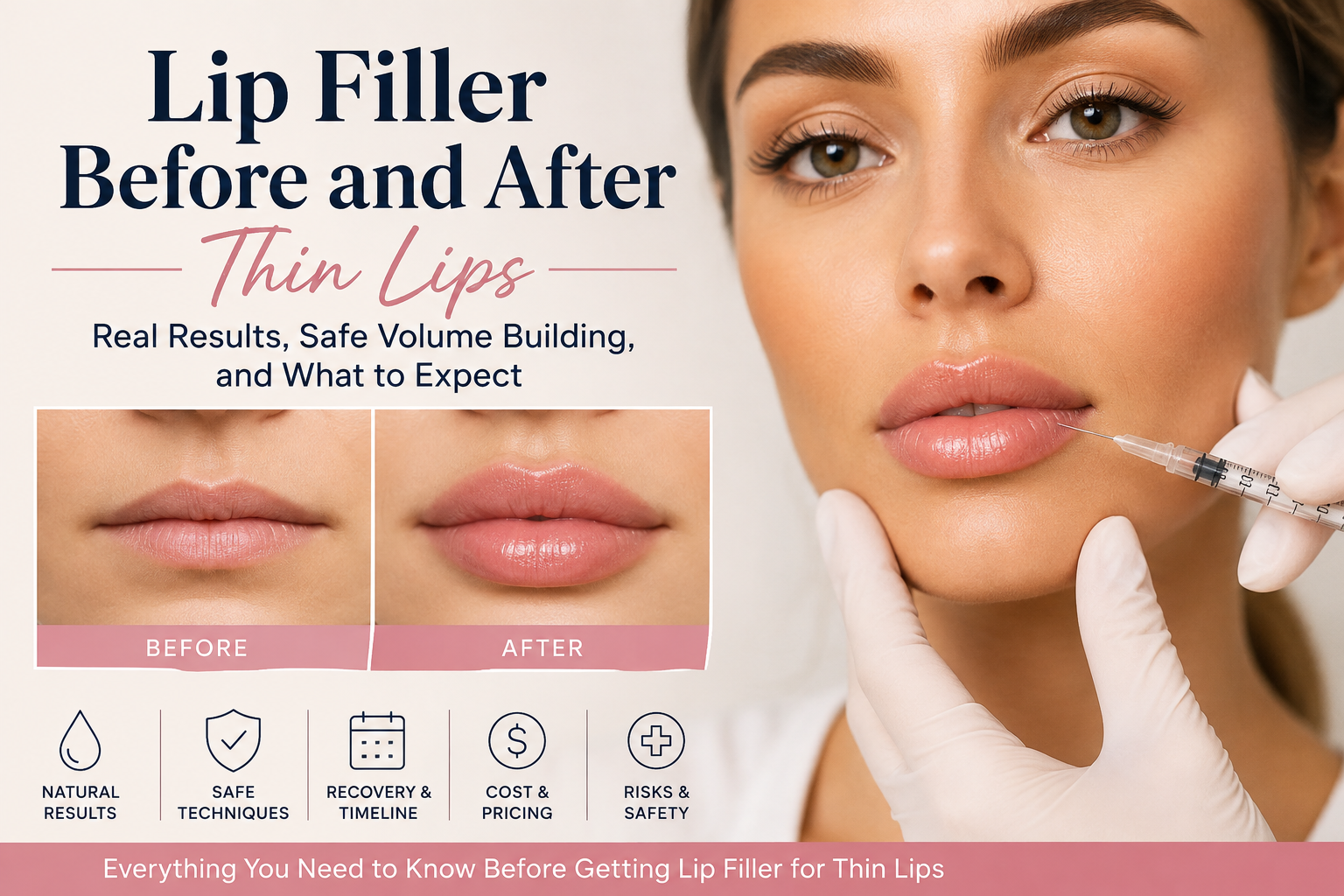
Lip Filler Before and After Thin Lips: Real Results, Safe Volume Building, and What to Expect
If you are researching lip filler before and after thin lips, your primary concern is likely how to achieve noticeable fullness without ending up with artificial or overfilled lips.
Treating naturally thin or asymmetrical lips requires a completely different approach than treating lips that already possess natural volume.
Because thin lip tissue has less space to hold fluid gel, forcing too much product in a single session can lead to duck-like projection, migration outside the lip border, or lumps. A successful outcome depends heavily on patient tissue stretch, precise injection depth, and patience.
This comprehensive guide covers everything you need to know about transforming thin lips safely using dermal fillers—including realistic expectations, recommended products, step-by-step volume building, recovery timelines, safety guidelines, and costs.
Quick Answer: Works Best for Thin Lips?
A gradual, multi-stage injection plan using flexible Hyaluronic Acid (HA) fillers delivers the most natural-looking results for thin lips.
According to official guidance from the U.S. Food and Drug Administration (FDA) on dermal fillers, absorbable materials like HA offer temporary structural support that naturally breaks down over time.
Rather than placing a full syringe at once, experienced injectors typically recommend starting with 0.5 mL to 1.0 mL total, evaluating the healed result after two to four weeks before adding more.
However, there is no universal syringe amount that works for everyone. A patient’s starting anatomy, lip length, existing asymmetry, age, skin elasticity, previous filler, desired appearance, and treatment goals all influence the appropriate plan.
The most important goal is not simply making the lips bigger. It is creating a result that fits the rest of the face. For someone with very thin lips, even a relatively small amount of carefully placed filler can produce a noticeable difference.
What to Expect in Lip Filler Before and After Thin Lips Transformations
When analyzing before-and-after cases specifically for thin lips, it is important to observe proportional structural changes rather than just size expansion.
Before treatment, naturally thin lips often present with:
- A very narrow or almost invisible upper lip pink tissue (vermilion).
- A flat or undefined Cupid’s bow.
- Tuck-in appearance when smiling, where the upper lip completely disappears.
- Noticeable vertical lines pulling across the tight lip tissue.
- Inverted lip borders that turn inward toward the teeth.
After a properly executed, conservative treatment, the outcome typically features:
- Increased vertical height and visibility of the pink lip area.
- A subtle forward roll (eversion) that reveals the lip without aggressive projection.
- Enhanced definition along the vermilion border.
- Smoother, hydrated surface texture with fewer visible lines.
- Maintained facial symmetry that matches the chin, nose, and jawline.

One of the biggest mistakes when looking at lip filler before and after thin lips photographs is focusing only on the number of milliliters used. Two people can receive the same amount of filler and have completely different outcomes.
The reason is simple: lips differ in thickness, muscle activity, skin elasticity, proportions, dental position, and natural shape. A successful result should therefore be judged by balance rather than volume alone.
For some patients, the most noticeable improvement comes from defining the vermilion border. For others, the priority may be increasing the vertical height of the upper lip or restoring volume that has gradually decreased with age.
What Makes Thin Lips Different?
Thin lips have less natural tissue volume, which means the margin for error can be smaller. This does not mean that people with thin lips cannot achieve beautiful results. It simply means the treatment needs to be customized.
When the lips are naturally narrow, aggressive filler placement can create a result that looks projected rather than naturally full. The lip may become noticeably larger from the side without gaining the soft, hydrated appearance that many patients actually want.
This is why a good consultation should focus on more than asking, “How much filler can I get?” A better question is, “What type of change is realistic for my anatomy?”
A qualified injector may assess the lips at rest and while smiling, speaking, and moving. Dynamic assessment can be particularly useful because the lips are highly mobile structures.
The goal is to preserve natural movement while creating additional definition and volume.
Anatomy of Thin Lips: Why Technique Is Different
Thin lips possess limited vascular capacity and tighter dermal tissue layers compared to naturally full lips. Injecting dense dermal fillers into tight tissue creates high internal resistance.
If an injector pushes a thick gel rapidly into thin tissue, the product will follow the path of least resistance—often spilling above the lip line into the cutaneous lip area, resulting in an unnatural “shelf” or lip mustache effect.
The American Academy of Dermatology (AAD) emphasizes tailored filler techniques, noting that achieving natural outcomes requires treating each patient’s unique facial anatomy with precision.
The anatomy of the lips is also important because blood vessels run through and around the treatment area. A medical professional performing filler injections needs a detailed understanding of facial anatomy and should be prepared to recognize and manage complications.
This is one reason why choosing an experienced medical injector is more important than finding the lowest advertised price.
Natural Lip Filler for Thin Lips: What Does “Natural” Actually Mean?
The phrase natural lip filler for thin lips can mean different things to different patients. Some people want a barely noticeable enhancement. Others want a clearly fuller lip but still want the result to look proportional.
A natural result generally means that the lips still look like lips rather than appearing excessively projected, stiff, or disproportionate to the face.
Natural-looking enhancement may involve:
- Preserving the patient’s original Cupid’s bow.
- Maintaining a balanced upper-to-lower lip relationship.
- Improving lip definition rather than simply adding bulk.
- Keeping the mouth area mobile during facial expressions.
- Avoiding excessive filler above the natural vermilion border.
- Building volume gradually when more fullness is desired.
In other words, natural-looking does not necessarily mean tiny. It means intentional, proportional, and appropriate for the individual.
The Stage-by-Stage Volume Building Process
To safely expand thin lips, many expert medical providers implement a staged strategy:
Stage 1: Structural Priming (0.5 mL to 1.0 mL)
The first appointment focuses on defining the border and creating micro-channels of hydration within the body of the lip. This softens the tight tissue and creates a baseline frame.
Stage 2: Healing & Tissue Integration (2 to 4 Weeks)
During this period, initial swelling subsides and the hyaluronic acid integrates with host tissue, pulling in water molecules to soften the lips naturally.
Stage 3: Refinement & Expansion (0.5 mL Optional)
Once the initial layer has integrated comfortably, additional product can be introduced safely to build outward volume without straining the skin envelope.
Not every patient needs Stage 3. Some people decide that the first treatment provides exactly the amount of enhancement they wanted.
This staged approach can also make it easier to identify what the patient’s lips naturally respond to. Instead of making a dramatic change during one appointment, the provider can observe how the filler settles and determine whether further treatment would actually improve the result.
How Much Lip Filler Do Thin Lips Usually Need?
There is no single amount that can be considered correct for every person with thin lips. The commonly discussed range of 0.5 mL to 1.0 mL should be treated as a general starting point rather than a prescription.
Some patients may achieve their desired result with less. Others may eventually choose additional treatment after the first appointment has fully settled.
The important distinction is between the amount used in one appointment and the total amount used over an entire treatment journey.
For example, someone wanting significant but natural-looking volume may choose a conservative initial treatment followed by a later refinement appointment. This can produce a more controlled result than attempting to achieve the entire transformation in one visit.
Patients should never pressure an injector to use a specific amount simply because they have seen a particular social media result.
Choosing the Right Filler Product for Thin Lips
Not all dermal fillers perform identically in narrow lip borders. Medical providers evaluate viscoelasticity—how the gel stretches and handles facial muscle movement—when selecting a formula.
| Product Family | Key Characteristics | Best Use Case for Thin Lips |
|---|---|---|
| Restylane Kysse | XpresHAn Technology™, highly flexible gel. | Natural movement, volume expansion with soft texture. |
| Juvederm Volbella XC | Low concentration, smooth Vycross® formula. | Subtle hydration, fine vertical lines, tight borders. |
| Juvederm Ultra XC | Higher water-binding capability, firmer structure. | Noticeable projection and definition when tissue permits. |
| Belotero Balance | Seamless tissue integration, low risk of Tyndall effect. | Superficial line smoothing and delicate upper-lip shaping. |
Product selection should ultimately be made by the qualified healthcare professional performing the procedure. The “best lip filler for thin lips” is not necessarily the same product for every patient.
Different formulations have different characteristics, and some may be better suited to subtle definition while others are designed to provide more noticeable volume.
Step-by-Step Treatment Walkthrough
Understanding what occurs during a treatment helps reduce anxiety and ensures proper preparation.
- Clinical Assessment: The provider analyzes facial symmetry, dental occlusion, lip dynamic movement, and medical history.
- Topical Anesthesia: A prescription-strength numbing cream (typically benzocaine/lidocaine/tetracaine) is applied for 15 to 30 minutes.
- Sanitization: The perioral area is cleansed thoroughly with medical-grade antiseptic solutions.
- Micro-Injections: Using either fine needles (30G–32G) or a blunt-tipped microcannula, micro-droplets of gel are placed strategically into the submucosal layer.
- Molding & Review: The provider gently massages the area to ensure uniform gel distribution and reviews symmetry with the patient.
The exact technique can differ between practitioners and patients. Needle versus cannula selection, injection depth, product choice, and placement pattern should be determined by the treating medical professional.
A reputable clinic should also have an appropriate emergency protocol in place before treatment begins. Patients should feel comfortable asking what the clinic does if a vascular complication is suspected.
Preparing for Lip Filler on Thin Lips
Preparation can make the treatment experience easier and may reduce avoidable bruising or irritation.
Before treatment, tell your healthcare provider about all medications, supplements, allergies, previous cosmetic procedures, and relevant medical conditions. Do not stop prescribed medication simply because you are having cosmetic treatment unless your healthcare provider specifically instructs you to do so.
Patients should also disclose any previous lip filler. Old filler can influence the appearance of the lips and may affect the treatment plan.
It is also helpful to arrive with realistic expectations. Bring reference photographs if you want to communicate a particular aesthetic preference, but understand that another person’s lips cannot necessarily be reproduced on your own face.
Recovery Timeline: From Swelling to Final Healed Result
Recovery dynamics can vary significantly, especially for thin lips undergoing initial expansion.
Reviewing consumer safety guidance from the FDA on filler do’s and don’ts can help patients manage normal post-treatment symptoms safely.
- Day 1–2 (Peak Swelling): Lips will look substantially larger than the intended final outcome. Mild asymmetry, tenderness, and minor bruising around needle insertion points are standard.
- Day 3–5 (Settling Phase): Swelling drops noticeably. Firmness may be felt in areas where the filler is integrating into the tissue.
- Day 7–14 (Integration): Residual bruising fades completely. Gel texture softens, blending naturally with lip tissue.
- Day 21–28 (Final Result): Tissue has completely healed. This is the ideal window for follow-up evaluation or secondary refinement.
Patients should avoid judging their final lip filler before and after thin lips result immediately after the appointment. Early swelling can make the lips appear dramatically larger than they will look once healed.
Taking photographs at the same distance, angle, and lighting before treatment and several weeks afterward can provide a more accurate comparison.
What Do Lip Filler Results Look Like After One Week?
One week after treatment, much of the initial swelling has usually improved, but the lips may still be changing. Minor bruising, tenderness, firmness, or uneven swelling can sometimes remain.
This is why patients should not immediately assume that a small difference between the left and right sides means the treatment failed.
Human faces are naturally asymmetrical. Swelling can also disappear at different rates on each side.
If there is significant pain, unusual discoloration, worsening symptoms, or any symptom that concerns you, contact the treating healthcare provider promptly rather than waiting for the scheduled follow-up.
What Do Lip Filler Results Look Like After One Month?
At approximately one month, the lips generally provide a much clearer representation of the treatment outcome than they did immediately after injection.
At this point, patients can assess:
- Overall lip volume.
- Upper and lower lip balance.
- Cupid’s bow definition.
- Vermilion border definition.
- Symmetry.
- Side-profile projection.
- How the lips move while speaking and smiling.
This is also an appropriate time for many patients to discuss whether they want additional refinement.
How to Avoid Overfilled Lips
One of the biggest concerns among people researching lip filler before and after thin lips is ending up with lips that look obviously treated.
Overfilling can happen when too much product is placed too quickly, when repeated treatments are performed before previous filler has been adequately assessed, or when the treatment goal is based entirely on volume rather than facial proportions.
Several principles can help reduce the likelihood of an overfilled appearance:
- Start conservatively.
- Allow the first treatment to settle.
- Use an injector experienced with thin lips.
- Do not copy another person’s exact syringe amount.
- Prioritize proportion over maximum volume.
- Discuss your desired result clearly before treatment.
More filler is not automatically better filler. In cosmetic medicine, restraint can sometimes produce a more attractive result than aggressive augmentation.
Lip Filler Migration in Thin Lips
Lip filler migration refers to filler moving away from the intended treatment area. It is one of the concerns people frequently research when considering lip augmentation.
Migration can have several possible contributing factors, including injection technique, anatomy, product characteristics, treatment volume, repeated treatments, and individual tissue response.
A visible ridge or fullness above the natural lip border may sometimes be mistaken for migration, although other conditions can create similar appearances. Only an appropriate clinical assessment can determine what is actually happening.
If you believe your filler has migrated, do not attempt to massage, puncture, or dissolve it yourself. Contact a qualified healthcare professional who can examine the area and recommend the appropriate course of action.
Can Thin Lips Be Filled Without Looking Fake?
Yes. Thin lips can be enhanced without automatically producing an artificial appearance.
The key is understanding that the goal of treatment should be customized to the starting anatomy.
A patient with very thin lips may not be able to achieve extremely large lips in one appointment while still maintaining a natural appearance. Attempting to force that transformation can increase the chance of complications or an aesthetically undesirable result.
Gradual enhancement allows the patient and provider to stop when the lips reach a point that looks balanced.
Thin Lips Before and After Filler: How to Compare Photos Correctly
Before-and-after photographs can be useful when researching a provider, but they should be interpreted carefully.
Lighting, camera angle, facial expression, makeup, lip liner, filters, and even hydration can dramatically change the appearance of lips.
When evaluating lip filler before and after thin lips photographs, look for images taken:
- From the same camera angle.
- With similar lighting.
- Without heavy makeup or lip liner.
- With similar facial expressions.
- At a reasonable time after treatment.
Ideally, look for patients whose starting lip anatomy resembles yours. A before-and-after photograph of someone with naturally full lips may not tell you much about what the same provider can achieve with very thin lips.
Safety Warnings and Complication Awareness
Although dermal fillers are common non-surgical procedures, medical risks exist and require careful consideration.

Common Side Effects
Standard post-procedure occurrences include localized swelling, minor bruising, temporary tenderness, and slight redness surrounding the injection points.
Vascular Occlusion Risk
The primary medical risk involved with dermal filler injections is accidental entry into facial arteries, leading to blocked blood flow. Detailed clinical research on PubMed documents vascular risks and emergency management protocols for dermal fillers.
Emergency Red Flag Symptoms: Immediate, severe or throbbing pain, blanched/white skin discoloration, mottled blue/purple blotches around the mouth, or visual changes require urgent medical intervention with hyaluronidase (filler dissolving enzyme).
These symptoms should never be ignored or treated as ordinary swelling. A vascular complication is a medical emergency and requires immediate professional assessment and management.
Who Should Avoid or Delay Lip Filler?
Not everyone is an appropriate candidate for cosmetic filler at every point in time.
A qualified healthcare provider should assess your individual circumstances before treatment. Certain medical conditions, active infections around the mouth, allergies, medications, previous reactions to fillers, and other factors may affect whether treatment is appropriate.
If you have an active cold sore or infection around the lips, tell your provider before undergoing treatment. The procedure may need to be postponed or additional precautions may be required.
Pregnancy and breastfeeding are also situations that should be discussed with a healthcare professional before considering elective cosmetic procedures.
Cost Analysis for Thin Lip Filler Treatments
Pricing varies based on geographic region, provider credentials, and the specific brand of hyaluronic acid used.
- Average Cost Per Syringe (US): $650 to $1,000+ per 1.0 mL syringe.
- Half-Syringe (0.5 mL) Pricing: $400 to $650 (Note: Not all clinics offer partial syringe sales due to single-use sterile packaging rules).
- Total Initial Investment for Thin Lips: $800 to $1,800 (accounting for initial treatment plus a secondary stage refinement session within 3 months).
These figures are general estimates and can vary considerably. Metropolitan areas, highly experienced injectors, premium brands, clinic overhead, and consultation or follow-up fees can all affect the final price.
When comparing prices, avoid choosing a provider solely because they offer the cheapest lip filler. Injectable cosmetic procedures are medical treatments, and training, experience, product authenticity, clinical standards, emergency preparedness, and follow-up care matter.
How Long Does Lip Filler Last in Thin Lips?
Hyaluronic acid lip filler is temporary. Many lip fillers used for augmentation are expected to gradually break down over time, but the exact duration varies from person to person.
Factors that can influence how long the result remains noticeable include:
- The specific filler formulation.
- The amount of product used.
- Individual metabolism.
- Muscle movement around the mouth.
- Previous filler treatments.
- Injection technique and placement.
- The patient’s individual tissue characteristics.
Because of these differences, one person’s filler may appear to last longer than another person’s even when the same product was used.
Maintenance Treatments for Thin Lips
Maintaining lip filler results is usually different from creating the initial result.
Once a patient has reached a comfortable level of volume, future appointments may involve smaller adjustments rather than repeating the entire initial treatment.
The timing of maintenance should be determined based on the patient’s actual appearance rather than an automatic schedule.
Some people may notice that the filler has substantially reduced before returning for treatment. Others may choose earlier refinement because they prefer to maintain a particular level of definition.
Avoid automatically adding more filler simply because a certain number of months has passed. A clinical assessment can determine whether additional product is actually needed.
Frequently Asked Questions
Can lip filler make very thin lips look natural?
Yes. By utilizing a conservative approach, micro-droplet injection techniques, and flexible HA gel formulas, thin lips can achieve natural-looking fullness while preserving crisp anatomical borders.
How many syringes of filler do thin lips need?
Most injectors recommend starting with 0.5 to 1.0 mL total for the initial appointment. Attempting to inject more than 1.0 mL into thin tissue during a single visit increases the risk of product migration.
How long does lip filler last in thin lips?
Most temporary hyaluronic acid fillers last between 6 to 12 months in the lips. Factors like fast metabolic rates, dynamic mouth movement, and lighter gel formulations influence breakdown speed.
Will lip filler stretch out thin lips permanently?
No. Hyaluronic acid is absorbable and dissolves gradually. When injected within appropriate anatomical volumes, the skin envelope contracts normally as the gel breaks down.
What is the best lip filler for naturally thin lips?
Low-viscosity, soft hyaluronic acid gels such as Restylane Kysse, Juvederm Volbella, and Belotero Balance are frequently selected for thin tissue because they integrate smoothly without producing firm lumps.
Can I get lip filler if my upper lip completely disappears when I smile?
Many people with this characteristic can still be candidates for lip filler, but the treatment needs to account for the movement of the upper lip. A qualified injector should assess the lips both at rest and during facial movement before recommending a treatment plan.
Should I get half a syringe or a full syringe?
The appropriate amount depends on your anatomy and goals. A provider may recommend a conservative amount for an initial treatment, particularly when the lips are very thin. The decision should be individualized rather than based on a standard rule.
Can lip filler improve lip asymmetry?
Yes, filler can sometimes be used to improve mild differences between the two sides of the lips. However, complete facial symmetry is neither realistic nor necessary. The objective is generally improved balance rather than perfect mathematical symmetry.
How soon can I get more filler?
Additional filler should generally be considered only after the initial treatment has settled and the provider has evaluated the result. The exact timing should be determined by the treating healthcare professional.
Can I remove hyaluronic acid lip filler?
Hyaluronic acid filler can generally be treated with hyaluronidase when medically appropriate. This should only be performed by an appropriately trained healthcare professional because unnecessary dissolving can also affect the patient’s desired result.
Does lip filler hurt?
Discomfort varies from person to person. Many lip fillers contain local anesthetic and clinics may also use topical numbing products or other comfort measures. Patients may experience pressure, pinching, or brief discomfort during injections.
Can I wear lipstick immediately after lip filler?
Follow your provider’s specific aftercare instructions. Because the skin has been punctured during injection, the provider may recommend avoiding certain cosmetics or products around the treatment area for a period of time.
Common Mistakes People Make When Getting Lip Filler for Thin Lips
Even when the procedure is performed correctly, unrealistic expectations can create disappointment. Several mistakes are particularly common among first-time patients.
1. Chasing Someone Else’s Lips
Social media is full of dramatic before-and-after images. However, another person’s facial proportions cannot necessarily be recreated on your face.
2. Adding Too Much Too Quickly
Patients who want dramatic results may ask for more product immediately. With thin lips, gradual treatment can provide more control.
3. Choosing a Provider Based Only on Price
A low price does not necessarily represent good value. Experience, training, product quality, sterile technique, and emergency preparedness are important considerations.
4. Judging the Result Too Early
The lips can look significantly different immediately after treatment because of swelling. Give the tissues time to settle before deciding whether you love or dislike the result.
5. Ignoring Red-Flag Symptoms
Severe pain, unusual discoloration, skin blanching, or visual symptoms require urgent professional evaluation.
ALSO CHECK:Lip Filler Before and After 60 Years Old: Results & Risks 2026
How to Choose a Qualified Lip Filler Provider
Choosing the right injector may be the most important decision in your entire lip filler journey.
Look for a qualified healthcare professional who has appropriate training in injectable aesthetics and a strong understanding of facial anatomy.
During your consultation, consider whether the provider:
- Performs a detailed assessment before recommending filler.
- Explains potential benefits and risks.
- Uses products from legitimate and identifiable sources.
- Shows examples of previous patients with similar anatomy.
- Has an emergency management protocol.
- Provides clear aftercare instructions.
- Does not pressure you into purchasing excessive amounts of filler.
A good injector should be willing to tell you when your requested result is unrealistic or when more filler is not necessary.
Questions to Ask During Your Consultation
A consultation should be a conversation rather than a sales presentation.
Consider asking:
- What type of filler do you recommend for my lip anatomy?
- How much product would you recommend initially?
- What would you change about my upper lip versus my lower lip?
- How will you prevent excessive projection?
- What are the possible complications?
- What symptoms should make me contact you immediately?
- How are complications handled at your clinic?
- When should I return for follow-up?
- What should I expect during the first week?
- What is included in the treatment price?
Before-and-After Expectations for Different Types of Thin Lips
Not all thin lips look the same. Some people have a thin upper lip but a relatively full lower lip. Others have both lips that are narrow. Some have good border definition but little central volume, while others have minimal vermilion show.
Thin Upper Lip
When the upper lip is substantially thinner than the lower lip, treatment may focus on improving balance rather than making both lips equally large.
Thin Lower and Upper Lips
Patients with thinness in both lips may benefit from a staged approach where volume is introduced conservatively across both lips.
Thin Lips With Asymmetry
Small differences between the two sides may sometimes be improved through targeted placement. However, complete symmetry is not the goal.
Thin Lips With Aging-Related Volume Loss
As people age, changes in soft tissue, skin elasticity, and surrounding facial structures can alter the appearance of the lips. Treatment may therefore involve more than simply adding volume.
Lip Filler and Aging: What Changes After 40, 50, or 60?
The principles of lip filler are not limited to younger patients. Older adults may also choose lip augmentation to address age-related volume loss or changes in lip definition.
However, aging lips may have additional concerns, including reduced skin elasticity, fine vertical lines, flattening of the Cupid’s bow, changes in the surrounding skin, and decreased structural support.
This means that simply adding large amounts of filler may not always create the desired result.
A personalized assessment is particularly important when treating mature lips because the goal may be to restore subtle structure and definition rather than create dramatically larger lips.
What Makes a Good Lip Filler Before and After Photo?
A useful before-and-after photograph should demonstrate the patient’s actual treatment result without misleading editing.
Ideally, the photographs should have consistent:
- Lighting.
- Camera distance.
- Head position.
- Facial expression.
- Makeup conditions.
- Image quality.
Patients should also ask when the “after” photograph was taken. A photograph taken immediately after injection may show swelling rather than the final result.
Why Gradual Lip Augmentation Can Be Better for Very Thin Lips
One advantage of gradual augmentation is control.
When only a modest amount of filler is placed initially, the patient can see how their lips respond. If they love the result, there may be no need for more treatment. If they want additional volume, a future appointment can be considered.
This approach also helps the injector identify how the patient’s tissue behaves.
For people with very thin lips, patience can therefore be an important part of the cosmetic strategy.
Aftercare Tips for Lip Filler
Your healthcare provider should give you individualized aftercare instructions. General recommendations may include avoiding unnecessary pressure or manipulation of the treated area and following the provider’s advice about exercise, heat exposure, cosmetics, and other activities.
Do not aggressively massage your lips unless your provider specifically tells you to do so.
Contact your provider if swelling becomes unusually severe, symptoms worsen rather than improve, or you experience concerning pain or discoloration.
Most importantly, do not attempt to inject, puncture, dissolve, or otherwise modify your filler at home.
Summary: What Makes the Best Thin Lip Filler Result?
The best lip filler before and after thin lips transformation is not necessarily the one showing the biggest increase in size.
A successful result is usually one that looks balanced, feels comfortable, maintains natural movement, and suits the patient’s facial proportions.
For very thin lips, conservative treatment can be especially valuable because the available tissue envelope is limited. Gradual volume building may allow the patient to achieve meaningful enhancement while reducing the temptation to overfill.
Patients should prioritize qualified medical care, appropriate products, realistic expectations, careful follow-up, and a provider who understands the anatomy of thin lips.
If your goal is fuller lips that still look like your lips, the treatment should be approached as a customized facial-balancing procedure rather than a simple volume injection.
Summary Checklists: Questions for Your Provider
Before scheduling a procedure, ask prospective injectors the following questions during your consultation:
- Are you a board-certified physician, physician assistant, or nurse practitioner with specialized aesthetic training?
- How do you adapt your technique specifically for thin lip anatomical limitations?
- Do you keep hyaluronidase immediately accessible in office to treat vascular emergencies?
- Can I review before-and-after photos of patients with starting lips similar to mine?