Book Appointment Now
How Long Do Lip Fillers Last? UK Guide for 2026
How Long Do Lip Fillers Last? A Complete UK Guide for 2026
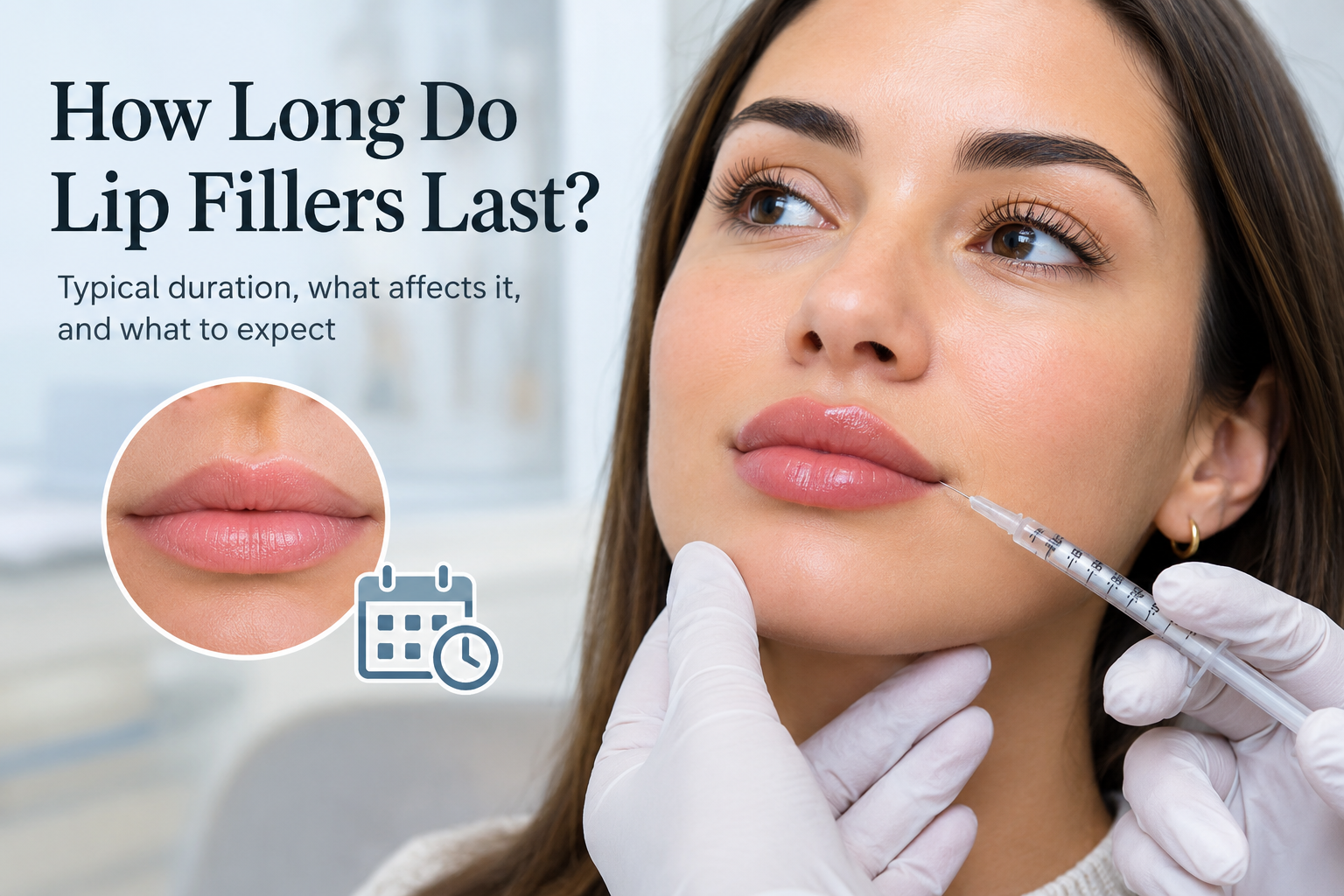
One of the first things people want to know before getting lip filler is simple: how long do lip fillers last?
The honest answer is usually around 6 to 12 months for noticeable lip enhancement, although the exact time varies. Some products can maintain visible results for longer, while some people’s lips lose noticeable volume sooner.
There is another detail that often causes confusion. A filler can still be present in the tissue after the visible effect has started to fade. A 2026 systematic review found that hyaluronic acid fillers can persist in tissue beyond the period when patients notice their original result, depending on the product, injection site and measurement method.
That means “the filler has gone” and “my lips no longer look as full” are not always the same thing.
This guide explains how long do lip fillers last in the UK in 2026, why the answer differs between people, what happens as filler fades, when to consider another treatment, and how to reduce the risk of a poor result.
You will also find information about popular hyaluronic acid fillers, aftercare, cost, top-ups, filler migration, dissolving treatment and UK safety rules.
How Long Do Lip Fillers Last?
Most hyaluronic acid lip fillers provide noticeable cosmetic results for about 6 to 12 months. Some products and patients may see useful results beyond 12 months, but manufacturers often give product-specific claims rather than one universal lifespan.
For example, JUVÉDERM’s UK information says lip treatment results may last up to 12 months. Its UK guidance also explains that the exact duration depends on the product and treatment area.
Restylane Kysse, another hyaluronic acid filler designed for the lips, has clinical information showing aesthetic improvement in a majority of patients at six months, with more than a third still showing improvement at 12 months in one study.
So if you are asking for one number, 6 to 12 months is a useful planning range. It is not a promise.
| Question | Typical answer |
|---|---|
| How long do lip fillers last? | Usually around 6 to 12 months for noticeable results |
| Can results last longer? | Yes. Some people retain noticeable effects beyond 12 months |
| Can results fade sooner? | Yes. Individual metabolism, product, technique and lip movement all matter |
| How long does swelling last? | Usually several days, with the lips continuing to settle over the following weeks |
| When should you judge the final result? | Usually after swelling has settled, rather than immediately after treatment |
| Do you need regular top-ups? | Only if you want to maintain the effect. There is no universal schedule |
Why There Is No Exact Answer to How Long Lip Fillers Last
Lip filler is not like a product with an expiry date inside your lips.
Your body gradually breaks down and clears the hyaluronic acid gel. The speed of that process differs from person to person.
The lips also move constantly. Talking, eating, drinking, smiling and kissing all involve repeated movement of the treated tissue.
The product itself matters too. Different fillers have different gel structures, concentrations and manufacturing methods. They are designed for different tissue properties and treatment goals.
A 2026 systematic review found that filler durability is influenced by factors including manufacturing technology, tissue mobility and anatomy. The review also found evidence of hyaluronic acid persistence at 12 months and beyond in some facial treatment studies.
This is why you should be careful with anyone who says every lip filler treatment lasts exactly six months, exactly one year or exactly two years.
A better question is: what product is being used, where is it being injected, how much is being used, and what does the manufacturer say about its expected duration?
Check Also: 1ml Restylane Kysse Before and After
What Lip Filler Actually Does
Most modern lip fillers use hyaluronic acid, or HA. Hyaluronic acid is a substance naturally found in the body.
When injected into the lips, the gel can add volume, improve definition, change proportions and create a fuller appearance.
It can also be used for more subtle changes.
For example, someone may not want noticeably bigger lips. They may want a sharper Cupid’s bow, better symmetry or slight restoration of volume lost with age.
That distinction matters when discussing longevity.
A treatment designed mainly to improve lip shape may look different as it fades than a treatment designed to create a large increase in volume.
How Long Do Hyaluronic Acid Lip Fillers Last?
Hyaluronic acid lip fillers commonly provide visible results for roughly 6 to 12 months. Some products can last longer, but the lips are a mobile treatment area and results vary.
HA fillers work partly by creating volume and partly by interacting with water in the surrounding tissue. The gel is gradually broken down by the body.
The clinical evidence supports useful improvement for months after treatment. A meta-analysis of HA lip augmentation studies found that the proportion of patients showing increased lip fullness was about 74% at six months and 46% at 12 months.
Those figures do not mean that 46% of people suddenly lose all filler after one year. They show how the proportion of patients meeting a study’s definition of improvement changes over time.
That is an important difference.
Real life is less dramatic than the phrase “it lasts one year” can make it sound.
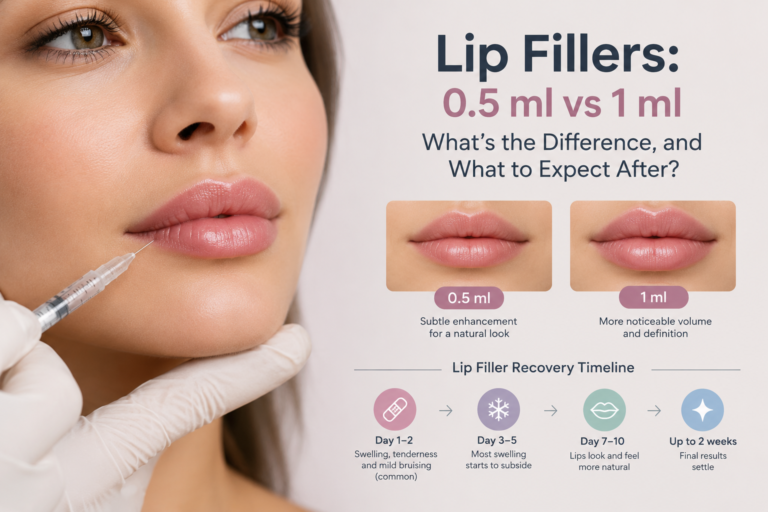
How Long Do 0.5ml Lip Fillers Last?
A 0.5ml lip filler treatment can last around 6 to 12 months, but the smaller amount does not automatically disappear twice as fast.
The amount of filler affects the starting volume, not simply the rate at which your body breaks down the product.
Someone receiving 0.5ml may notice a subtle result that gradually becomes less obvious. Another person receiving the same amount may still notice shape improvement many months later.
There is also a practical issue.
People who choose 0.5ml often want a very natural change. Because the starting effect is subtle, they may decide the filler has “worn off” earlier than someone who had a larger treatment.
The filler may still be present. The visible difference has simply become harder to notice.
How Long Does 1ml Lip Filler Last?
One millilitre of lip filler commonly provides noticeable results for about 6 to 12 months.
One millilitre is a common treatment volume, but it does not suit everyone. Some people need less, especially for a first treatment or subtle correction.
More filler does not automatically mean a longer-lasting result.
Using 1ml instead of 0.5ml can create more volume, but your body still breaks down the product over time. The longevity depends on the filler, tissue, placement, your biology and other factors.
A good practitioner should choose the amount based on your lips and your goal, rather than simply selling you a larger syringe.
How Long Do Lip Fillers Last the First Time?
First-time patients often wonder if their first treatment wears off faster.
There is no reliable rule that says your first lip filler will always disappear sooner.
What can change is your perception of the result.
After seeing fuller lips for several months, you may notice the loss of volume earlier. A gradual change can feel sudden because you have become used to the enhanced shape.
Some people also have small amounts of filler added at later appointments. Over time, this can create a different overall treatment pattern.
That does not mean filler builds up forever. It does mean you should not assume that every appointment should involve another full syringe.
What Makes Lip Filler Last Longer?
There is no proven trick that guarantees longer-lasting lip filler.
The biggest factors are the filler itself, your biology, the treatment area and how the product is placed.
The Filler Product
Different HA fillers are made differently.
Some are designed to create more structure. Others are designed to feel softer and move naturally in areas such as the lips.
The manufacturer may provide clinical data for a particular product and treatment area. That information is more useful than a generic claim that “all fillers last 12 months.”
JUVÉDERM’s UK site, for example, states that lip treatment results may last up to 12 months.
Restylane Kysse’s clinical information reports sustained improvement for at least 24 weeks in most subjects and continued improvement in a proportion of patients at 12 months.
Your Individual Metabolism
People process filler at different rates.
There is no simple blood test that can tell you exactly how long your lip filler will last.
If your previous filler faded quickly, tell your practitioner. That history can help them choose a suitable product and treatment plan.
Lip Movement
The lips are one of the most active areas of the face.
You use them all day.
That constant movement is one reason lip filler generally does not behave like filler placed in a less mobile area.
Injection Technique
Placement matters.
The injector needs to understand lip anatomy, tissue planes, proportions and the product being used.
Good technique is not just about making lips look fuller. It is also about controlling where the product sits.
Incorrect placement can contribute to lumps, asymmetry or an unnatural appearance. Save Face notes that what people call “migration” is sometimes related to poor placement rather than filler simply travelling around the face.
Does Exercise Make Lip Filler Wear Off Faster?
People often hear that intense exercise makes dermal filler disappear faster.
There is not enough good evidence to say that ordinary exercise causes a predictable reduction in lip filler lifespan.
However, strenuous exercise can increase heat, blood flow and swelling shortly after an injection. That is different from proving that exercise permanently speeds up filler breakdown.
For aftercare, follow your practitioner’s instructions. Save Face advises avoiding vigorous exercise and other factors such as strong heat exposure during the early recovery period.
Do not confuse short-term swelling with filler longevity.
Does Smoking Make Lip Filler Wear Off Faster?
Smoking is often discussed as a reason for shorter-lasting filler.
It is better not to present that as a guaranteed rule.
Smoking can affect skin health, healing and circulation, but there is no reliable formula that says a smoker’s lip filler will last a particular number of months less.
If you smoke, tell your practitioner before treatment. It gives them a fuller picture of your health and helps them plan appropriate aftercare.
Does Drinking Water Make Lip Filler Last Longer?
Good hydration is sensible for general health, but drinking large amounts of water will not lock filler in place.
Hyaluronic acid interacts with water, but that does not mean drinking extra water creates a permanent boost in filler volume.
Drink normally and avoid extreme hydration claims made by social media accounts.
Does Massage Make Lip Filler Last Longer?
Do not massage your lips unless your practitioner specifically tells you to.
Some practitioners may recommend gentle massage for a specific lump or placement issue. Others may advise leaving the area alone.
Unnecessary pressure can irritate recently treated tissue.
If you notice a lump, do not try to fix it aggressively yourself. Contact the practitioner who treated you.
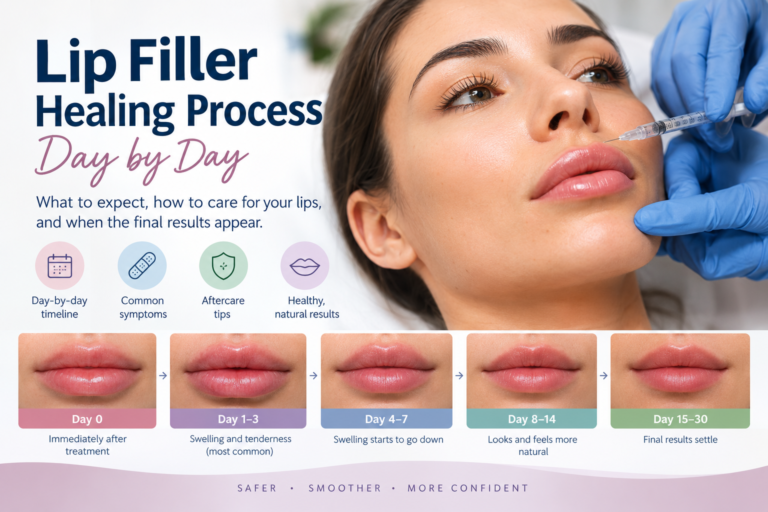
How Long Does Lip Filler Take to Settle?
The immediate appearance is not the final result.
Swelling and bruising are common after lip filler. Save Face says swelling is often more noticeable the next morning, while bruising can take around a week to 10 days to settle and sometimes longer.
Save Face also notes that lips can take around two to three weeks to fully settle after treatment.
That gives you an important rule: do not judge a new lip filler result in the first few hours.
Your lips may look larger than expected because of swelling rather than excessive filler.
They may also look uneven temporarily.
Patience is part of the treatment process.
How Long Does Lip Filler Swelling Last?
Most swelling improves within several days, but the lips can continue settling for one to two weeks or longer.
Individual recovery varies.
Some people have mild swelling and return to normal quickly. Others wake up the next morning with significantly swollen lips.
The first 24 to 48 hours can be the most frustrating because the lips may not look like the result you expected.
Save Face lists redness, swelling, bruising, itching and tenderness among common temporary effects.
If swelling keeps getting worse rather than improving, or if you develop severe pain or unusual skin colour, contact your practitioner urgently.
When Should You Get Lip Filler Topped Up?
Do not automatically book a top-up every six months.
The better approach is to assess whether you still like the result and whether the remaining filler supports your goal.
A top-up may make sense when:
- your lips have visibly lost the volume you wanted;
- your original shape has become less defined;
- you want to maintain a similar result over time;
- your practitioner believes additional filler is appropriate;
- there are no unresolved complications from the previous treatment.
You may not need another treatment simply because six months have passed.
If your lips still look good, waiting can be the better choice.
This is one area where chasing a calendar can lead to over-treatment.
Should You Wait Until Lip Filler Has Completely Gone?
Not necessarily.
Some patients choose a maintenance approach before the original effect has disappeared completely.
Others prefer to wait until most of the visible result has faded.
There is no universal medical rule that everyone must refill their lips at a certain month.
Your practitioner should assess the current tissue rather than treating the date on your calendar.
This matters because repeated injections without enough thought can contribute to unwanted volume, lumps or an appearance you no longer like.
Does Lip Filler Last Longer After Multiple Treatments?
You may hear that lip filler lasts longer after repeated treatments.
This claim needs some care.
Repeated treatment can change the way a person’s lips look over time, especially if there is residual product when another treatment is performed.
But that does not mean the body suddenly stops breaking down hyaluronic acid after several appointments.
A person may simply have some remaining filler plus new filler.
That can make the overall effect appear more persistent.
It is one reason experienced practitioners should keep records of previous products, treatment dates and amounts used.
Can Lip Filler Permanently Stretch Your Lips?
There is a lot of fear online about lips being permanently stretched by filler.
The answer is not as simple as “yes” or “no.”
Temporary HA filler is designed to be gradually broken down. However, repeated overfilling can change how the lips and surrounding tissue look.
If someone repeatedly receives large amounts of filler, the skin may become stretched or the proportions may become less natural.
Save Face notes that people who have had frequent or excessive filler may appear temporarily deflated after dissolving because the tissue has been stretched and needs time to recover.
The safest approach is not to keep adding volume simply because you can.
A good result should still look like your lips.
What Happens When Lip Filler Starts to Wear Off?
It usually fades gradually.
You may notice that your lips look slightly less full in photos. Your lip border may look softer. The shape you liked may become less defined.
You may also notice less hydration or smoothness.
It should not normally disappear overnight.
If your lips suddenly change dramatically, become painful or develop unusual swelling months after treatment, that deserves assessment rather than an assumption that the filler has simply “worn off.”
Can Lip Filler Migrate?
Filler migration is possible, but not every area of fullness above the lip is proof that filler has migrated.
Swelling, anatomy, injection technique and the natural shape of the lip can all affect appearance.
Save Face explains that apparent migration can sometimes actually relate to inexperienced or incorrect placement.
That is why correction should start with an assessment.
Do not automatically ask for more filler to fix an area that may already contain too much product.
Can Lip Filler Be Dissolved?
Most hyaluronic acid fillers can be treated with hyaluronidase, an enzyme that breaks down hyaluronic acid.
This can be useful when a patient dislikes the result or when a medical complication needs urgent treatment.
However, dissolving is not something to treat casually.
Save Face explains that hyaluronidase can be used to dissolve HA filler, including in emergencies involving blood flow problems. It also warns that elective dissolving can cause its own swelling and discomfort.
If you dislike your lips immediately after treatment, do not assume they need dissolving.
Early swelling can make the result look much worse than it will look after healing.
Save Face recommends allowing the lips time to settle before making an elective decision to dissolve filler.
How Long Should You Wait Before Dissolving Lip Filler?
For a non-emergency aesthetic concern, the answer depends on what happened and what your clinician finds.
Swelling needs time to settle before you can fairly judge the result.
Save Face notes that it can take around two to three weeks for lip filler to settle and advises against rushing into elective dissolving simply because the lips look swollen immediately after treatment.
A suspected vascular complication is different.
Severe pain, unusual skin colour or other warning signs require urgent assessment. Do not wait several weeks because you think the filler will naturally disappear.
What Are the Risks of Lip Fillers?
Lip filler is a medical procedure, even though it is often marketed as a quick beauty treatment.
Common short-term effects include swelling, bruising, redness, tenderness and itching. These usually improve with time.
More serious complications are less common but can be significant.
A major concern is vascular occlusion, where filler interferes with blood flow through a blood vessel.
JCCP information warns that vascular problems can cause tissue damage and, in extreme cases, blindness. The organisation identifies the lips and several other facial areas as higher-risk locations for this type of complication.
BAAPS also stresses the importance of using a properly qualified and experienced practitioner who understands facial anatomy and the safety profile of the filler being used.
Warning Signs After Lip Filler
Some swelling and bruising can be normal.
Severe or unusual symptoms are different.
Contact your practitioner urgently if you develop symptoms such as:
- severe or increasing pain;
- skin that becomes unusually pale, white, blue or dark;
- rapidly worsening swelling;
- significant changes in skin temperature;
- visual changes;
- symptoms that your practitioner told you could indicate a vascular problem.
Do not rely on a social media group for urgent medical advice.
Your injector should give you an emergency contact number before treatment. JCCP specifically advises patients to have an emergency contact available after dermal filler treatment.
Who Should Avoid or Delay Lip Filler?
Whether lip filler is appropriate depends on your health, medical history, current medications and the reason for treatment.
Tell your practitioner about previous filler, allergies, cold sores, medicines, medical conditions and any planned dental or cosmetic treatment.
Cold sores deserve special attention.
Save Face advises people with a history of cold sores to tell their clinician before lip filler because injections can trigger the virus.
Pregnancy and breastfeeding also require a separate discussion with a healthcare professional. Do not assume that a cosmetic clinic’s social media post is enough to establish whether treatment is appropriate for you.
Is Lip Filler Legal for Under-18s in the UK?
In England, cosmetic dermal fillers cannot legally be provided to people under 18.
The Botulinum Toxin and Cosmetic Fillers (Children) Act 2021 made cosmetic fillers and botulinum toxin injections for under-18s unlawful in England. The rules apply to cosmetic treatment, not medically indicated treatment.
Do not treat age rules as a minor detail when comparing clinics.
If you are under 18 and someone offers cosmetic lip filler in England, that should be treated as a major warning sign.
UK Rules Around Lip Fillers in 2026
The rules around non-surgical cosmetic treatment differ across the UK, so the phrase “UK rules” needs some care.
In England, dermal fillers do not generally have the same prescription-only status as medicines such as botulinum toxin. The NHS advises patients to ask what product is being used, where it came from, and what qualifications, training and experience the practitioner has.
England is also considering stronger restrictions on certain non-surgical cosmetic procedures. The government’s consultation says some higher-risk procedures should be restricted to suitably qualified and regulated healthcare professionals.
Scotland has also moved forward with legislation covering non-surgical procedures. The 2026 Scottish legislation includes injectable cosmetic procedures within its specified non-surgical procedures, although different parts of the Act have different commencement dates.
That means patients should check the rules that apply in their nation rather than relying on advice written years ago.
How to Choose a Lip Filler Practitioner in the UK
Choose the practitioner based on training, anatomy knowledge and complication management, not just price.
The NHS advises patients to research the practitioner, ask about the product and check qualifications. It also points people towards organisations including JCCP and Save Face when checking practitioners.
Before booking, ask:
- What is your professional qualification?
- What training have you completed in dermal fillers?
- How often do you perform lip filler?
- What product will you use?
- Can I see the sealed product before treatment?
- What happens if I develop a complication?
- Do you have an emergency plan for vascular occlusion?
- Who should I contact outside normal clinic hours?
- What happens if I dislike the result?
- Is a follow-up appointment included?
The NHS also advises against paying before a proper consultation and warns people to be cautious about group treatments, alcohol-linked events, mobile services and practitioners who only advertise through social media.
How Much Does Lip Filler Cost in the UK in 2026?
There is no single official UK price for lip filler.
Prices vary by location, practitioner, product, treatment amount and clinic setting.
Published UK 2026 pricing guides commonly place lip filler around £200 to £450 per treatment or syringe, although prices outside that range exist. One 2026 UK price review found published one-millilitre lip filler prices ranging from £170 to £430 across a selection of providers.
These figures are useful for budgeting, not for deciding whether a practitioner is safe.
| Factor | Why it can change the price |
|---|---|
| Location | London and major city clinics may charge more |
| Practitioner | Experience, qualifications and clinical setting affect fees |
| Product | Different filler brands and formulations have different costs |
| Amount | 0.5ml and 1ml treatments may be priced differently |
| Consultation | Some clinics charge separately or include it in treatment |
| Aftercare | Follow-up appointments may be included or charged separately |
Do not choose a clinic solely because it is the cheapest.
A low price can be attractive, but it does not tell you who is injecting the filler or what emergency support is available.
What Should Be Included in the Price?
Ask what the advertised price actually covers.
A £200 treatment may sound cheaper than a £300 treatment until you discover that the first price excludes the consultation and follow-up.
Ask whether the fee includes:
- the consultation;
- the filler product;
- the injection procedure;
- aftercare advice;
- a review appointment;
- emergency support;
- any correction policy.
The NHS recommends understanding all costs, including future procedures that may be needed to maintain the result.
How Long Do Different Lip Filler Brands Last?
Brand names should not be treated as guarantees.
Even within one brand, different products can have different characteristics.
JUVÉDERM
JUVÉDERM’s UK information states that lip treatment results may last up to 12 months. Its range includes products designed for lip enhancement and definition.
That “up to” wording matters.
It does not mean every patient will have the same result for exactly 12 months.
Restylane Kysse
Restylane Kysse is a hyaluronic acid filler specifically designed for the lips.
Galderma’s clinical information reports aesthetic improvement in at least 24 weeks in most subjects, with more than 39% of subjects showing improvement in both lips at month 12 in one clinical study.
Again, this is clinical study information, not a personal guarantee.
Other Hyaluronic Acid Fillers
Other HA products can have different expected durations.
Do not assume that a filler advertised for a cheek, jawline or chin will have the same performance in the lips.
The lips move more than many other facial areas. The product therefore needs to be suitable for the tissue and the intended result.
Does More Lip Filler Make It Last Longer?
Adding more filler is not a reliable way to extend the lifespan of your treatment.
It may create more volume, but that is different from making the product last longer.
Large amounts can also increase the risk of an overfilled appearance, lumps or unwanted changes in lip shape.
The best treatment plan is usually based on the smallest amount that achieves the desired result safely.
That does not mean everyone should receive tiny amounts. It means volume should match anatomy and the patient’s goal.
How Long Do Lip Fillers Last Compared With a Lip Flip?
A lip flip and lip filler are different treatments.
Lip filler adds material to the lip area. A lip flip uses botulinum toxin to reduce activity in selected muscles around the upper lip.
Because they work differently, their duration is different too.
A lip flip usually needs more frequent maintenance than HA lip filler.
Do not choose between them based only on longevity. Choose based on the change you actually want.
Can You Make Lip Fillers Last Longer?
There is no reliable home treatment that can guarantee a longer-lasting filler result.
The sensible approach is to protect the treated area during early healing and maintain general skin health.
After treatment:
- follow your practitioner’s aftercare instructions;
- avoid unnecessary pressure or massage;
- avoid activities your practitioner tells you to avoid during early recovery;
- protect your skin from excessive sun exposure;
- do not inject additional filler simply because you think the first treatment has faded too quickly;
- keep records of the product, amount and treatment date.
Save Face advises avoiding alcohol, vigorous exercise, sun exposure, sunbeds and saunas during the early recovery period, according to the specific advice given by your practitioner.
What If Your Lip Filler Does Not Last as Long as Expected?
Start by checking what “not lasting” actually means.
If the lips looked fuller for two months and then returned close to baseline, tell your practitioner.
Ask what product was used and what its expected duration is for lip treatment.
Also ask whether the original swelling made the early result look larger than the actual filler effect.
Sometimes the issue is not rapid breakdown.
The initial result may have included substantial swelling, making the later settled result seem much smaller.
Photographs taken at the same angle and lighting can help you compare changes more fairly.
Should You Get a Top-Up at Two Weeks?
A two-week review can be useful, but it should not automatically mean another injection.
JUVÉDERM’s UK information says a practitioner may suggest a follow-up appointment around two weeks after treatment.
The purpose of a review is to assess the settled result.
If there is a small asymmetry or an area that needs refinement, the practitioner can decide whether a small adjustment makes sense.
Do not treat a review as a sales appointment.
Common Mistakes That Can Shorten Your Satisfaction With Lip Filler
Some problems have nothing to do with how fast your body breaks down the filler.
Judging the Result Too Early
Swelling can make the lips look much bigger than the final result.
Give them time to settle.
Choosing a Clinic by Price Alone
A cheaper treatment is not automatically a better deal.
Ask what qualifications, product, aftercare and emergency support come with the price.
Adding More Filler Too Soon
Repeated injections before the previous result has settled can make it harder to judge the amount you actually need.
Changing Practitioners Without Sharing Your Treatment History
If you have had filler elsewhere, tell your new practitioner.
Give them the brand, approximate amount and date if you know them.
Using Unregulated or Unknown Products
Ask to see the product packaging and find out what is being injected.
The NHS specifically recommends asking the practitioner about the name and source of the product.
Following Social Media Advice Instead of Clinical Advice
Online before-and-after photographs can be useful for understanding style, but they cannot tell you whether a treatment is appropriate for your anatomy.
The NHS warns people to take extra care with cosmetic procedures advertised through social media.
How to Get a More Natural Lip Filler Result
Start with the shape you want, not the syringe size.
Show your practitioner what you like about your current lips.
Then explain what you would change.
You may want more upper-lip definition without much extra volume.
You may want the lower lip to remain dominant.
You may want better symmetry.
Or you may want a noticeable increase in fullness.
These are different treatment goals.
A good practitioner should discuss proportions rather than simply asking how many millilitres you want.
What to Ask at Your Consultation
Use the consultation to find out exactly what you are paying for and what could happen if something goes wrong.
- What type of filler are you recommending?
- Why is that product suitable for my lips?
- How much filler do you recommend?
- What result should I expect after swelling settles?
- How long do you expect the result to last?
- What are the common side effects?
- What are the serious complications?
- How would you manage a vascular occlusion?
- Who can I contact after treatment?
- When will you review the result?
- What is included in the price?
If the practitioner rushes these questions, walk away.
You are not buying a haircut. You are agreeing to an injection into a sensitive and highly vascular part of the face.
How to Prepare for Lip Filler
Your practitioner should give you specific preparation advice based on your health and treatment.
Tell them about medicines and supplements that may affect bleeding or bruising.
Also mention previous filler, cold sores and other relevant medical history.
Save Face advises avoiding alcohol around treatment because it can increase bruising risk and recommends telling the clinician about medicines or supplements that may affect bleeding.
Do not stop prescribed medicines on your own.
If a medication needs to be changed, speak with the clinician who prescribed it.
How Long Do Lip Fillers Last If You Have Thin Lips?
Thin lips do not automatically mean the filler will disappear faster.
However, the visible effect can be different.
A small amount of filler can create a noticeable change in a thin lip because there is less existing volume to begin with.
That means the treatment may look very natural at first but seem less obvious as the filler settles and gradually breaks down.
Thin lips also require careful planning because simply adding more product is not always the best way to create a balanced result.
Definition, projection, upper-to-lower lip ratio and the relationship between the lips and surrounding face all matter.
How Long Do Lip Fillers Last as You Get Older?
Age does not create one fixed filler lifespan.
Older lips may have different skin quality, volume loss and structural changes. The treatment goal may also change.
Someone in their 20s may want more definition or volume.
Someone in their 40s, 50s or 60s may be more interested in restoring age-related volume and improving lip shape.
The filler still breaks down gradually, but the way the result looks as it fades can differ because the underlying tissue has changed.
That is why an older patient should not simply copy the amount used on a younger person.
Can Lip Filler Improve Lip Lines?
Sometimes, but filler is not a universal solution for every line around the mouth.
Fine vertical lines above the upper lip can have several causes, including age-related changes and repeated movement.
A practitioner may recommend a different approach or a combination of treatments rather than filling every line directly.
JUVÉDERM and Restylane products have been studied for lip and perioral concerns, but the correct product and technique depend on the treatment goal.
If the main problem is skin texture rather than lost volume, more filler may not solve it.
What the Research Says About Lip Filler Longevity
The research is useful because it shows why simple marketing claims can be misleading.
A 2021 meta-analysis found that HA lip augmentation produced increased fullness in a large proportion of patients. Its pooled results showed about 91% of participants had increased lip fullness at two months, around 74% at six months and around 46% at 12 months.
A 2026 systematic review of HA fillers across facial treatment areas found measurable filler persistence at 12 months and, in some studies, at 24 months or longer. The review also stressed that durability depends on the product, tissue mobility and anatomy.
These findings do not mean that every lip filler lasts two years.
They show something more useful: visible cosmetic effect and detectable filler are not the same measurement.
A person may stop seeing the same level of fullness before every trace of filler has disappeared.
Are Lip Fillers Safe?
Hyaluronic acid lip fillers have a substantial clinical history, but no injectable cosmetic treatment is risk-free.
A 2026 systematic review and meta-analysis of randomised trials found that swelling, firmness, bruising and tenderness were common reported adverse events. Serious adverse events were much less common, but the authors still identified serious events requiring treatment or follow-up.
This is why “non-surgical” should never be confused with “risk-free.”
The most important safety decision you control is who performs the treatment.
The NHS advises choosing a reputable, qualified practitioner with appropriate training and insurance.
Why the Practitioner Matters More Than the Syringe Size
Two people can receive the same 1ml filler and have completely different results.
The product is only one part of the equation.
Placement, depth, injection technique, anatomy, treatment planning and complication management all affect the outcome.
A skilled injector may also tell you that you do not need as much filler as you expected.
That is a good sign.
The NHS recommends asking about the practitioner’s qualifications, training, experience and the source of the product before treatment.
Who Are Lip Fillers Suitable For?
Lip filler may suit an adult who wants a measured change in lip volume, definition or symmetry and understands the risks.
The goal should be realistic.
You should also be comfortable with the fact that the result is temporary.
If you already feel pressure to keep increasing your lip size, pause before booking another treatment.
Cosmetic treatment should not become a cycle where every small change feels like a problem that needs another injection.
The NHS recommends thinking carefully about why you want a cosmetic procedure and whether your expectations are realistic before going ahead.
Who Should Be More Cautious?
Anyone with a history of significant reactions to filler, certain medical conditions, active infection around the mouth or unrealistic expectations should have a detailed consultation before treatment.
People with recurrent cold sores should tell the practitioner before lip injections.
People who are pregnant or breastfeeding should discuss cosmetic treatment with an appropriate healthcare professional rather than relying on generic online advice.
If you are considering filler because you feel intense pressure about your appearance, take time before booking.
The NHS advises people to consider their reasons, expectations and emotional wellbeing before cosmetic treatment.
How Often Should You Get Lip Filler?
There is no universal six-month rule.
Some people return around six months. Others wait nine or 12 months. Some go longer.
The right time depends on how much of the original effect remains and whether you still want the same look.
Think of lip filler as maintenance by assessment, not maintenance by alarm clock.
If the result still looks good, you may not need another appointment.
What Happens If You Stop Getting Lip Filler?
Your lips will gradually move back toward their untreated appearance as the filler effect fades.
They do not normally become permanently smaller simply because you stopped treatment.
However, your natural lips may have changed during the time you were receiving filler.
Ageing continues.
Skin and tissue volume naturally change over time.
So your lips may not look exactly as they did years earlier, but that is not the same as filler causing permanent shrinkage.
Can You Get Lip Filler Every Six Months?
You can discuss six-month maintenance with a qualified practitioner, but frequency should depend on your actual result.
Repeated treatment without proper assessment can lead to unnecessary filler use.
If you still have substantial volume, another full syringe may not be appropriate.
A good clinician should examine your lips and recommend the amount, if any, that makes sense.
How to Track Your Lip Filler Results
Take clear photographs.
Use the same lighting, distance, facial expression and camera angle each time.
Take one set before treatment, another after swelling has settled and later photographs as the result fades.
Keep a simple record of:
- treatment date;
- product name;
- amount used;
- injection areas;
- how long swelling lasted;
- when you first noticed fading;
- when you decided another treatment was needed.
This information can be more useful than guessing from memory.
How Long Do Lip Fillers Last Before a Wedding or Major Event?
Do not schedule your first lip filler immediately before a major event.
Swelling and bruising can be unpredictable.
Save Face notes that bruising may take around a week to 10 days to resolve and sometimes longer.
The exact timing should be discussed with your practitioner, but allowing enough recovery time is sensible.
A first treatment should never be treated like a last-minute beauty appointment.
What If Your Lips Look Too Big After Treatment?
Wait before panicking.
Early swelling can make the lips look significantly larger than the final result.
Do not squeeze, massage or attempt to remove the filler yourself.
Contact your practitioner if you are worried.
If you have severe pain, unusual skin colour or visual symptoms, seek urgent medical assessment rather than waiting for normal swelling to settle.
What If Your Lip Filler Looks Uneven?
Mild unevenness can happen while swelling settles.
The two sides of your lips do not always swell at exactly the same rate.
Give the tissue time to settle unless you have warning signs.
If the asymmetry remains after healing, your practitioner can assess whether it is caused by remaining filler, natural anatomy or another issue.
Do not automatically add more filler to the smaller side.
What If Your Lip Filler Feels Hard?
Some firmness can occur after injection and may improve as the tissue settles.
Persistent hard lumps should be assessed by your practitioner.
Do not attempt forceful massage unless you have been specifically instructed to do so.
Persistent swelling, pain, redness or a lump that concerns you deserves professional review.
How to Compare Clinics Before Booking
Price should be one of the last things you compare.
Start with safety.
| Check | What you want to see |
|---|---|
| Practitioner | Appropriate professional registration, training and experience |
| Consultation | A proper discussion before treatment |
| Product | Clear product name, source and packaging |
| Emergency plan | Clear management process for serious complications |
| Aftercare | Written advice and a way to contact the clinic |
| Follow-up | A clear review plan |
| Pricing | A clear explanation of what the fee includes |
The NHS recommends checking qualifications and avoiding practitioners who rely only on social media advertising.
Where to Find UK Practitioner Information
The NHS lists several professional organisations that can help patients check practitioner credentials and training. These include the NHS guidance on choosing a cosmetic procedure practitioner, JCCP and Save Face.
You can also read Save Face information about dermal fillers before booking. It explains common side effects, safety concerns and aftercare.
For broader cosmetic safety advice, the NHS recommends researching the procedure, asking about risks and taking time before deciding.
The Most Useful Answer to “How Long Do Lip Fillers Last?”
If you want a simple number, plan around 6 to 12 months of noticeable lip enhancement.
Do not treat that as an expiry date.
Some people see the effect fade earlier. Others still notice a difference after a year. Some HA filler can remain detectable in tissue after the visible cosmetic effect has reduced.
The product, injection technique, anatomy, tissue movement and your individual biology all matter.
The safest way to plan maintenance is to judge your actual result, not follow a fixed six-month schedule.
Frequently Asked Questions About How Long Do Lip Fillers Last
How long do lip fillers last?
Most hyaluronic acid lip fillers provide noticeable cosmetic results for around 6 to 12 months. Some people see useful effects beyond 12 months, while others notice fading sooner. Product choice, anatomy, tissue movement and individual biology all affect longevity.
How long does 1ml lip filler last?
One millilitre of lip filler commonly provides noticeable results for around 6 to 12 months. The amount used affects the starting volume but does not guarantee a longer lifespan. Your product and individual response matter more than the syringe size alone.
How long does 0.5ml lip filler last?
A 0.5ml lip filler treatment can provide noticeable results for around 6 to 12 months. Because the starting change is smaller, the result may become less noticeable sooner even when some filler remains in the tissue.
Do lip fillers last longer the more you get?
Not necessarily. A larger amount can create more volume, but it does not guarantee slower breakdown. Repeated treatments can also leave some residual product, making the overall effect appear more persistent.
How long does lip filler swelling last?
Swelling often improves within several days, but lips can continue settling for one to two weeks or longer. Bruising may last around a week to 10 days and sometimes longer. Contact your practitioner if swelling is severe, worsening or accompanied by unusual symptoms.
When should you top up lip filler?
There is no universal top-up date. Many people consider treatment again when the visible effect has reduced significantly. Your practitioner should assess the remaining filler and your desired result before recommending more product.
Can lip filler last longer than 12 months?
Yes. Some people continue to notice an effect beyond 12 months. Clinical studies and imaging research also show that hyaluronic acid can remain detectable in tissue beyond the period when the original cosmetic effect is most obvious.
Can lip filler be dissolved?
Most hyaluronic acid fillers can be dissolved with hyaluronidase. The treatment can be useful for unwanted results or medical complications. Elective dissolving should be discussed with a qualified clinician because the process can cause swelling and discomfort and is not risk-free.
Does exercise make lip filler disappear faster?
There is no reliable evidence that ordinary exercise causes a predictable reduction in lip filler lifespan. Vigorous exercise can increase early swelling, so practitioners commonly advise limiting strenuous activity during the initial recovery period.
How much does lip filler cost in the UK in 2026?
Published UK 2026 pricing commonly places lip filler around £200 to £450 per treatment or syringe, although prices vary widely. London and premium clinics can charge more. Price depends on the practitioner, product, amount used and what the treatment fee includes.
Are lip fillers safe?
Hyaluronic acid lip fillers have substantial clinical evidence, but they are not risk-free. Common effects include swelling, bruising and tenderness. Rare but serious complications can include vascular occlusion, which requires prompt treatment. Choosing a properly trained practitioner with a clear emergency plan is essential.
What should I do if my lips look too big after filler?
Give the lips time to settle because early swelling can make them look much larger than the final result. Do not massage or attempt to remove the filler yourself. Contact your practitioner if you are concerned, and seek urgent help for severe pain, unusual skin colour or visual symptoms.