Book Appointment Now
Lip Filler Healing Process Day by Day: 2026 Timeline & Recovery Guide
Lip Filler Healing Process Day by Day: Complete Recovery Timeline and Aftercare Guide
You glance in the mirror on morning two, and panic sets in. Your top lip feels stiff, the vermilion border looks exaggerated, and one side sits noticeably higher than the other. Before you contact your injector demanding emergency hyaluronidase, take a breath. What you are looking at is not your final result; it is the inflammatory peak of your body responding to micro-trauma and an intensely water-binding substance.
Every year, hundreds of thousands of people undergo lip augmentation with hyaluronic acid dermal fillers. Yet, despite how common the procedure has become, post-treatment anxiety remains remarkably consistent. The gap between clinic marketing photos—frequently taken immediately after injection while lidocaine causes mild blanching or filtered weeks later—and the gritty, swollen reality of the first forty-eight hours causes unnecessary distress. Understanding the lip filler healing process day by day transforms that anxiety into predictable, manageable steps.
Healing is neither instantaneous nor perfectly symmetrical. Hyaluronic acid (HA) does not simply sit inertly in tissue; it integrates into mucosal architecture, draws in systemic water, and triggers a localized wound-healing cascade. Whether you received 0.5 ml of a soft gel for subtle hydration or a full syringe structured for projection, knowing what should happen on day one, day four, and day fourteen gives you control over your recovery.
The Lip Filler Healing Timeline: Summary Overview
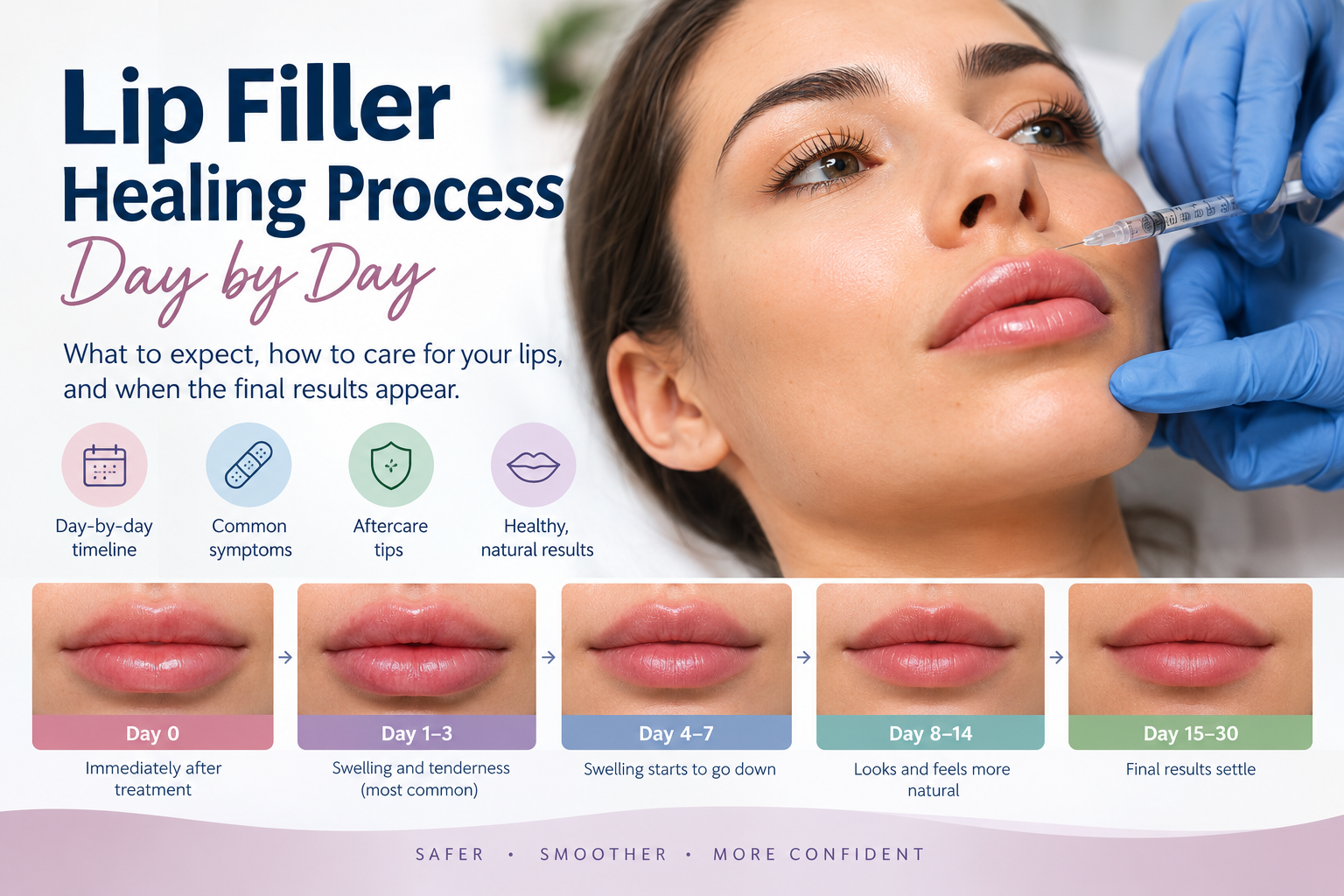
The standard lip filler healing process day by day spans roughly two to three full weeks, progressing from acute inflammation to mechanical tissue integration.
| Stage | Primary Symptoms | What Is Happening Under the Skin | Primary Action Required |
|---|---|---|---|
| Day 0 (0–12 Hours) | Pinprick bleeding, mild erythema, localized tenderness, early numbness wearing off. | Mechanical puncture trauma; dermal injury activates histamine release; filler sits in boluses or threads. | Keep area clean; avoid touching; use cold compress intermittently; sleep elevated. |
| Days 1–3 | Peak swelling, firm lumps, asymmetrical distortion, purpura (bruising), tightness. | Inflammatory response peaks; HA draws local interstitial fluid via hydrophilic osmotic pull. | Cold compress (10 min on/off); Arnica montana/bromelain; strictly avoid heat, alcohol, and vigorous workouts. |
| Days 4–7 | Swelling recedes 40–60%; bruises turn yellow-green; firm nodules soften into pliable tissue. | Macrophage activity clears cellular debris; acute edema drains through lymphatic channels. | Switch from ice to gentle warm compresses if bruising lingers; hydrate orally; keep lips moisturized. |
| Days 8–13 | Residual asymmetry balances; surface feels smooth; baseline sensation fully returns. | Hydrodynamic equilibrium established; filler integrates with host collagen fibrils. | Resume regular facial treatments; assess genuine volume rather than fluid retention. |
| Day 14+ | Final aesthetic result; soft, natural tissue mobility; complete resolution of edema. | Full histophysiological tissue integration; capsular tissue micro-stabilization. | Attend routine 2-week follow-up; evaluate if touch-up or targeted correction is necessary. |
How Hyaluronic Acid Fillers Behave in Lip Tissue
To understand why your lips swell and distort after treatment, it helps to understand what hyaluronic acid actually does beneath the surface. Hyaluronic acid is an anionic, nonsulfated glycosaminoglycan distributed widely throughout connective tissue. In cosmetic medicine, brands such as Juvéderm, Restylane, Belotero, and Teosyal use synthetically cross-linked variations of bacterial-derived HA to resist immediate enzymatic degradation by endogenous hyaluronidase.
The lips are distinct from almost every other facial feature. They lack sebaceous glands, contain an ultra-thin stratum corneum (the vermilion border), and feature dense vascular and neural networks driven by the superior and inferior labial arteries. When an injector slides a 30-gauge needle or a blunt cannula through the orbicularis oris muscle, two distinct physiological processes occur simultaneously:
- Mechanical trauma and inflammatory cascade: The entry punctures lacerate micro-capillaries, triggering immediate platelet aggregation, clotting, and the release of pro-inflammatory cytokines such as histamine, bradykinin, and prostaglandins. This reaction causes vasodilation and leaks fluid into extracellular space, generating physical edema (swelling) and purpura (bruising).
- Hygroscopic water absorption: Hyaluronic acid molecules are exceptionally hydrophilic. A single gram of cross-linked HA can hold up to six liters of water. Once deposited into the submucosal or intramuscular plane, the gel acts like an invisible sponge, pulling water out of surrounding tissues and systemic circulation over the first 72 to 96 hours.
This dynamic means that during the first few days, up to 30 to 50 percent of the lip volume you see in the mirror is fluid swelling and water retention, not cross-linked filler. According to post-market surveillance data highlighted by the U.S. Food and Drug Administration (FDA), transient swelling and localized tenderness occur in more than 85 percent of soft-tissue filler patients. It is an expected biological reaction, not an adverse event.
Day-by-Day Lip Filler Healing Timeline
Day 0: The First 12 Hours Post-Injection
The appointment ends, the injector cleans your lips with chlorhexidine or alcohol, and you hand over your credit card. In this initial window, your lips often look full, defined, and surprisingly shapely. This early phase is deceptive.
Within two to four hours, the local anesthetic (usually lidocaine mixed directly into the syringe or delivered via a dental nerve block) wears off. As sensation returns, you will feel a dull, throbbing ache and a sensation of physical stretching. The puncture sites will show up as small red pinpricks, occasionally with tiny dark crusts where bleeding stopped.
Swelling begins rapidly by evening. As your body recognizes mechanical punctures, local capillaries widen. If the injector used a needle rather than a cannula, each injection point carries its own micro-zone of tissue disruption. By the time you head to bed, your lips will feel significantly tighter and warmer than they felt leaving the clinic chair.
Primary tasks for Day 0:
- Apply an ice pack wrapped in a clean paper towel for 10 minutes at a time to blunt early histamine release. Never place bare ice directly against your skin.
- Sleep with your head elevated on two pillows. Gravity is your ally; sleeping flat allows hydrostatic pressure to accumulate in facial tissues overnight.
- Avoid touching your mouth. The puncture wounds are open pathways for bacteria during the first 6 to 12 hours.
Days 1 to 2: The Peak Swelling Stage
Morning one is when post-injection regret typically strikes. You wake up, look in the mirror, and see lips that appear disproportionate, rigid, and occasionally duck-like. This is the physiological peak of acute edema.
Between 18 and 48 hours, swelling reaches maximum intensity. Because human tissue rarely swells symmetrically, one side of your upper lip or a single oral commissure may look double the size of the opposite side. The philtral columns may appear flattened, and the upper lip can project outward past the nasal tip when viewed in profile. This is not poor technique or overfilling; it is an uneven accumulation of interstitial fluid combined with the filler’s initial water uptake.
Bruising becomes apparent during this window. Blood that seeped from injured micro-vessels oxidizes within the extracellular matrix, shifting from dark red to deep purple and blue. If your injector used serial puncture techniques across the lip border, you may develop a line of bruising that resembles dark lip liner.
Tenderness peaks alongside the swelling. Smiling, chewing solid food, yawning, and speaking can feel stiff and uncomfortable. The lips may feel firm or rubbery, and small, distinct nodules can be felt if you press your tongue against the inner mucosa.
Here is where many patients make a costly mistake: they panic and begin firmly pressing, squeezing, or massaging these firm lumps. Unless your injector gave you explicit, written instructions to massage a specific spot, leave the area alone. Hyaluronic acid gels are malleable during the first 72 hours. Aggressive manual manipulation can displace the product from the vermilion border into the cutaneous lip (causing filler migration) or turn localized edema into prolonged inflammation.
Day 3: The Turning Point
By day three, acute inflammation shifts toward tissue stabilization. While your lips will still look noticeably augmented and fuller than your baseline, the explosive swelling of days one and two begins to recede.
The intense throbbing subsides into mild tenderness that only surfaces when you apply pressure. The skin begins to adapt to the volume expansion, reducing that drum-tight sensation. Bruises typically begin their natural chromic shift, evolving from deep purple toward dark blue or brownish-red as macrophages clear extravasated red blood cells.
You will likely still notice asymmetry on day three. Remember that the side of your body that receives more injections, sits closer to a damaged vein, or sleeps pressed against a pillow will hold onto fluid longer. Do not judge your final lip balance on day three.
Days 4 to 7: The Deswelling Phase
The period between day four and the end of week one brings the most visible structural changes. Over these three days, swelling drops significantly—often decreasing by 40 to 60 percent compared to peak levels.
As inflammatory fluid clears through the facial lymphatic system, the underlying structure crafted by your injector becomes visible. The initial artificial projection softens into more natural contours. You will regain normal articulation and expression; drinking from open glasses feels natural again, and laughing no longer feels like you might stretch the skin to its limit.
Bruises turn yellowish-green during this phase as hemoglobin breaks down into biliverdin and bilirubin. Many patients experience localized surface flaking or peeling around day five or six. This occurs because the rapid stretching of the delicate vermilion skin temporarily disrupts epidermal barrier function, causing transepidermal water loss. A medical-grade petrolatum-based ointment will resolve this within days.
Firm nodules also begin to soften. The filler starts integrating with surrounding collagen bundles, shifting from an isolated gel deposit to a coherent component of your submucosal tissue.
Days 8 to 13: Tissue Integration and Refinement
Entering the second week, your lips enter the stage of hydrodynamic equilibrium. Hyaluronic acid has pulled in its stable volume of water, and the body’s acute wound-healing process has resolved.
Any remaining discoloration at this stage is usually faint yellow shadowing that is easily concealed with lip balm or lipstick. The persistent lumps that felt like small peas under the mucosa during week one have largely softened into pliable, natural-feeling tissue. If you run your tongue along the inside of your lip, it should feel uniform rather than segmented.
Interestingly, some patients experience mild psychological disappointment during this week—a phenomenon clinicians call “swelling blind.” Having grown accustomed to the dramatic, inflated volume of days one through three, the emergence of the true, subtle result can make them feel as if the filler disappeared entirely. In reality, what vanished was edema, leaving behind the precise volume of cross-linked hyaluronic acid placed during your appointment.
Day 14+: The Final Settled Result
Two weeks marks the clinical finish line for filler integration. The European and American dermatological guidelines establish 14 days as the earliest interval to accurately evaluate treatment outcomes.
At day fourteen:
- Edema has completely cleared.
- Micro-vessels have healed, and bruising is fully resolved.
- The product has reached its final viscosity and elastic modulus (G’) inside the host tissue.
- Natural mucosal movement, sensation, and softness are fully restored.
If true structural asymmetry, overfilling, or genuine nodule formation persists at day fourteen, this represents the product’s actual placement rather than temporary healing artifacts. This is the exact moment to attend a follow-up review with your injector. If a small area requires micro-adjustment, a fractional dose can be added, or a persistent bead can be dissolved with targeted hyaluronidase. Touching up before day 14 is a clinical mistake, as injectors risk adding product over residual swelling.
Bruising and Swelling Patterns: What Is Normal vs. Abnormal
Because lip tissue is soft, vascular, and mobile, it bruises and swells more dramatically than anywhere else on the face. However, there is a clear distinction between expected recovery reactions and genuine medical emergencies.
| Symptom Category | Expected Normal Recovery | Concerning (Contact Injector) | Medical Emergency (Immediate Intervention) |
|---|---|---|---|
| Pain Level | Dull ache, tenderness when touching; manageable with cold packs. Peaks within 36 hours. | Pain increasing in severity after 48 hours; throbbing that prevents sleep. | Severe, escalating, unremitting pain radiating across the jaw, nose, or cheek within minutes to hours. |
| Skin Color & Tissue Appearance | Erythema (redness), blue or dark purple localized bruising, fading to yellow-green. | Spreading red rash, localized warmth, pustules along puncture lines. | Blanching (stark white, grayish skin), reticulated livedoid pattern (mottled purple fishnet look). |
| Symmetry & Structure | One side noticeably larger during days 1–4 due to uneven fluid drainage. | Hard, discrete, visible nodule that remains tender past day 10. | Rapid, ballooning unilateral swelling accompanied by skin cool to the touch. |
| Skin Surface Integrity | Dryness, mild surface peeling, small pinprick scabbing. | Cluster of tingling blisters resembling a severe herpes simplex outbreak. | Tissue breakdown, skin ulceration, or dark, necrotic surface erosion. |
Understanding Vascular Occlusion: The Red-Flag Event
The most critical complication in aesthetic medicine is a vascular occlusion (VO). This occurs when an injector accidentally places filler directly into an artery—specifically the superior or inferior labial artery—or deposits so much product adjacent to a vessel that external compression cuts off arterial blood supply to the tissue.
Tissue deprivation begins immediately when an artery is compromised. If untreated, vascular occlusion progresses to full-thickness skin necrosis, scarring, and permanent structural deformity. While rare—occurring in an estimated 1 in 5,000 to 1 in 10,000 facial injections according to aesthetic safety literature—recognizing early warning signs is vital.
The hallmark of a vascular occlusion is blanching. The skin supplied by the blocked vessel immediately loses blood supply and turns a chalky, pale white or gray. Within hours, this transforms into a distinct livedo reticularis pattern: a dull, purple-gray mottled net-like discoloration that looks entirely different from a localized, circular bruise. Crucially, a vascular occlusion is almost always accompanied by severe, disproportionate, throbbing pain that worsens rather than improves over time.
If you observe chalky white skin, mottled purple webs spreading away from your lips, or severe pain within hours of leaving the clinic, contact your injector immediately or proceed to an emergency department. Reversing an occlusion requires rapid infiltration of high-dose reconstituted hyaluronidase to dissolve the blockage and restore micro-vascular perfusion.
Aftercare Protocol: How to Protect Your Investment
What you do outside the clinic walls directly influences your rate of swelling, bruising severity, and product longevity. Approaching your aftercare systematically avoids unnecessary complications.
The First 48 Hours: The Critical Rules
- Thermal control: Avoid all forms of extreme heat. Saunas, steam rooms, hot yoga, scalding showers, and direct sun exposure dilate facial blood vessels, significantly worsening edema and prolonging bruising.
- Physical exertion: Skip high-intensity cardiovascular training and heavy weightlifting for at least 48 hours. Elevated heart rates and spikes in blood pressure drive fluid straight into freshly traumatized oral tissue. Light walking is completely acceptable.
- Chemical irritants: Do not consume alcohol for 24 to 48 hours post-procedure. Alcohol acts as a systemic peripheral vasodilator and mild anticoagulant, making bruises spread deeper and linger longer. Avoid high-sodium meals during this window, as excess dietary sodium exacerbates the osmotic water-drawing property of hyaluronic acid.
- Mechanical stability: Do not use drinking straws, vape, smoke, or engage in vigorous kissing for 48 to 72 hours. The repetitive pursing motion of the orbicularis oris muscle places radial mechanical pressure on pliable filler before it has integrated, increasing the risk of product displacement.
- Hygiene and cosmetics: Avoid applying conventional lipsticks, glosses, or balms from used containers for 24 hours. The injection points remain unsealed micro-wounds; introducing bacteria from an old makeup tube invites superficial cellulitis. Cleanse the face with a mild, fragrance-free wash and pat—never rub—the lips dry.
Days 3 to 14: Maintenance and Tissue Integration
- Hydration: Drink plenty of water. Hyaluronic acid relies on systemic hydration to attain its optimal structural volume. Drinking two to three liters of water daily helps the product integrate cleanly and plump appropriately.
- Topical recovery aids: Apply topical Arnica montana gel or cream to surrounding cutaneous skin (avoiding open punctures) to accelerate the clearance of pooled blood. Oral bromelain—a proteolytic enzyme derived from pineapple stems—taken at 500 mg twice daily can help clear soft-tissue swelling and speed up bruise resorption.
- Barrier repair: Combat day-5 lip flaking with fresh, sterile white petrolatum or medical-grade lanolin ointment. Apply gently with a clean cotton swab without peeling away dry skin flakes prematurely.
- Dental care: Postpone routine dental cleanings, fillings, or orthodontic work for at least two weeks before and two weeks after lip injections. Dental procedures release transient bacteremia into the bloodstream, which can seed fresh filler deposits and form delayed-onset bacterial biofilms.
Also Check: How Long Do Lip Fillers Last? UK Guide for 2026
Common Lip Filler Healing Complications and Solutions
Even with careful aftercare, biological healing does not always go according to plan. Understanding common complications helps you respond pragmatically.
1. Asymmetry During Recovery
Few faces are perfectly balanced at baseline. Subtle skeletal shifts, dental arches, and muscular dynamics mean one side of the mouth naturally moves more than the other. When swelling exaggerates these differences, it is easy to assume the injector made an error. In over 90 percent of cases where patients report asymmetry during days one through seven, the issue resolves on its own as fluid drains. Do not seek corrective filler while recovering; wait until day fourteen.
2. Persistent Hard Lumps and Nodules
A lump felt inside the lip can represent three distinct entities:
- A localized hematoma: A deep, trapped pocket of clotted blood caused by needle trauma. These feel firm early on but spontaneously soften and clear within 10 to 14 days without intervention.
- Filler bolus: A concentrated deposit of cross-linked gel that has not flattened into the tissue plane. If non-tender and hidden, gentle massage after day 7 can smooth it out. If visible or altering movement past day 14, an injector can easily disperse it with a micro-drop of hyaluronidase.
- Inflammatory granuloma: A rare, delayed immune reaction where the body forms a chronic foreign-body capsule around the product, usually emerging weeks or months later. These require clinical evaluation, intralesional steroids, or targeted enzymatic dissolution.
3. The Tyndall Effect
If an injector places hyaluronic acid too superficially within the delicate submucosa or cutaneous border, light entering the skin scatters against the clear gel particles. This phenomenon—the Tyndall effect—manifests as a bluish, cool-toned hue beneath the skin that looks like a permanent bruise. Unlike an authentic bruise, it never changes color or fades over time. The only effective treatment for the Tyndall effect is targeted dissolution with hyaluronidase to clear the misplaced superficial gel.
4. Cold Sore Reactivation (Herpes Simplex Virus 1)
Needle trauma, tissue stretching, and localized inflammation are well-documented triggers for HSV-1 reactivation. If you carry the herpes simplex virus—even if you have not had an outbreak in years—the injection process can provoke an outbreak. Unlike standard filler swelling, an HSV recurrence begins with localized tingling, burning, and itching, followed by clusters of small, fluid-filled vesicles along the vermilion border. If you have a history of cold sores, discuss prophylactic oral antivirals (such as valacyclovir) with your practitioner, typically starting 24 to 48 hours prior to injection.
Costs, Product Formulations, and Longevity Factors
The cost of lip augmentation and the characteristics of your healing process depend directly on the formulation of hyaluronic acid selected for your anatomy. Different products feature varying degrees of cross-linking, particle sizes, and water-binding capacities.
| Filler Formulation | G’ (Firmness) & Flexibility | Primary Clinical Indication | Average Healing Profile | Typical Cost per Syringe (US Average) |
|---|---|---|---|---|
| Juvéderm Ultra XC | Moderate firmness; high hydrophilic pull. | Plumpness, bold volume expansion, vertical height. | Higher initial swelling; noticeable water retention during days 1–3. | $650 – $850 |
| Juvéderm Volbella XC | Low firmness; subtle Vycross formulation. | Perioral lines, soft hydration, subtle definition. | Minimal swelling; faster resolution within 4–6 days. | $700 – $950 |
| Restylane Kysse | Balanced flexibility (XpresHAn Technology); natural movement. | Natural dynamic movement, texture enhancement, balanced volume. | Moderate, uniform swelling; low incidence of palpable nodules. | $700 – $900 |
| Restylane-L | Firm, granular structure; high precision. | Vermilion border crispness, philtral definition. | Moderate bruising; firm initial feel settling cleanly by day 10. | $600 – $800 |
| Belotero Balance | Ultra-low viscosity; cohesiveness allows superficial placement. | Fine mucosal hydration, mature lips, subtle volume. | Very low edema; rapid recovery often complete in 5–7 days. | $600 – $750 |
How long your result lasts depends on your metabolic rate, baseline oral movement, and the specific cross-linking technology used. On average, lip fillers break down within 6 to 12 months. Highly active individuals, runners, and people with rapid metabolic rates often break down hyaluronic acid faster because of elevated hyaluronidase turnover and increased tissue perfusion.
Who Should Avoid or Postpone Lip Fillers?
While dermal fillers are accessible outpatient procedures, they are medical interventions with definitive contraindications. You should postpone or avoid treatment if you fall into any of the following categories:
- Active oral or facial infections: Any active bacterial acne breakout near the lips, active cold sores, or oral thrush introduces dangerous pathogens that can cause severe deep-tissue infection or biofilm formation.
- Autoimmune conditions in active flare: Patients managing active systemic lupus erythematosus, rheumatoid arthritis, or Crohn’s disease face heightened risks of severe delayed-onset inflammatory nodule formation.
- Pregnancy and breastfeeding: Ethical medical standards preclude testing dermal fillers on pregnant or lactating individuals. Reputable practitioners will not administer elective aesthetic fillers during pregnancy or nursing.
- Imminent life events: Scheduling lip injections within 10 days of a wedding, photo shoot, public presentation, or vacation is a major logistical mistake. The unpredictable nature of bruising and swelling means you should always leave a minimum three-week window between treatment and critical social engagements.
- Bleeding disorders or anticoagulant therapy: Patients using prescription anticoagulants (such as warfarin or apixaban) or high-dose NSAID regimens face severe hematoma risks and should proceed only with medical clearance and an experienced injector utilizing blunt micro-cannulas.
Frequently Asked Questions About Lip Filler Healing
How long does the lip filler healing process take?
The complete healing process takes 14 full days. While peak swelling and visible bruising typically resolve within the first four to seven days, microscopic tissue integration and complete fluid equilibrium require two weeks before the final outcome can be accurately assessed.
Can I drink coffee after getting lip fillers?
You can drink warm or iced coffee immediately, but you should avoid scalding hot coffee for the first 24 to 48 hours. High temperatures cause local vasodilation, increasing swelling. Additionally, drink straight from an open cup; do not drink through a straw, as the pursing motion can compress newly placed filler.
Why are my lips so uneven on day 2?
Asymmetry on day two is almost always caused by uneven swelling rather than improper product placement. Factors such as localized vascular trauma, sleeping positions, and differing tissue dynamics cause one side of the mouth to hold more fluid than the other. True symmetry cannot be judged until day fourteen.
How should I sleep after lip injections?
Sleep on your back with your head elevated on two pillows for the first two to three nights. This uses gravity to drain fluid away from the face, reducing morning edema. Sleeping on your face or side can put uneven mechanical pressure on pliable filler and worsen localized swelling.
Can I wear makeup or lip balm the day after treatment?
You should avoid all lip cosmetics, including traditional lipsticks, glosses, and used lip balms, for the first 24 hours to prevent introducing bacteria into open puncture sites. After 24 hours, you can apply fresh, sterile petrolatum-based balms or clean lip products using clean hands or sterile applicators.
What does a vascular occlusion feel like compared to normal swelling?
Normal swelling presents as a dull, manageable ache with localized tightness and reddish-blue discoloration. A vascular occlusion produces severe, escalating, throbbing pain that radiates across the perioral area, accompanied by distinct blanching (chalky white skin) or a purple mottled, net-like pattern (livedo reticularis) that demands immediate medical evaluation.
When can I safely exercise again after getting lip filler?
Avoid strenuous exercise, intense cardio, and heavy lifting for 48 hours post-injection. Elevated blood pressure and accelerated heart rates increase blood flow to facial capillaries, prolonging acute swelling and worsening bruising. Light walking is completely safe during this period.
Can I gently massage lumps out of my lips during the first week?
Do not massage your lips unless your injector has specifically instructed you to do so for a designated area. In the first week, lumps are usually localized swelling or small hematomas. Firm manual pressure can shift malleable filler out of place, causing unwanted migration into the surrounding skin.
Why do my lips feel so dry and chapped a few days after filler?
Rapid stretching of the thin vermilion border temporarily impairs the skin’s barrier function, causing heightened transepidermal water loss. This leads to dryness and mild surface peeling around days four to six. Applying medical-grade petrolatum keeps the healing barrier protected until it restores itself.
When can I schedule a touch-up or correction if I am unhappy with the shape?
Always wait a minimum of 14 days before scheduling a touch-up, adding volume, or dissolving with hyaluronidase. Intervening before two weeks means treating temporary swelling and inflammation rather than the genuine aesthetic result, frequently leading to overfilling or unnecessary product removal.
The secret to surviving the lip filler recovery process comes down to clinical patience and hands-off discipline. Recognize the difference between the wild, fluid-driven peaks of the first 48 hours and the soft, balanced reality that emerges at day fourteen. Guard your puncture sites against contamination, keep tissue cool and calm, let gravity manage early fluid buildup, and give the hyaluronic acid the time it needs to become a seamless part of your natural anatomy.