Book Appointment Now
How Long Do Lip Fillers Last? 2026 Guide to Results and Longevity
How Long Do Lip Fillers Last? Results, Brands and Aftercare in 2026
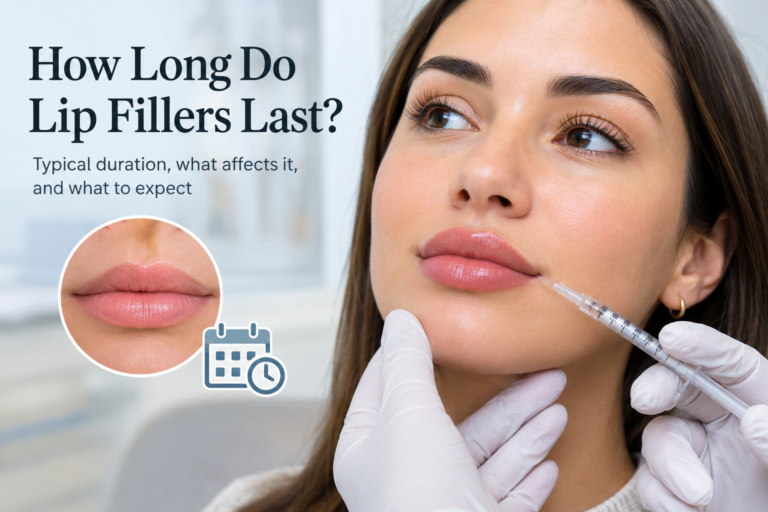
One of the biggest questions people ask before getting lip fillers is how long the results will actually last. You might love the fuller shape you see immediately after treatment, but you also want to know when your lips will start returning to their natural appearance.
For most people, hyaluronic acid lip fillers last approximately six to twelve months. Some results fade sooner, while others remain noticeable beyond a year. The exact duration depends on the product, the amount injected, your natural lip anatomy, the injection technique, and your individual response.
There is a detail many first-time patients miss: the lips often look larger immediately after treatment because of swelling. That early appearance is not the final result, and comparing it with your lips several months later can make the filler seem to have disappeared faster than it actually has.
This guide explains how long lip fillers last in 2026, how different amounts and brands compare, what affects longevity, when to consider a top-up, and what you can realistically do to maintain your results. It also covers costs, safety concerns, recovery, and the questions worth asking before booking an appointment.
How Long Do Lip Fillers Last on Average?
Most temporary hyaluronic acid lip fillers provide visible cosmetic results for around six to twelve months. However, this is a general estimate rather than a guaranteed lifespan. Your results may fade earlier or remain noticeable for longer, depending on the filler used and your individual circumstances.
The US Food and Drug Administration’s information about dermal fillers explains that different products have different characteristics, indications, and expected durations. This is why the exact filler matters more than a clinic’s general promise that all lip fillers last a particular number of months.
| Question | General answer |
|---|---|
| How long do lip fillers last? | Often around 6–12 months for temporary hyaluronic acid fillers. |
| How long do 0.5 ml lip fillers last? | Duration varies; a smaller volume may produce a subtler effect that becomes less noticeable sooner. |
| How long do 1 ml lip fillers last? | Often around 6–12 months, depending on the product and individual response. |
| How long does swelling last? | Noticeable swelling often improves over several days, although some symptoms can last longer. |
| When can you judge the final result? | Often around two weeks, once most swelling has settled. |
| When should you get a top-up? | When the settled result has faded enough to matter to you and a qualified practitioner considers further treatment appropriate. |
These estimates apply mainly to temporary hyaluronic acid fillers. They should not be applied automatically to other injectable materials or permanent fillers, which have different properties and risks.
Why Do Lip Fillers Eventually Wear Off?
Lip fillers are temporary treatments designed to improve lip volume, shape, definition, or the appearance of certain lines around the mouth. Most commonly, practitioners use a gel made from hyaluronic acid, a substance that naturally occurs in the body.
Hyaluronic acid attracts water, helping the injected gel contribute to fullness. The filler is gradually broken down through processes in the body. As the material changes and is absorbed, the extra volume and definition slowly decrease.
Hyaluronic acid and lip volume
Hyaluronic acid can bind water, which contributes to the appearance of fuller lips. The gel’s formulation affects how it behaves in the tissue, including its flexibility, consistency, and resistance to breakdown.
Different formulations are designed for different purposes. A product intended for the lips needs to work in a highly mobile area, where the tissue moves whenever you speak, smile, eat, or express emotion.
Why the results fade gradually
Lip filler usually does not disappear on a particular date. Instead, the cosmetic effect may become less noticeable over time. You might first notice that your lips look less projected, then see a gradual reduction in fullness or definition over subsequent months.
Some filler may remain even after the original result has faded. This means that the visible appearance of your lips is not a reliable way to determine whether every trace of injected material has been absorbed.
For additional information, consult the FDA’s guidance on dermal filler benefits, limitations, and risks.
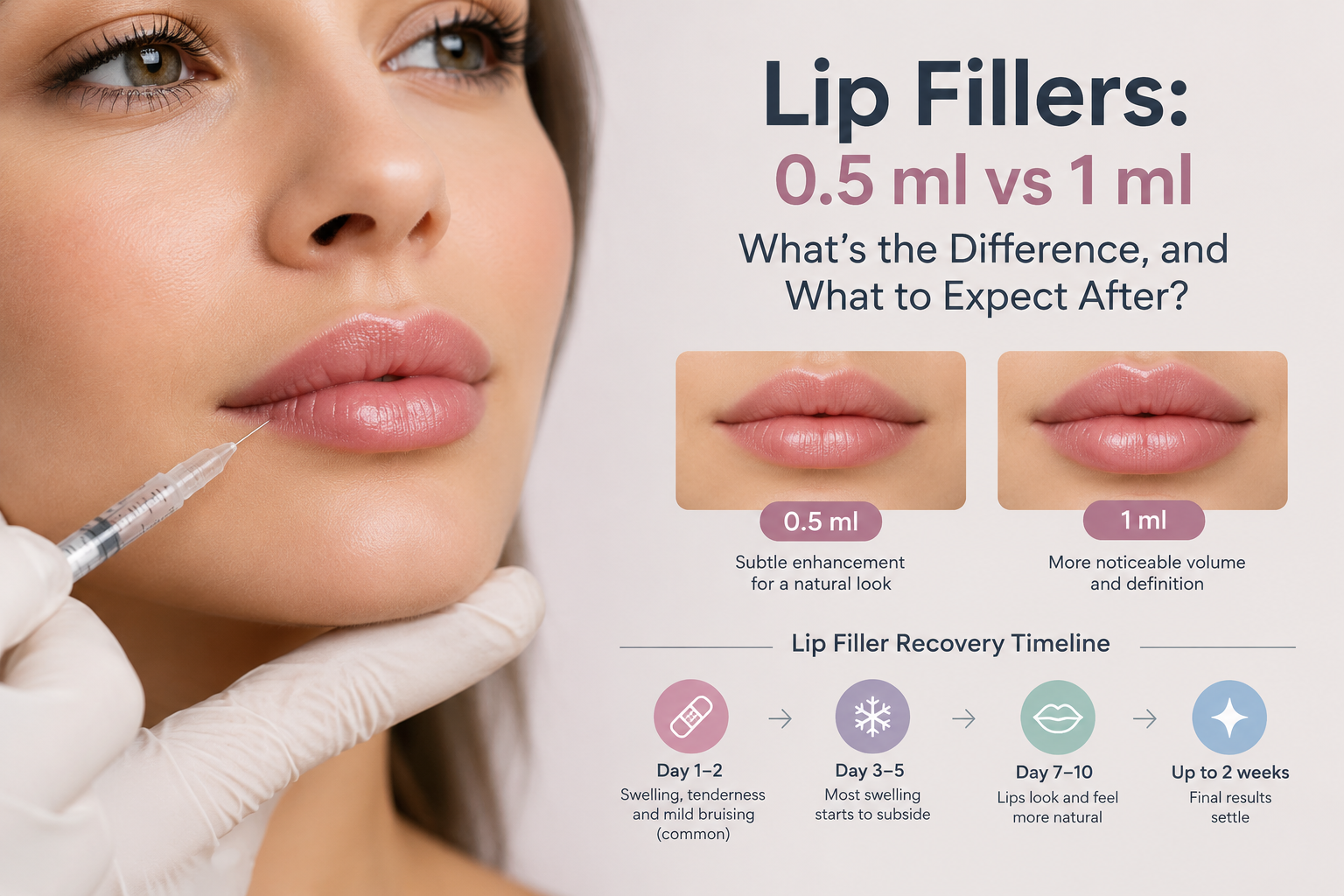
How Long Do 0.5 ml Lip Fillers Last?
A 0.5 ml lip filler treatment uses a relatively small amount of product. It can suit someone who wants a subtle enhancement, prefers gradual changes, or already has reasonable lip volume but wants more definition.
A 0.5 ml treatment does not automatically last half as long as a 1 ml treatment. The amount injected affects the initial result, but it does not provide a reliable mathematical formula for predicting how quickly the filler will break down.
For example, imagine two people receive the same hyaluronic acid product. One receives 0.5 ml to improve a slightly uneven lip border. The other receives 1 ml to create more noticeable fullness. After several months, the first person’s change might be harder to see because the original enhancement was smaller.
That does not prove the smaller amount was absorbed twice as quickly. The difference may simply be that a subtle result becomes less obvious as the filler gradually changes.
Who might benefit from 0.5 ml lip filler?
- First-time patients who want a conservative change.
- People who want improved definition without a dramatic increase in volume.
- People who prefer to discuss gradual enhancement with their practitioner.
- People whose anatomy can be treated appropriately with a smaller amount.
Half a millilitre is not automatically the best choice for every person with thin lips. The practitioner needs to consider lip proportions, tissue characteristics, existing filler, and your goals before recommending an amount.
Does 0.5 ml disappear faster than 1 ml?
Not necessarily. The visible result from a smaller treatment may become difficult to notice sooner, but the amount injected alone cannot establish how long the filler remains in the tissue.
When comparing before-and-after photographs, check when each photograph was taken. A photograph taken shortly after injection may show swelling, while a photograph taken two weeks later may represent the settled result more accurately.
How Long Do 1 ml Lip Fillers Last?
One millilitre is a commonly used volume for lip augmentation, but it is not the right amount for everyone. Depending on the person’s natural lip shape and desired result, 1 ml may create a subtle improvement or a more noticeable change.
Many temporary hyaluronic acid lip fillers have an expected duration of around six to twelve months. However, the exact duration depends on the formulation, placement, individual response, and how much cosmetic change the person wants to maintain.
It helps to separate three related but different things:
- Volume: the amount of filler injected.
- Appearance: how much fullness and definition you can see.
- Longevity: how long the cosmetic effect remains noticeable.
Two people can receive the same 1 ml product and experience different outcomes. Their starting anatomy, previous treatments, tissue characteristics, and expectations may differ.
If you are considering 1 ml lip filler for thin lips, ask the practitioner how the amount is likely to affect your proportions. A larger volume is not automatically a better result, and overfilling can create an appearance you did not intend.
Also Check: 14-Day Lip Filler Recovery Timeline: Day-by-Day Healing Guide
How Long Do Different Lip Filler Brands Last?
Brand names can help you identify a product, but they do not tell the whole story. Many well-known manufacturers sell several formulations, and products within the same range may have different indications and clinical evidence.
| Brand or product family | What affects its duration? | What to ask your practitioner |
|---|---|---|
| JUVÉDERM | The specific formulation, treatment area, and clinical evidence. | Which exact product will be injected, and what duration is supported for lip treatment? |
| Restylane | The formulation, amount used, treatment technique, and individual response. | Which Restylane product is intended for your lips? |
| Other hyaluronic acid fillers | Product design, approved use, tissue characteristics, and individual variation. | Is the product authorized locally, and what does its official labeling say? |
It would be misleading to claim that every product from one brand lasts exactly the same number of months. Published durations may come from specific clinical trials with different participants, injection techniques, follow-up periods, and definitions of success.
How long do JUVÉDERM lip fillers last?
JUVÉDERM is a family of hyaluronic acid fillers. The expected duration depends on the specific formulation and the treatment for which it is used.
Visit the official JUVÉDERM website to review product information. Ask your practitioner for the exact product name and its current patient information rather than relying on a general claim about the brand.
Pay attention to the treatment area in the product information. A duration reported for cheeks or another facial area should not automatically be assumed to apply to the lips.
How long do Restylane lip fillers last?
Restylane also includes multiple hyaluronic acid formulations. Restylane Kysse is associated with lip augmentation in markets where it is authorized, but its evidence and instructions should not be confused with those of every other product in the range.
For current product information, visit the official Restylane USA website. Your practitioner should explain the expected duration for the specific product they intend to use.
Is the longest-lasting filler always the best?
No. Longevity is only one factor in choosing a filler. The product must also suit your anatomy, the movement of your lips, and the result you want.
A filler that is appropriate for one person may not be suitable for another. The safest choice is not necessarily the product with the longest advertised duration, but the product and treatment plan that fit your needs and are supported by appropriate clinical evidence.
Eight Factors That Affect How Long Lip Fillers Last
Several factors influence lip filler longevity. Some are related to the product and treatment technique, while others are individual differences that cannot be predicted with complete accuracy.
1. The filler formulation
Different hyaluronic acid gels have different physical properties. Their formulation affects flexibility, consistency, and how the product behaves in the tissue.
A product designed for the lips must work in a mobile area. The practitioner should choose a formulation suitable for your treatment goals rather than selecting a product based only on a longevity claim.
2. Individual biological differences
People respond differently to injectable treatments. Some notice that their results fade earlier, while others retain visible fullness for longer.
Although individual biology may contribute, there is no simple way to calculate an exact lifespan from a person’s age or metabolism. Be cautious of anyone who promises to predict the precise number of months your filler will last.
3. Lip movement
The lips move throughout the day when you talk, smile, eat, and make facial expressions. This makes them different from areas of the face that move less.
You do not need to avoid smiling or speaking to preserve filler. Normal facial movement is part of everyday life, and there is no good reason to stop expressing yourself in an attempt to extend your results.
4. Injection technique and placement
Placement, injection technique, and product selection influence the result. An appropriately qualified practitioner should assess your lip anatomy and plan treatment around your goals.
More filler is not necessarily better. Injecting excessive amounts can create an unnatural appearance and may increase the risk of unwanted outcomes.
5. Your natural lip shape
Your starting anatomy affects how noticeable the remaining filler will be. Someone with naturally fuller lips may retain a visible enhancement for longer than someone whose lips are naturally very thin, even if both received the same amount.
This difference does not necessarily mean that one person’s filler was absorbed faster. It may simply be easier to notice a small change in someone who began with less volume.
6. The amount injected
The amount used affects the initial result, but it does not determine the duration on its own. A larger amount may produce a more noticeable result, yet it cannot guarantee that the cosmetic effect will last longer.
Choose the amount that suits your anatomy and treatment goals. Avoid asking for extra filler simply because you hope it will last longer.
7. Previous treatments
If you have had lip filler before, some material may remain even when the original result has faded. This can affect the starting point for a later treatment.
Tell your practitioner about previous injections, including the product, amount, approximate date, and any complications. Do not assume that every trace of earlier filler has disappeared just because your lips look smaller.
8. Your preferred appearance
People have different expectations. Someone who wants a very subtle enhancement may feel that the result has faded once the lip border becomes less defined. Someone who prefers more noticeable fullness may remain satisfied for longer.
For this reason, two people can describe the same product as lasting different amounts of time. Their definition of a successful result may not be the same.
Do Lip Fillers Dissolve Completely on Their Own?
Temporary hyaluronic acid fillers are gradually broken down and absorbed by the body. However, visible fading does not prove that every trace of the product has disappeared.
Some research using imaging has identified persistent hyaluronic acid filler in certain facial areas beyond the duration commonly quoted in cosmetic consultations. Findings from other facial areas cannot predict exactly what will happen in an individual’s lips, but they demonstrate why advertised duration should not be treated as a guarantee that all material will be gone by a particular date.
The practical lesson is straightforward: do not assume your lips contain no filler simply because the original fullness has faded. A practitioner should assess your current appearance before recommending additional injections.
Can lip fillers be dissolved?
Hyaluronic acid fillers can often be broken down using an enzyme called hyaluronidase. A qualified medical professional may consider this treatment for certain unwanted results or complications.
Dissolving filler is still a medical procedure. It can cause discomfort, swelling, bruising, or other reactions, and it does not guarantee a perfect cosmetic result. The enzyme can affect naturally occurring hyaluronic acid as well as injected material.
Do not buy dissolving products online or attempt to inject them yourself. Seek an appropriately qualified practitioner who can assess whether dissolving is suitable for your circumstances.
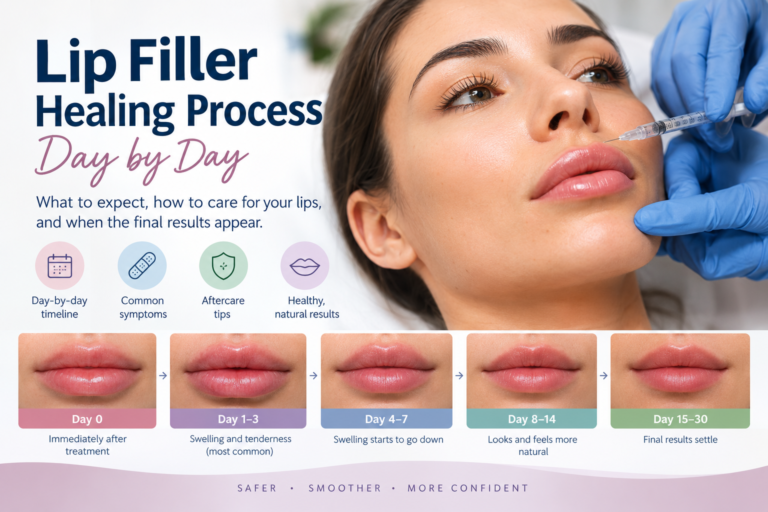
How Long Does Lip Filler Swelling Last?
Swelling is a common short-term effect of lip filler injections. Your lips may look larger than expected, feel tender, or appear uneven during the first few days. Bruising can also occur, and one side may swell more than the other.
For many people, the most noticeable swelling improves over several days. Some tenderness or residual swelling can last longer. The exact timeline varies by person and treatment.
| Time after treatment | What you may notice |
|---|---|
| First 24 hours | Swelling, tenderness, redness, and small injection marks may be visible. |
| Days 2–3 | Swelling and bruising may remain noticeable. The lips may temporarily look uneven. |
| Days 4–7 | Many people see improvement, although some swelling or bruising may remain. |
| Around two weeks | The result is often more settled and can be assessed more fairly. |
| Beyond two weeks | Persistent, worsening, or concerning symptoms should be discussed with a healthcare professional. |
This is a general recovery guide, not a way to diagnose complications. Severe pain, unusual skin colour changes, rapidly worsening symptoms, or vision problems should never be dismissed as normal swelling.
Why do lips look smaller after two weeks?
The most common explanation is that the initial swelling has decreased. Immediately after treatment, the combination of filler and swelling can make the lips appear larger than they will look once the tissues settle.
Do not judge the final result using only a photograph taken on the day of injection. Take another photograph after the swelling has substantially resolved and compare the two under similar lighting.
If you remain unhappy with the result, speak to your injector before arranging more filler. Additional product may not be the right solution.
Can swelling make lip filler look uneven?
Yes. Uneven swelling can temporarily make one side look fuller than the other. However, not every lump or difference in shape is caused by ordinary swelling.
Contact your practitioner if you are concerned, especially if the area becomes increasingly painful, red, hot, discoloured, or swollen. Do not massage a lump unless a qualified practitioner who has assessed your lips specifically advises you to do so.
How to Make Lip Fillers Last Longer
You cannot guarantee longer-lasting results through a particular skincare routine, supplement, or aftercare trick. Sensible aftercare can support recovery, but it cannot stop the body from gradually breaking down temporary filler.
Follow your practitioner’s aftercare instructions
Your practitioner should explain what to expect, which symptoms are common, and when to seek medical help. Follow the instructions provided for your specific procedure instead of relying on generic social media advice.
Clinics may advise temporarily avoiding strenuous exercise, excessive heat, or pressure on the treated area. Ask how long any restrictions should last. Many aftercare recommendations focus on managing early swelling and bruising rather than proving that the filler will last longer.
Protect your lips from excessive sun exposure
Sun protection is a sensible part of general skin and lip care. Use a lip product with appropriate sun protection when outdoors and reapply it according to the product instructions.
However, sun protection has not been established as a way to extend lip filler longevity by a specific number of months. It supports skin health, but it cannot guarantee that injected filler will remain visible for longer.
Keep your routine gentle during recovery
Avoid picking at injection marks, squeezing lumps, or repeatedly pressing your lips to check whether the filler has moved. Follow your practitioner’s advice about cosmetics and skincare products near the treated area.
If you develop symptoms that concern you, seek professional guidance instead of trying multiple home remedies.
Stay normally hydrated
Drinking enough water supports normal health, but drinking excessive amounts has not been shown to reliably extend the lifespan of lip filler.
Hyaluronic acid interacts with water, but that does not mean you can preserve the injected gel simply by drinking more. Stay hydrated according to your needs and any medical advice you have received.
Avoid unnecessary top-ups
Some clinics promote regular top-ups to maintain a consistent appearance. That does not mean everyone needs injections every few months.
If your lips still look the way you want, there may be no reason to add more product. A review should consider your current appearance, previous treatments, and goals rather than follow an automatic injection schedule.
Choose an appropriately qualified practitioner
Good product selection, careful assessment, safe technique, and proper complication management matter more than chasing a few extra weeks of longevity.
The NHS guidance on choosing a cosmetic procedure provider offers practical advice on checking qualifications, training, and experience. Legal requirements for administering fillers vary between countries, so verify the rules where you live.
When Should You Get Lip Filler Topped Up?
There is no universal date when everyone needs another lip filler treatment. A top-up is generally considered when the original effect has faded enough that you want to restore it and a qualified practitioner has assessed whether more filler is appropriate.
For many people, a maintenance consultation may fall within the six-to-twelve-month range. Others may want an assessment earlier or decide they do not need further treatment for longer.
Signs you may be ready for a maintenance consultation
- Your settled lips have gradually lost some of the fullness you wanted.
- The definition of your lip border has softened compared with your settled result.
- You have allowed the initial swelling to resolve before judging the outcome.
- You have no unexplained pain, swelling, lumps, or other symptoms requiring assessment first.
- You still want the result and understand the risks and costs of repeating treatment.
A maintenance consultation does not have to end with another injection. Your practitioner may recommend waiting, addressing a specific concern, or avoiding additional filler if enough material is already present.
Why getting a top-up too early can be a mistake
Some people schedule another appointment as soon as their lips look smaller than they did immediately after treatment. This comparison can be misleading because early swelling makes the lips appear fuller.
If you add more filler before the original result has settled, you may end up with more volume than you intended. Repeated injections without careful assessment can also make it harder to judge how much material remains.
Unless there is a clinical reason for an earlier review, allow time for recovery before deciding whether you need additional volume.
What Does Lip Filler Cost in 2026?
Lip filler prices vary by country, city, clinic, product, practitioner, and amount used. There is no single reliable worldwide price for either 0.5 ml or 1 ml of filler.
Because prices differ substantially by location, the most useful approach is to compare what each quote includes rather than assume that the cheapest option offers the best value.
| Cost factor | How it affects the price |
|---|---|
| Product brand and formulation | Different fillers can have different costs and intended uses. |
| Amount used | Clinics may charge by syringe, treatment package, or another clearly defined method. |
| Practitioner expertise | Fees may reflect training, experience, consultation, and complication management. |
| Clinic location | Local operating costs and market conditions influence prices. |
| Follow-up care | Reviews and aftercare may or may not be included in the quoted fee. |
| Dissolving treatment | A separate consultation and treatment fee may apply if dissolving is needed. |
Before booking, ask for the exact product name, amount to be injected, total price, and details of follow-up care. Check whether the quoted fee includes the initial consultation and any planned review.
Be cautious if a price seems unusually low and the clinic will not identify the product or explain the practitioner’s qualifications. The origin of the filler, appropriate storage, clinical setting, and ability to manage complications all matter.
Think about maintenance costs as well. If you choose to repeat treatment several times a year, the total annual expense may be substantially higher than the initial appointment fee.
Are Longer-Lasting Lip Fillers Better?
Not necessarily. Longevity is only one part of a good result. A filler should also suit your anatomy, move naturally, and provide the appearance you want without unnecessary complications.
A product advertised as longer-lasting is not automatically the best option for thin lips, a defined Cupid’s bow, subtle enhancement, or correction of asymmetry. Your practitioner should consider the formulation, intended use, and clinical evidence.
Potential advantages of longer-lasting results
- You may need fewer maintenance appointments.
- You may spend less on repeat treatments over a given period.
- You may prefer the consistency of a result that fades more slowly.
Potential limitations
- An unwanted result may remain noticeable for longer.
- Longer duration does not eliminate injection risks.
- The advertised duration may not match your individual experience.
- A particular product may not suit every treatment area or goal.
Hyaluronic acid fillers can often be dissolved with hyaluronidase when a qualified clinician considers it appropriate. However, reversibility is not a guarantee that complications can be corrected easily or completely.
What Are the Risks of Lip Fillers?
Lip filler is a medical procedure, even when an appointment takes only a short time. Common short-term effects include swelling, bruising, redness, tenderness, and temporary unevenness.
Less common but more serious complications include infection, nodules, allergic reactions, and tissue damage caused by an interruption of blood flow. Accidental injection into a blood vessel can have severe consequences, including skin necrosis and, in rare cases, vision loss or stroke.
The FDA’s dermal filler safety guidance explains important risks and precautions. It also warns against needle-free filler injection devices and products sold directly to consumers for self-injection.
Warning signs that need urgent medical attention
Seek urgent medical assessment if you experience any of the following after filler injections:
- Severe or increasing pain, particularly pain that seems out of proportion to expected recovery.
- Skin that becomes unusually pale, white, dusky, mottled, blue, or purple.
- Blistering or other signs of possible skin injury.
- Sudden changes in vision, blurred vision, or loss of vision.
- Severe headache, weakness, difficulty speaking, or other sudden neurological symptoms.
- Rapidly worsening swelling or signs of a serious allergic reaction.
Vision changes or signs of stroke require emergency care. Do not wait for a routine follow-up appointment or assume these symptoms are normal swelling. Contact emergency services and tell the medical team that you recently received dermal filler.
For possible infection, including increasing redness, warmth, pain, discharge, or fever, contact a healthcare professional promptly. If symptoms are severe or rapidly worsening, seek urgent care.
Who should be cautious before getting lip filler?
Fillers may not be suitable for everyone. An active infection or inflammation near the treatment site, certain allergies, bleeding disorders, and some medical circumstances may affect whether treatment should proceed.
Tell your practitioner about your medical history, medications, allergies, previous injections, and any past complications. Do not stop prescribed medication to reduce bruising without advice from the clinician responsible for your care.
Pregnancy and breastfeeding are also situations in which safety data may be limited. Because cosmetic filler treatment is elective, discuss the uncertainty with a qualified healthcare professional and consider postponing treatment.
How to Choose a Safe Lip Filler Practitioner
Choosing a qualified practitioner is more important than finding the cheapest appointment or a clinic promising the longest-lasting filler. You need someone who understands facial anatomy, uses an appropriate product, recognizes complications, and has a clear plan for managing them.
Before booking, ask these questions:
- What are your qualifications? Verify that the practitioner is legally permitted and appropriately trained to perform the procedure where you live.
- Which exact filler will you use? Ask for the product name and information about its intended use.
- Is the product authorized locally? Product approvals and permitted uses differ between countries.
- What result is realistic for my lips? A responsible practitioner should explain limitations instead of promising a particular look or duration.
- How do you manage complications? Ask about emergency protocols, access to appropriate treatment, and follow-up arrangements.
- What is included in the price? Clarify whether consultation, review, and follow-up are included.
Be cautious if someone offers injections at home without an appropriate clinical setting, refuses to identify the product, pressures you to receive more filler than you want, or claims the procedure has no serious risks.
Do not use needle-free pens or inject filler yourself. The FDA warns that these devices cannot reliably control where the product goes and have been associated with serious injuries.
Can Lifestyle Changes Make Lip Fillers Last Longer?
Healthy habits support your general wellbeing, but they cannot guarantee longer-lasting filler. There is limited reliable evidence that specific foods, supplements, or skincare routines extend the lifespan of lip injections.
Does drinking water make lip fillers last longer?
Drinking enough water supports normal health, but there is no reliable evidence that drinking extra water significantly extends the lifespan of lip filler. Hyaluronic acid interacts with water, yet that does not mean drinking excessive amounts will preserve the injected gel for longer.
Does exercise make lip fillers disappear faster?
Normal exercise has not been established as a simple predictor of how quickly lip filler breaks down. Practitioners may recommend avoiding strenuous activity for a short period after treatment to help manage early swelling or bruising.
Follow your practitioner’s recovery instructions, then return to normal activities when appropriate. You do not need to avoid exercise permanently to protect your lips.
Does smoking affect lip filler longevity?
Smoking can harm general health and skin health, but there is no reliable formula for calculating how many months of filler longevity it removes. Avoid smoking for your overall health and follow your practitioner’s advice about recovery after injections.
Can lip balm preserve filler?
Lip balm can moisturize the surface of your lips and improve comfort. It cannot prevent the body from gradually breaking down injected hyaluronic acid.
Skincare may support the appearance and health of the skin around your mouth, but it does not replace filler or guarantee longer-lasting volume.
What Happens When Lip Fillers Start to Wear Off?
The change is usually gradual. You may notice that your lips look less projected, the border is not as sharply defined, or your lipstick sits differently. Over time, your lips may look closer to their natural shape.
A gradual reduction in fullness over months is different from a sudden complication. Abrupt pain, skin discolouration, or rapidly increasing swelling should not be treated as ordinary fading.
Will your lips look worse than before?
There is no reason to assume that your lips will automatically become thinner or more wrinkled once temporary filler fades. Many people gradually return toward their original appearance.
Individual outcomes vary, however, and repeated treatments can affect lip appearance. If you have persistent swelling, irregularities, or concerns about changes in shape, seek a professional assessment rather than assuming the issue will resolve by itself.
Will lip fillers stretch your lips permanently?
It is not accurate to claim that every lip filler treatment permanently stretches the lips. The outcome depends on factors such as the amount injected, tissue characteristics, and treatment history.
Excessive volume or repeated injections without proper assessment can contribute to an unwanted appearance. A conservative treatment plan and an experienced practitioner can help reduce the risk of overfilling.
What Are the Alternatives to Lip Fillers?
If you want fuller-looking lips but do not want injections, several alternatives are available. They do not provide the same result as dermal fillers, and their effects may be more limited or temporary.
Hydrating lip products
Lip balms and moisturizers can improve surface comfort and make dry lips look smoother. Products that help retain moisture may temporarily improve the appearance of fine surface lines.
They do not provide the same structural volume as injected filler, and their effects generally last only while their moisturizing benefits remain.
Lip liner and makeup
Lip liner, lipstick, and gloss can create the appearance of fuller lips without a medical procedure. This is a flexible option because you can adjust the effect for different occasions and remove it whenever you like.
Lip-plumping cosmetics
Some lip-plumping products temporarily create a fuller appearance by irritating the skin or changing its surface appearance. Their effects are usually short-lived, and some products can cause burning, redness, or irritation.
Stop using a product that causes a strong reaction. Avoid applying irritating products to lips that are already inflamed or damaged.
Surgical lip enhancement
Surgical procedures can change lip shape or position and may provide longer-lasting structural changes than temporary fillers. They involve different risks, recovery periods, costs, and limitations.
If you are considering surgery, consult a suitably qualified specialist who can explain the procedure, likely outcome, recovery, and potential complications.
How to Track Your Lip Filler Results Over Time
If you want to understand how long your own filler lasts, consistent photographs and follow-up can be more useful than comparing your lips with another person’s social media posts.
- Take a baseline photograph. Photograph your lips before treatment in natural, even lighting.
- Record the product and amount. Keep the product name, injection date, and volume used for future consultations.
- Photograph the settled result. Take another photograph after the initial swelling has substantially resolved, often around two weeks after treatment.
- Compare at reasonable intervals. Use similar lighting, angles, and facial expressions to make changes easier to judge.
- Record changes and concerns. Note when you begin to notice fading, but seek medical advice for symptoms that could indicate a complication.
- Discuss maintenance before booking. Let your practitioner assess the current result instead of assuming that a certain date means you need more filler.
This simple record can help you compare products and outcomes if you decide to have another treatment. It will not predict the exact lifespan of future injections, but it can help you make better-informed decisions.
Final Takeaway: How Long Do Lip Fillers Last in 2026?
For most people receiving temporary hyaluronic acid lip fillers, a reasonable starting estimate is six to twelve months. Your individual result may fade sooner or remain visible for longer, depending on the product, anatomy, technique, and personal response.
Do not judge the result on the first day, when swelling can make your lips look much larger than they will after recovery. Allow time for the lips to settle, keep a record of the product used, and arrange a review if you are unsure whether you need additional treatment.
Most importantly, do not chase a longer-lasting result by asking for more filler than you need. Choose a qualified practitioner, verify the product, understand the risks, and seek urgent care for severe pain, unusual skin colour changes, or vision symptoms after injections.
The best maintenance plan is not necessarily the one with the most frequent appointments. It is the one that fits your goals, protects your health, and avoids unnecessary treatment.
Frequently Asked Questions About How Long Lip Fillers Last
1. How long do lip fillers last on average?
Most hyaluronic acid lip fillers last around six to twelve months. The actual duration depends on the product, the amount injected, your anatomy, and how noticeable the remaining effect is over time.
2. Do lip fillers last longer the second time?
Not necessarily. Some people report longer-lasting results after repeat treatments, but this is not guaranteed. The product, amount, previous filler, and individual response all affect the outcome.
3. How long do 0.5 ml lip fillers last?
A 0.5 ml treatment may provide a subtler result than a 1 ml treatment, but it does not automatically last half as long. Many hyaluronic acid lip fillers remain effective for roughly six to twelve months, with individual variation.
4. How long do 1 ml lip fillers last?
A 1 ml treatment commonly has an expected duration of around six to twelve months when a temporary hyaluronic acid filler is used. The exact duration depends on the formulation, treatment technique, and individual response.
5. How long does lip filler swelling last?
Noticeable swelling often improves over the first several days, although mild swelling or bruising can last longer. The result is often easier to assess around two weeks after treatment. Severe pain, skin colour changes, or worsening symptoms need prompt medical assessment.
6. Can lip fillers last longer than 12 months?
Yes, some people may notice a cosmetic effect beyond twelve months. However, duration varies by product and individual, and visible fullness does not prove that all the filler remains or that every trace has disappeared.
7. Does drinking water make lip fillers last longer?
Drinking enough water supports normal health, but there is no reliable evidence that drinking extra water will significantly extend the lifespan of lip filler. Stay normally hydrated rather than forcing excessive water intake.
8. Do lip fillers dissolve completely on their own?
Temporary hyaluronic acid fillers are gradually broken down and absorbed by the body. The visible effect may fade before all material has disappeared, so you should not assume that no filler remains simply because your lips look smaller.
9. When should I get my lip fillers topped up?
Consider a maintenance consultation when your settled result has faded enough that you want a change. There is no universal top-up schedule, and a practitioner should assess your lips before recommending more filler.
10. Can lip filler be removed if I do not like the result?
Hyaluronic acid filler can often be dissolved by a qualified medical professional using hyaluronidase when appropriate. Dissolving has its own risks and limitations, so it should not be attempted at home or treated as a guaranteed fix.
11. Do lip fillers make your lips thinner after they wear off?
Temporary filler does not automatically make lips thinner after it fades. Many people move toward their original appearance, although results vary and repeated treatments can affect lip shape. Seek an assessment if you notice persistent irregularities or unexpected changes.
12. Are lip fillers safe to get every six months?
There is no single schedule that is suitable for everyone. Repeated treatment should be based on your current appearance, the product used, your medical history, and a qualified practitioner’s assessment. Do not get another injection simply because six months have passed.